

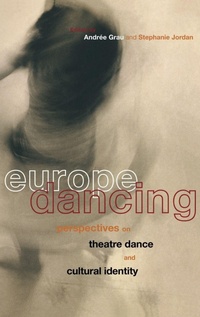
Europe Dancing
Perspectives on Theatre, Dance, and Cultural Identity
1st Edition
Published on 1. June 2000
Book
Hardback
248 pages
978-0-415-17102-1 (ISBN)
Description
Europe Dancing examines the dance cultures and movements which have developed in Europe since the Second World War. Nine countries are represented in this unique collaboration between European dance scholars. The contributors chart the art form, and discuss the outside influences which have shaped it.
This comprehensive book explores:
* questions of identity within individual countries, within Europe, and in relation to the USA
* the East/West cultural division
* the development of state subsidy for dance
* the rise of contemporary dance as an 'alternative' genre
* the implications for dance of political, economic and social change.
Useful historical charts are included to trace significant dance and political events throughout the twentieth century in each country.
Never before has this information been gathered together in one place. This book is essential reading for everyone interested in dance and its growth and development in recent years.
This comprehensive book explores:
* questions of identity within individual countries, within Europe, and in relation to the USA
* the East/West cultural division
* the development of state subsidy for dance
* the rise of contemporary dance as an 'alternative' genre
* the implications for dance of political, economic and social change.
Useful historical charts are included to trace significant dance and political events throughout the twentieth century in each country.
Never before has this information been gathered together in one place. This book is essential reading for everyone interested in dance and its growth and development in recent years.
Reviews / Votes
'An interesting . . . survey of the state of European dance in a global age.' - The Scotsman'Eighteen distinguished contributors examine post-WW II European theater dance in ten revealing essays ... this reviewer applauds them for bringing together such a diverse group of scholars and outstanding work connecting dance studies to cultural studies and beyond. An essential purchase for any undergraduate or research library ... since nothing tryly comparable presently exists.' - Choice
'An informative book.' - International Theatre Institute 'An interesting . . . survey of the state of European dance in a global age.' - The Scotsman
'Eighteen distinguished contributors examine post-WW II European theater dance in ten revealing essays ... this reviewer applauds them for bringing together such a diverse group of scholars and outstanding work connecting dance studies to cultural studies and beyond. An essential purchase for any undergraduate or research library ... since nothing tryly comparable presently exists.' - Choice
More details
Language
English
Place of publication
London
United Kingdom
Publishing group
Taylor & Francis Ltd
Target group
College/higher education
Professional and scholarly
General
Illustrations
10 s/w Tabellen
10 Tables, black and white
Dimensions
Height: 240 mm
Width: 161 mm
Thickness: 18 mm
Weight
540 gr
ISBN-13
978-0-415-17102-1 (9780415171021)
Copyright in bibliographic data and cover images is held by Nielsen Book Services Limited or by the publishers or by their respective licensors: all rights reserved.
Schweitzer Classification
Other editions
Additional editions
E-Book
06/2002
1st Edition
Routledge
€53.99
Available for download
E-Book
06/2002
1st Edition
Routledge
€53.99
Available for download
Book
06/2000
1st Edition
Routledge
€61.30
Shipment within 15-20 days
Persons
Stephanie Jordan is Head of the Dance Department at the Roehampton Institute. Her publications include Striding Out: Aspects of Contemporary and New Dance in Britain (1992), and Moving Music (2000). Andree Grau is Senior Lecturer in Dance at the Roehampton Institute. She is a contributor to many dance journals, and author of Eyewitness Dance (1998), and Following in Sir Fred's Steps (1996) with Stephanie Jordan.
Content
Introduction 1. Belgium: Constructing Identities: the Case of 'the Flemish Dance Wave' 2. France: Effervescence and Tradition in French Dance 3. Germany: Between Institutions and Aesthetics: Choreographing Germanness? 4. Hungary: On Hungarian Dance 5. Italy: The Cinderella of the Arts 6. The Netherlands: The Dutch Don't Dance 7. Spain: Between Tradition and Innovation: Two Ways of Understanding the History of Dance in Spain 8. Sweden: Equal rights to dance? 9. United Kingdom: An Expanding Map