

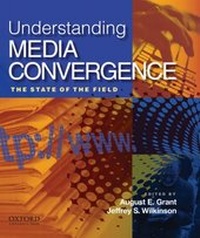
Understanding Media Convergence
Published on 29. October 2009
Book
Hardback
320 pages
978-0-19-532777-9 (ISBN)
Description
On our contemporary media landscape, the potential of the written word is limitless. Repurposing print journalism for the Internet and beyond, convergent journalism invigorates and transforms how we create and experience media. A vital new resource in our digital age, Understanding Media Convergence outlines and investigates the broad theoretical and conceptual issues surrounding this emergent subject.
Bringing together incisive work by some of the leaders in the field--including Janet Kolodzy, Bob Papper, Kenneth Killebrew, and Charles Bierbauer--editors August E. Grant and Jeffrey S. Wilkinson have selected readings that introduce readers to this provocative subject and provide a strong framework for inquiry. Through its dynamic and diverse voices, this compelling anthology
* outlines the various types of convergence and their theoretical underpinnings
* presents real-world case studies that show convergent journalism in action
* investigates the democracy of weblogs
* provides insight into convergence by applying feminist theory, organizational culture, and management theory
* concludes with a discussion of the future of convergent journalism
These essays expand and underscore the practical techniques put forth in Grant and Wilkinson's textbook, Principles of Convergent Journalism, and the contributors offer a fascinating look at the controversies, constraints, and possibilities of media convergence. Essential for advanced journalism students, scholars, and professional journalists, Understanding Media Convergence sheds light on the future of the media--and the transformations that will affect us all.
Bringing together incisive work by some of the leaders in the field--including Janet Kolodzy, Bob Papper, Kenneth Killebrew, and Charles Bierbauer--editors August E. Grant and Jeffrey S. Wilkinson have selected readings that introduce readers to this provocative subject and provide a strong framework for inquiry. Through its dynamic and diverse voices, this compelling anthology
* outlines the various types of convergence and their theoretical underpinnings
* presents real-world case studies that show convergent journalism in action
* investigates the democracy of weblogs
* provides insight into convergence by applying feminist theory, organizational culture, and management theory
* concludes with a discussion of the future of convergent journalism
These essays expand and underscore the practical techniques put forth in Grant and Wilkinson's textbook, Principles of Convergent Journalism, and the contributors offer a fascinating look at the controversies, constraints, and possibilities of media convergence. Essential for advanced journalism students, scholars, and professional journalists, Understanding Media Convergence sheds light on the future of the media--and the transformations that will affect us all.
Reviews / Votes
The major strength of this book is that it's a first. Convergence is perhaps the biggest issue facing journalism and mass media. I need this book. * Ralph Braseth, University of Mississippi * The overall approach is perfect for a seminar course. The material is definitely suitable for upper-level students and researchers. Convergence is definitely an area that deserves attention and inclusion in a mass communication curriculum. I would recommend it as a good source of relevant information about converging and emerging media. * Colin Pillow, Arkansas State University * The text presents an impressive list of topics that are written by an impressive list of authors. Simply put, I want to own a copy of this book. * Larry Dailey, University of Nevada, Reno * This is a very active area of study where a publication of this sort does not exist. Serious researchers need this book. It would also be of benefit to graduate students and advanced undergraduates. The strength of this book is how it pulls all the different aspects of convergence together in one place. The approach is logical and takes the reader through the various aspects of the literature. This text is the starting point for convergence research. * Richard Landesburg, Elon University *More details
Language
English
Place of publication
New York
United States
Target group
College/higher education
Professional and scholarly
Dimensions
Height: 198 mm
Width: 236 mm
Thickness: 25 mm
Weight
748 gr
ISBN-13
978-0-19-532777-9 (9780195327779)
Copyright in bibliographic data and cover images is held by Nielsen Book Services Limited or by the publishers or by their respective licensors: all rights reserved.
Schweitzer Classification
Persons
August E. Grant is Associate Professor in the School of Journalism and Mass Communications at the University of South Carolina and editor of Communication Technology Update.
Jeffrey S. Wilkinson is Professor and Coordinator of the International Journalism Programme at United International College (Zhuhai, China), founded jointly by Beijing Normal University and Hong Kong Baptist University.
Jeffrey S. Wilkinson is Professor and Coordinator of the International Journalism Programme at United International College (Zhuhai, China), founded jointly by Beijing Normal University and Hong Kong Baptist University.
Editor
Associate Professor in the School of Journalism and Mass CommunicationsAssociate Professor in the School of Journalism and Mass Communications, University of South Carolina
Professor and Coordinator of the International Journalism ProgrammeProfessor and Coordinator of the International Journalism Programme, United International College (Zhuhai, China)
Content
1. Introduction: The Digital Revolution and Technological Convergence, August E. Grant ; 2. Organizational Convergence: The State of the Field, Camille Kraeplin & Carrie Criado ; 3. Convergent Journalism, Janet Kolodzy ; 4. Middletown Media Studies II: Observing Consumer Interactions with Media, Bob Papper, Michael Holmes, and Mark Popovich ; 5. The Converged Audience: Receiver-Senders and Content Creators, Jeffrey Wilkinson, Steven McClung, and Varsha Sherring ; 6. Media Convergence and the Neo-Dark Age, Van Kornegay ; 7. Diffusion of Convergence, Jeffrey Wilkinson ; 8. Culture, Conflict, and Convergence: A Theoretical Discussion of Group-Based Identity and Bias Reduction in a Converged Newsrooms, Vincent Filak ; 9. Developing Media Managers for Convergence: A Study of Management Theory and Practice for Managers of Converged Newsrooms, Holly Fisher ; 10. A Feminist Approach to Convergence, E. Jordan Storm and August E. Grant ; 11. Theories of Audience Processes, George Daniels ; 12. The Meaning and Influence of Convergence: A Qualitative Case Study of Newsroom Work at the Tampa News Center, Michel Dupagne and Bruce Garrison ; 13. Convergence in Small Markets, Tony DeMars ; 14. Translating the Tower of Babel: Issues of Language and Culture in Converged Newsrooms, Bill Silcock and Susan Keith ; 15. Weblogs: Democratizing Media Production, Bryan Murley ; 16. Global Aspects of Convergence, Kenneth Killebrew ; 17. Sequences, Tracks, and Silos: Post-Secondary Convergence Journalism Education in the United States, Tim Bajkiewicz ; 18. The Future of Media Convergence, Charles Bierbauer ; Index