

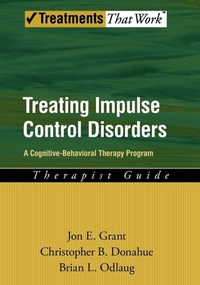
Treating Impulse Control Disorders
A Cognitive-Behavioral Therapy Program, Therapist Guide
1st Edition
Published on 10. March 2011
Book
Paperback/Softback
176 pages
978-0-19-973879-3 (ISBN)
Description
Impulse control disorders (ICDs) include pathological gambling, kleptomania, trichotillomania, intermittent explosive disorder, and pyromania, and are characterized by difficulties resisting urges to engage in behaviors that are excessive or ultimately harmful to oneself or others. ICDs are relatively common among adolescents and adults, carry significant morbidity and mortality, and can be effectively treated with behavioral and pharmacological therapies.
This guide includes all the information and materials necessary to implement a successful cognitive behavioral therapy program for impulse control disorders (CBT-ICD). This evidence-based intervention was developed for the treatment of pathological gambling, kleptomania, compulsive buying, and pyromania.
Originators of interventions for impulse control disorders, the authors review the background and diagnostic information for each ICD as well as available treatment outcome studies; the assessment process for each ICD problem and the individual therapy sessions are also reviewed. This format affords you the flexibility to treat one or more ICD problem, and since they co-occur, this approach is essential.
This therapist guide and its corresponding workbook form a complete treatment package. It is a resource that no clinician specializing in these disorders can do without.
This guide includes all the information and materials necessary to implement a successful cognitive behavioral therapy program for impulse control disorders (CBT-ICD). This evidence-based intervention was developed for the treatment of pathological gambling, kleptomania, compulsive buying, and pyromania.
Originators of interventions for impulse control disorders, the authors review the background and diagnostic information for each ICD as well as available treatment outcome studies; the assessment process for each ICD problem and the individual therapy sessions are also reviewed. This format affords you the flexibility to treat one or more ICD problem, and since they co-occur, this approach is essential.
This therapist guide and its corresponding workbook form a complete treatment package. It is a resource that no clinician specializing in these disorders can do without.
More details
Series
Language
English
Place of publication
New York
United States
Target group
Professional and scholarly
Mental health clinicians
Dimensions
Height: 254 mm
Width: 178 mm
Thickness: 10 mm
Weight
344 gr
ISBN-13
978-0-19-973879-3 (9780199738793)
Copyright in bibliographic data and cover images is held by Nielsen Book Services Limited or by the publishers or by their respective licensors: all rights reserved.
Schweitzer Classification
Other editions
Additional editions
Jon E. Grant | Christopher B. Donahue | Brian L. Odlaug
Treating Impulse Control Disorders
A Cognitive-Behavioral Therapy Program, Therapist Guide
E-Book
02/2011
1st Edition
OUP eBook
€29.99
Available for download
Jon E. Grant | Christopher B. Donahue | Brian L. Odlaug
Treating Impulse Control Disorders
A Cognitive-Behavioral Therapy Program, Therapist Guide
E-Book
02/2011
1st Edition
OUP eBook
€29.99
Available for download
Persons
Jon E. Grant, JD, MD, MPH, is a Professor of Psychiatry and Director of the Impulsive Compulsive Disorders Clinic at the University of Minnesota Medical School. An author of over 200 peer-reviewed scientific publications, Dr. Grant serves on the editorial boards of several journals and is the Editor in Chief of the Journal of Gambling Studies.
Christopher B. Donahue, PhD, is an Assistant Professor in the Department of Psychiatry at the University of Minnesota, Minneapolis, MN. He is involved in ongoing collaboration with co-authors investigating treatments for impulse control disorders. Dr. Donahue has published book chapters and refereed journal articles on the treatment of anxiety and impulse control disorders. Other areas of research include cognitive behavioral therapy for comorbid alcohol and anxiety disorders and Exposure/Response Prevention treatment of obsessive compulsive disorder. Dr. Donahue divides his time between research and an independent clinical practice.
Brian L. Odlaug, BA, is a graduate student in the School of Public Health at the University of Minnesota and concurrently works in the Department of Psychiatry as the Lead Clinical Research Coordinator for the Impulse Control Disorders Clinic. He has published over 50 peer-reviewed articles and book chapters exploring the phenomenology, treatment, and clinical characteristics of impulse control disorders and other psychiatric conditions. His current research interests include examining the public health consequences of behavioral addictions on individual quality of life and their economic and social impact in the general population.
Christopher B. Donahue, PhD, is an Assistant Professor in the Department of Psychiatry at the University of Minnesota, Minneapolis, MN. He is involved in ongoing collaboration with co-authors investigating treatments for impulse control disorders. Dr. Donahue has published book chapters and refereed journal articles on the treatment of anxiety and impulse control disorders. Other areas of research include cognitive behavioral therapy for comorbid alcohol and anxiety disorders and Exposure/Response Prevention treatment of obsessive compulsive disorder. Dr. Donahue divides his time between research and an independent clinical practice.
Brian L. Odlaug, BA, is a graduate student in the School of Public Health at the University of Minnesota and concurrently works in the Department of Psychiatry as the Lead Clinical Research Coordinator for the Impulse Control Disorders Clinic. He has published over 50 peer-reviewed articles and book chapters exploring the phenomenology, treatment, and clinical characteristics of impulse control disorders and other psychiatric conditions. His current research interests include examining the public health consequences of behavioral addictions on individual quality of life and their economic and social impact in the general population.
Author
Professor of Psychiatry and Director of the Impulsive Compulsive Disorders ClinicProfessor of Psychiatry and Director of the Impulsive Compulsive Disorders Clinic, University of Minnesota Medical School
Assistant Professor in the Department of PsychiatryAssistant Professor in the Department of Psychiatry, University of Minnesota Medical School
School of Public HealthSchool of Public Health, University of Minnesota
Content
Chapter 1: Introductory Information for Therapists ; Chapter 2: Assessment ; Chapter 3: Session 1: Education and Motivational Enhancement ; Chapter 4: Session 2: Financial Planning, ICD Trigger Planning, Plan for Managing Stolen Goods ; Chapter 5: Session 3: Behavioral Interventions ; Chapter 6: Session 4: Imaginal Exposure ; Chapter 7: Session 5: Impulsive Beliefs: Cognitive Therapy ; Chapter 8: Session 6: Relapse Prevention ; Chapter 9: Session 7: Family Involvement (Optional) ; Appendix of Assessment Measures ; References and Suggested Readings ; About the Authors ; 4. Contributors (give full