

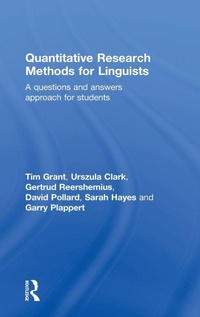
Quantitative Research Methods for Linguists
a questions and answers approach for students
1st Edition
Published on 29. June 2017
Book
Hardback
152 pages
978-0-415-73631-2 (ISBN)
Description
Quantitative Research Methods for Linguistics provides an accessible introduction to research methods for undergraduates undertaking research for the first time. Employing a task-based approach, the authors demonstrate key methods through a series of worked examples, allowing students to take a learn-by-doing approach and making quantitative methods less daunting for the novice researcher.
Key features include:
Chapters framed around real research questions, walking the student step-by-step through the various methods;
Guidance on how to design your own research project;
Basic questions and answers that every new researcher needs to know;
A comprehensive glossary that makes the most technical of terms clear to readers;
Coverage of different statistical packages including R and SPSS.
Quantitative Research Methods for Linguistics is essential reading for all students undertaking degrees in linguistics and English language studies.
Key features include:
Chapters framed around real research questions, walking the student step-by-step through the various methods;
Guidance on how to design your own research project;
Basic questions and answers that every new researcher needs to know;
A comprehensive glossary that makes the most technical of terms clear to readers;
Coverage of different statistical packages including R and SPSS.
Quantitative Research Methods for Linguistics is essential reading for all students undertaking degrees in linguistics and English language studies.
Reviews / Votes
"This is an ideal text for Linguistics undergraduates needing guidance on quantitative methods. It features step-by-step guides, engagingly grounded in real-world case studies. Especially helpful is the focus on linguistic research contexts, with discussion of appropriate tests and approaches for each one. Students will find this book a useful and accessible reference."Will Barras, University of Aberdeen, UK
More details
Language
English
Place of publication
London
United Kingdom
Publishing group
Taylor & Francis Ltd
Target group
College/higher education
Product notice
sewn/stitched
Cloth over boards
Illustrations
31 s/w Abbildungen, 2 s/w Photographien bzw. Rasterbilder, 29 s/w Zeichnungen, 35 s/w Tabellen
35 Tables, black and white; 29 Line drawings, black and white; 2 Halftones, black and white; 31 Illustrations, black and white
Dimensions
Height: 234 mm
Width: 156 mm
Thickness: 11 mm
Weight
413 gr
ISBN-13
978-0-415-73631-2 (9780415736312)
Copyright in bibliographic data and cover images is held by Nielsen Book Services Limited or by the publishers or by their respective licensors: all rights reserved.
Schweitzer Classification
Other editions
Additional editions

Tim Grant | Urszula Clark | Gertrud Reershemius
Quantitative Research Methods for Linguists
a questions and answers approach for students
E-Book
07/2017
Routledge
€59.49
Available for download

Tim Grant | Urszula Clark | Gertrud Reershemius
Quantitative Research Methods for Linguists
a questions and answers approach for students
E-Book
07/2017
Routledge
€59.49
Available for download

Tim Grant | Urszula Clark | Gertrud Reershemius
Quantitative Research Methods for Linguists
a questions and answers approach for students
Book
06/2017
1st Edition
Routledge
€72.90
Shipment within 15-20 days
Persons
Tim Grant is Professor in Forensic Linguistics at Aston University, UK.
Urszula Clark is Professor of English Language and Linguistics at Aston University, UK.
Gertrud Reershemius is the 50th Anniversary Chair in Language Contact and Linguistics at Aston University, UK.
David Pollard is Learning and Teaching Support Manager at Aston University, UK.
Sarah Hayes is Senior Lecturer in Technology Enhanced and Flexible Learning at Aston University, UK
Garry Plappert is a lecturer in the Department of English at Aston University, UK.
Urszula Clark is Professor of English Language and Linguistics at Aston University, UK.
Gertrud Reershemius is the 50th Anniversary Chair in Language Contact and Linguistics at Aston University, UK.
David Pollard is Learning and Teaching Support Manager at Aston University, UK.
Sarah Hayes is Senior Lecturer in Technology Enhanced and Flexible Learning at Aston University, UK
Garry Plappert is a lecturer in the Department of English at Aston University, UK.
Content
Part 1: Basic Statistical Ideas
1. Basic concepts of quantification and number
2. Designing research projects which count things
Part 2: Asking and Answering Quantitative Questions
3. Survey of the sexiness of Klingon
4. Who speaks Low German with their children?
5. Frequency of use of the present perfect tense in two newspapers
Comparison of two groups where the data is not normally distributed - Mann Whitney U test
6. Is there a difference in the way 'ing' is pronounced by people from Birmingham and the Black Country?
Testing for difference using Chi square
7. Do letter writers tend to use nouns and verbs together?
Scatterplots and correlation of linear data
8. Does the use of pronouns differ between two academic disciplines?
Using T-test to compare between two groups
9. Does the use of pronouns differ between three academic disciplines?
Comparison between three or more groups: One-Way Anova
10. Asking and answering quantitative questions - conclusions
Glossary
Index
1. Basic concepts of quantification and number
2. Designing research projects which count things
Part 2: Asking and Answering Quantitative Questions
3. Survey of the sexiness of Klingon
4. Who speaks Low German with their children?
5. Frequency of use of the present perfect tense in two newspapers
Comparison of two groups where the data is not normally distributed - Mann Whitney U test
6. Is there a difference in the way 'ing' is pronounced by people from Birmingham and the Black Country?
Testing for difference using Chi square
7. Do letter writers tend to use nouns and verbs together?
Scatterplots and correlation of linear data
8. Does the use of pronouns differ between two academic disciplines?
Using T-test to compare between two groups
9. Does the use of pronouns differ between three academic disciplines?
Comparison between three or more groups: One-Way Anova
10. Asking and answering quantitative questions - conclusions
Glossary
Index