

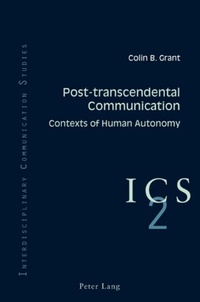
Post-transcendental Communication
Contexts of Human Autonomy
Published on 3. September 2008
Book
Paperback/Softback
188 pages
978-3-03911-032-2 (ISBN)
Description
Compared with other human and social sciences, communication theory appears to be of recent origin. Appearances deceive, however, for the antecedents of this growing field of work can be found in the classic philosophical treatises of western and non-western thinkers including Plato, Sextus Empiricus and Laozi, reaching forward through the theolinguistic tradition of St Augustine, Boethius, Averroës and Ockham before arriving at the modern age. Following Wittgenstein's linguistic turn and Husserl's phenomenology in the early decades of the twentieth century, we arrive at the fertile plains of semiotics, information theory, pragmatics and dialogism out of which communication theory has grown. And yet an unresolved and historically non-coincidental tension remains between the implicit transcendental claims of much of communication theory and our experiences of risk, uncertainty and dissolution in what Zygmunt Bauman has described as our 'liquid age'. As communication theory matures, it is an opportune moment to reflect on what form a detranscendentalised theory of communication might take. In bringing intentions, understandings, meanings and interactions down to earth this book invites its readers to account for the complex communications between communications, actors and social processes without recourse to transcendental theories of understanding.
More details
Series
Edition
New edition
Language
English
Place of publication
Oxford
United Kingdom
Publishing group
Peter Lang Group AG, International Academic Publishers
Edition type
New edition
Dimensions
Height: 220 mm
Width: 150 mm
Thickness: 11 mm
Weight
267 gr
ISBN-13
978-3-03911-032-2 (9783039110322)
Schweitzer Classification
Person
The Author: Colin B. Grant has a Ph.D. in German Literature and Literary Theory from the University of Bath. He is now Professor of Social and Communication Theory in the Department of Sociology in the Faculty of Arts and Human Sciences, and Dean of International Relations at the University of Surrey.
Content
Contents: History of communication theory - The appeal of communication - Errors in transmission: information and meaning - Communication and autonomy - Interactivity - Multiple meanings, multiple readings - Power, communication, control - Detranscendentalising understanding.