

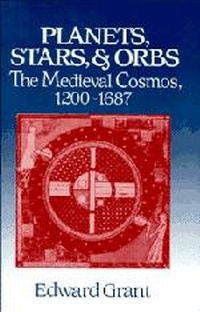
Planets, Stars, and Orbs 2 Volume Paperback Set
The Medieval Cosmos, 1200-1687
Published on 16. July 2009
Book
Paperback/Softback
842 pages
978-0-521-13868-0 (ISBN)
Description
Medieval cosmology was a fusion of pagan Greek ideas and biblical descriptions of the world, especially the creation account in Genesis. Because cosmology was based on discussions of the relevant works of Aristotle, primary responsibility for its study fell to scholastic theologians and natural philosophers in the universities of western Europe from the thirteenth to the seventeenth century. Edward Grant describes the extraordinary range of themes, ideas, and arguments that constituted scholastic cosmology for approximately five hundred years, from around 1200 to 1700. Primary emphasis is placed on the world as a whole, what might lie beyond it, and the celestial region, which extended from the Moon to the outermost convex surface of the cosmos. Another important aspect of this study is how natural philosophers in the sixteenth and seventeenth centuries responded to the new interpretations of a heliocentric instead of a geoheliocentric Aristotelian cosmology.
Reviews / Votes
'Professor Grant ploughs through this morass of mediaeval opinion and argument with unfailing zest and admirable rationality. His long history of time long past should be of lasting value to everyone interested in either scholasticism or cosmology.' Nature 'Grant's book is not only thorough and scholarly but is also eminently readable. The author has shown a masterly grasp of his subject. It will also be an absolute joy not only for astronomical and scientific historians but also for modern cosmologists.' The ObservatoryMore details
Language
English
Place of publication
Cambridge
United Kingdom
Target group
College/higher education
Product notice
Paperback (trade)
Illustrations
14 Halftones, unspecified
Dimensions
Height: 250 mm
Width: 324 mm
Thickness: 69 mm
Weight
1550 gr
ISBN-13
978-0-521-13868-0 (9780521138680)
Copyright in bibliographic data and cover images is held by Nielsen Book Services Limited or by the publishers or by their respective licensors: all rights reserved.
Schweitzer Classification
Other editions
Previous edition
Book
01/1994
Cambridge University Press
€74.40
Article exhausted; check for reprint
Person
Content
Illustrations; Preface; Acknowledgements; Abbreviations; Introduction: scope, sources, and social context; 1. Pierre Duhem, Medieval cosmology and the scope of the present day; 2. The sources of cosmology in the late Middle Ages; 3. The social and institutional matrix of scholastic cosmology; Part I. The Cosmos as a Whole and What, if Anything, Lies Beyond: 4. Is the world eternal, without beginning or end?; 5. The creation of the world; 6. The finitude, shape, and place of the world; 7. The perfection of the world; 8. The possibility of other worlds; 9. Extracosmic void space; Part II. The Celestial Region: 10. The incorruptibility of the celestial region; 11. Celestial perfection; 12. On celestial matter: can it exist in a changeless state?; 13. The mobile celestial orbs: concentrics, eccentrics, and epicycles; 14. Are the heavens composed of hard orbs or a fluid substance?; 15. The immobile orb of the cosmos: the empyrean heaven; 16. Celestial light; 17. The properties and qualities of celestial bodies, and the dimensions of the world; 18. On celestial motions and their causes; 19. The influence of the celestial region on the terrestrial; 20. The earth and its cosmic relations: size, centrality, shape, and immobility; Conclusion: Five centuries of scholastic cosmology; Appendices; Bibliography; Index.