

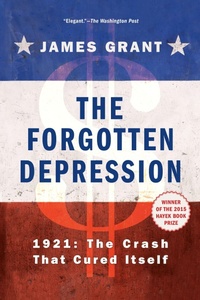
The Forgotten Depression
1921, the Crash That Cured Itself
Published on 17. November 2015
Book
Paperback/Softback
272 pages
978-1-4516-8646-3 (ISBN)
Description
James Grant’s story of America’s last governmentally untreated depression: A bible for conservative economists, this “carefully researched history…makes difficult economic concepts easy to understand, and it deftly mixes major events with interesting vignettes” (The Wall Street Journal).
In 1920–1921, Woodrow Wilson and Warren G. Harding met a deep economic slump by seeming to ignore it, implementing policies that most 21st century economists would call backward. Confronted with plunging prices, wages, and employment, the government balanced the budget and, through the Federal Reserve, raised interest rates. No “stimulus” was administered, and a powerful, job-filled recovery was under way by late 1921. Yet by 1929, the economy spiraled downward as the Hoover administration adopted the policies that Wilson and Harding had declined to put in place.
In The Forgotten Depression, James Grant “makes a strong case against federal intervention during economic downturns” (Pittsburgh Tribune Review), arguing that the well-intended White House-led campaign to prop up industrial wages helped turn a bad recession into America’s worst depression. He offers examples like this, and many others, as important strategies we can learn from the earlier depression and apply today and to the future. This is a powerful response to the prevailing notion of how to fight recession, and “Mr. Grant’s history lesson is one that all lawmakers could take to heart” (Washington Times).
In 1920–1921, Woodrow Wilson and Warren G. Harding met a deep economic slump by seeming to ignore it, implementing policies that most 21st century economists would call backward. Confronted with plunging prices, wages, and employment, the government balanced the budget and, through the Federal Reserve, raised interest rates. No “stimulus” was administered, and a powerful, job-filled recovery was under way by late 1921. Yet by 1929, the economy spiraled downward as the Hoover administration adopted the policies that Wilson and Harding had declined to put in place.
In The Forgotten Depression, James Grant “makes a strong case against federal intervention during economic downturns” (Pittsburgh Tribune Review), arguing that the well-intended White House-led campaign to prop up industrial wages helped turn a bad recession into America’s worst depression. He offers examples like this, and many others, as important strategies we can learn from the earlier depression and apply today and to the future. This is a powerful response to the prevailing notion of how to fight recession, and “Mr. Grant’s history lesson is one that all lawmakers could take to heart” (Washington Times).
More details
Language
English
Product notice
Paperback (trade)
Unsewn / adhesive bound
Dimensions
Height: 228 mm
Width: 151 mm
Thickness: 22 mm
Weight
309 gr
ISBN-13
978-1-4516-8646-3 (9781451686463)
Copyright in bibliographic data and cover images is held by Nielsen Book Services Limited or by the publishers or by their respective licensors: all rights reserved.
Schweitzer Classification
Other editions
Additional editions
E-Book
11/2014
1st Edition
Simon + Schuster LLC
€13.84
Available for download
Person
James Grant is the founder of Grant’s Interest Rate Observer, a leading journal on financial markets, which he has published since 1983. He is the author of seven books covering both financial history and biography. Grant’s journalism has been featured in Financial Times, The Wall Street Journal, and Foreign Affairs. He has appeared on 60 Minutes, Jim Lehrer’s News Hour, and CBS Evening News.