

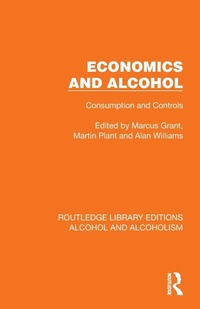
Economics and Alcohol
Consumption and Controls
1st Edition
Will be published approx. on 1. December 2025
Book
Paperback/Softback
298 pages
978-1-032-60583-8 (ISBN)
Description
During the 1950s, 1960s and 1970s, general levels of alcohol consumption had risen considerably in all parts of the world. In association with this, there was a proliferation of alcohol-related problems such as liver disease, drunkenness offences, marital disharmony and employment difficulties. Many factors influence the probability of alcohol addiction and the habits of drinking; they include age, sex, race, occupation and income.
Economic aspects of the use and misuse of alcohol had been attracting increasing attention during the early 1980s. Politicians and scholars alike had drawn attention to the benefits of a vigorous alcohol industry on the one hand, and on the other, the costs of providing medical, social and educational services for those suffering from alcohol-related problems. Originally published in 1983, the real nature of the relationship between economics and alcohol is explored in detail for the first time in this book. It argues for increased participation by economists in the processes of social policy decision-making and considers the key issues of cost-benefit analyses, control policies, taxation and programme efficiency. No easy solutions are provided, but a host of unjustified assumptions about this subject are clarified. This book paved the way for substantial future collaboration between economists and those involved in alcohol studies.
Economic aspects of the use and misuse of alcohol had been attracting increasing attention during the early 1980s. Politicians and scholars alike had drawn attention to the benefits of a vigorous alcohol industry on the one hand, and on the other, the costs of providing medical, social and educational services for those suffering from alcohol-related problems. Originally published in 1983, the real nature of the relationship between economics and alcohol is explored in detail for the first time in this book. It argues for increased participation by economists in the processes of social policy decision-making and considers the key issues of cost-benefit analyses, control policies, taxation and programme efficiency. No easy solutions are provided, but a host of unjustified assumptions about this subject are clarified. This book paved the way for substantial future collaboration between economists and those involved in alcohol studies.
More details
Series
Language
English
Place of publication
London
United Kingdom
Publishing group
Taylor & Francis Ltd
Target group
College/higher education
Professional and scholarly
Postgraduate, Professional, and Undergraduate
Dimensions
Height: 216 mm
Width: 140 mm
Thickness: 17 mm
Weight
395 gr
ISBN-13
978-1-032-60583-8 (9781032605838)
Copyright in bibliographic data and cover images is held by Nielsen Book Services Limited or by the publishers or by their respective licensors: all rights reserved.
Schweitzer Classification
Other editions
Additional editions
E-Book
12/2023
1st Edition
Taylor & Francis
€41.99
Available for download
Book
12/2023
1st Edition
Routledge
€177.10
Shipment within 10-20 days
E-Book
12/2023
1st Edition
Taylor & Francis
€41.99
Available for download
Persons
Marcus Grant, Martin Plant and Alan Williams
Content
Acknowledgements. Introduction Marcus Grant, Martin A. Plant and Alan Williams 1. What Can Economists Contribute? Robert E. Leu 2. Alcohol Studies from an Economic Perspective Robert Weeden 3. Programmes, Interests and Alcohol Dean R. Gerstein 4. Societal Costs of Alcohol Abuse in the United States: An Updating Leonard G. Schifrin 5. Calculating the Costs of Alcohol: The Scandinavian Experience Esa OEsterberg 6. The Costs and Benefits of Alcohol in Ontario: A Critical Review of the Evidence Eric W. Single 7. Alcoholism: An Econometric Model of its Causes, its Effects and its Control Stuart O. Schweitzer, Michael D. Intriligator and Hossein Salehi 8. Modelling Alcohol Consumption and Abuse: The Powers and Pitfalls of Economic Techniques Alan Maynard 9. The Relationship Between Taxation, Price and Alcohol Consumption in the Countries of Europe Phil Davies 10. An Evaluation of the Control of Consumption Policy David J. Pittman 11. The Economics of Alcohol Taxation Brendan M. Walsh 12. Alcohol Taxes as a Public Health Measure Philip J. Cook 13. Government Policies Concerning Alcohol Taxation: Beyond the Excise Tax Debate James F. Mosher 14. Advertising Exposure, Alcohol Consumption and Misuse of Alcohol Donald E. Strickland 15. Advertising, Alcohol Consumption and Policy Alternatives M. J. van Iwaarden 16. The Demand for Beer, Spirits and Wine in the UK, 1956-79 Tony McGuinness 17. Alcohol Advertising Reassessed: The Public Health Perspective Larry Wallack 18. The Structure and Role of the British Alcoholic Drinks Industry C. W. Thurman 19. Paternalism, Rationality and the Special Status of Alcohol Robin Room 20. Alcohol and Health Economics: The Policy Perspective David Taylor. References. Notes on Contributors. Name Index. Subject Index.