

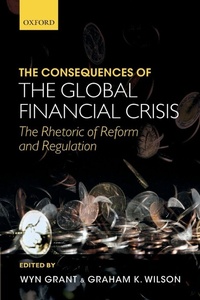
The Consequences of the Global Financial Crisis
The Rhetoric of Reform and Regulation
Published on 6. February 2014
Book
Paperback/Softback
296 pages
978-0-19-870460-7 (ISBN)
Description
This is an open access title available under the terms of a CC BY-NC-ND 3.0 International licence. It is free to read at Oxford Scholarship Online and offered as a free PDF download from OUP and selected open access locations.
The Global Financial Crisis is the most serious economic crisis since the Great Depression, and although many have explored its causes, relatively few have focused on its consequences. Unlike earlier crises, no new paradigm seems yet to have come forward to challenge existing ways of thinking and neo-liberalism has emerged relatively unscathed. This crisis, characterized by a remarkable policy stability, has lacked a coherent and innovative intellectual response.
This book, however, systematically explores the consequences of the crisis, focusing primarily on its impact on policy and politics. It asks how governments responded to the challenges that the crisis has posed, and the policy and political impact of the combination of both the Global Financial Crisis itself and these responses.
It brings together leading academics to consider the divergent ways in which particular countries have responded to the crisis, including the US, the UK, China, Europe, and Scandinavia. The book also assesses attempts to develop global economic governance and to reform financial regulation, and looks critically at the role of credit rating agencies.
The Global Financial Crisis is the most serious economic crisis since the Great Depression, and although many have explored its causes, relatively few have focused on its consequences. Unlike earlier crises, no new paradigm seems yet to have come forward to challenge existing ways of thinking and neo-liberalism has emerged relatively unscathed. This crisis, characterized by a remarkable policy stability, has lacked a coherent and innovative intellectual response.
This book, however, systematically explores the consequences of the crisis, focusing primarily on its impact on policy and politics. It asks how governments responded to the challenges that the crisis has posed, and the policy and political impact of the combination of both the Global Financial Crisis itself and these responses.
It brings together leading academics to consider the divergent ways in which particular countries have responded to the crisis, including the US, the UK, China, Europe, and Scandinavia. The book also assesses attempts to develop global economic governance and to reform financial regulation, and looks critically at the role of credit rating agencies.
Reviews / Votes
Contributors, from both sides of the Atlantic and clearly experts in their areas, have written informative surveys that surely are worth reading. Recommended. * CHOICE * This book highlights the main issues of the current global financial crises and gives an important historical background of the previous financial and economic crisis... An excellent book, worth reading. * Global Governance *More details
Language
English
Place of publication
Oxford
United Kingdom
Target group
Professional and scholarly
Dimensions
Height: 234 mm
Width: 156 mm
Thickness: 16 mm
Weight
453 gr
ISBN-13
978-0-19-870460-7 (9780198704607)
Copyright in bibliographic data and cover images is held by Nielsen Book Services Limited or by the publishers or by their respective licensors: all rights reserved.
Schweitzer Classification
Other editions
Additional editions
Wyn Grant | Graham K. Wilson
The Consequences of the Global Financial Crisis
The Rhetoric of Reform and Regulation
E-Book
05/2012
OUP eBook
€0.00
Available for download
Persons
Wyn Grant is Professor of Politics at the University of Warwick and vice-president for Europe and Africa of the International Political Science Association. He has written extensively on economic policy, government-business relations, pressure groups, and agricultural and environmental policy.
Graham Wilson is Professor and Chair, Department of Political Science, Boston University. He previously taught at the Universities of Wisconsin-Madison and Essex.
Graham Wilson is Professor and Chair, Department of Political Science, Boston University. He previously taught at the Universities of Wisconsin-Madison and Essex.
Content
1. Introduction ; 2. The Theory and Practice of Global Economic Governance in the Early 21st Century: the Limits of Multilateralism ; 3. The UK: the Triumph of Fiscal Realism? ; 4. The United States: the strange survival of (Neo)Liberalism ; 5. Constructing Financial Markets: reforming Over-the-Counter Derivatives in the aftermath of the financial crisis ; 6. Financial Regulation after the Global Financial Crisis: Regionalist Impulses and National Strategies ; 7. Regaining Control: Capital Controls and the Global Financial Crisis ; 8. Institutional Failure and the Global Financial Crisis ; 9. What Happened to the State-influenced Market Economies (SMEs)? France, Italy, and Spain Confront the Crisis as the Good, the Bad, and the Ugly ; 10. Social Solidarity in Scandinavia after the Failure of Finance Capitalism ; 11. French Responses to the Global Economic Crisis: the Political Economy of Post-dirigisme and New State Activism ; 12. Pardigm(s) Shifting? Responding to China's Response to the Global Financial Crisis? ; 13. Conclusion