

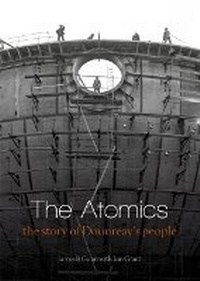
The Atomics
the story of Dounreay's people
Published on 31. July 2025
Book
Hardback
230 pages
978-1-84995-610-9 (ISBN)
Description
Highlights the significance of Dounreay to the nation in being the UK's centre for research and development into nuclear fast reactors
Details how it affected a small and remote rural community, particularly the market town of Thurso, Caithness
Published to mark the 70th anniversary of Dounreay
The UK Government's 1954
decision, made without any community consultation or public inquiry, to centre
the country's fast reactor R&D nuclear programme at Dounreay's disused
military airfield in Caithness, changed the fishing and farming county forever.
Around 1,100 workers, labelled
by the locals as 'Atomics', arrived from the South, and joined around 1,200
locals to operate three nuclear reactors. In one fell swoop, the continual
depopulation of Caithness was reversed and Thurso's population trebled from
3,200 to over 9,000 in only eight years.
In
1988, the Government decided that fast reactor technology was not required and
the last reactor was shut down in 1994. The world-leading pioneering work left
a legacy of radioactively-contaminated facilities and environment. The
challenging work programme of clean-up, decommissioning and demolition will extend
to the 2070s, and so Caithness and North Sutherland have time to prepare for
life after Dounreay.
Whatever
the future holds, enjoy the 70-year journey and discover how the incomers
became labelled as the 'Atomics'.
Details how it affected a small and remote rural community, particularly the market town of Thurso, Caithness
Published to mark the 70th anniversary of Dounreay
The UK Government's 1954
decision, made without any community consultation or public inquiry, to centre
the country's fast reactor R&D nuclear programme at Dounreay's disused
military airfield in Caithness, changed the fishing and farming county forever.
Around 1,100 workers, labelled
by the locals as 'Atomics', arrived from the South, and joined around 1,200
locals to operate three nuclear reactors. In one fell swoop, the continual
depopulation of Caithness was reversed and Thurso's population trebled from
3,200 to over 9,000 in only eight years.
In
1988, the Government decided that fast reactor technology was not required and
the last reactor was shut down in 1994. The world-leading pioneering work left
a legacy of radioactively-contaminated facilities and environment. The
challenging work programme of clean-up, decommissioning and demolition will extend
to the 2070s, and so Caithness and North Sutherland have time to prepare for
life after Dounreay.
Whatever
the future holds, enjoy the 70-year journey and discover how the incomers
became labelled as the 'Atomics'.
More details
Language
English
Place of publication
United Kingdom
Publishing group
Porto Press Ltd
Target group
College/higher education
Illustrations
illustrated with 125 photos, c.70 in colour
Dimensions
Height: 240 mm
Width: 170 mm
ISBN-13
978-1-84995-610-9 (9781849956109)
Copyright in bibliographic data and cover images is held by Nielsen Book Services Limited or by the publishers or by their respective licensors: all rights reserved.
Schweitzer Classification
Persons
Grant, a Caithness journalist, has reported extensively on Dounreay, its workforce and its impact on the local economy and environment for 47 years.
Gunn, a Caithness farmer's son, has worked at Dounreay and the neighbouring Ministry of Defence's Naval Reactor Test Establishment for 47 years.
Gunn, a Caithness farmer's son, has worked at Dounreay and the neighbouring Ministry of Defence's Naval Reactor Test Establishment for 47 years.