

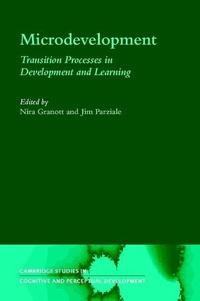
Microdevelopment
Transition Processes in Development and Learning
Published on 9. May 2002
Book
Hardback
368 pages
978-0-521-66053-2 (ISBN)
Description
Microdevelopment is the process of change in abilities, knowledge and understanding during short time-spans. This book presents a new process-orientated view of development and learning based on recent innovations in psychology research. Instead of characterising abilities at different ages, researchers investigate processes of development and learning that evolve through time and explain what enables progress in them. Four themes are highlighted: variability, mechanisms that create transitions to higher levels of knowledge, interrelations between changes in the short-term scale of microdevelopment and the crucial effect of context. Learning and development are analysed in and out of school, in the individual's activities and through social interaction, in relation to simple and complex problems and in everyday behaviour and novel tasks. With contributions from the foremost researchers in the field Microdevelopment will be essential reading for all interested in cognitive and developmental science.
Reviews / Votes
"The task of attaining optimal outcomes for learners from a range of cultural backgrounds remains a major social challenge. The research program outlined in Microdevelopment could help us meet that challenge." - David MacLennan, Ph.D. The University College of the CaribooMore details
Series
Language
English
Place of publication
Cambridge
United Kingdom
Target group
Professional and scholarly
Illustrations
8 Tables, unspecified
Dimensions
Height: 235 mm
Width: 157 mm
Thickness: 26 mm
Weight
747 gr
ISBN-13
978-0-521-66053-2 (9780521660532)
Copyright in bibliographic data and cover images is held by Nielsen Book Services Limited or by the publishers or by their respective licensors: all rights reserved.
Schweitzer Classification
Other editions
Additional editions
E-Book
12/2004
1st Edition
Cambridge University Press
€44.49
Available for download
Persons
Nira Granott is an assistant professor at the School of Human Development, University of Texas at Dallas, and director of the Microdevelopmental Lab at the UT Dallas. She has a Ph.D. from Massachusetts Institute of Technology, the Media Laboratory, and Ed.M. from Harvard University, the Graduate School of Education. She had taught in teachers' continuing education programs, at Harvard Graduate School of Education, and at UT Dallas. She had worked as an educational software designer, producer of multimedia projects in educational television, and consultant for software design projects. Her primary research interests are collaborative microdevelopment, the process of change in development and learning, pathways and mechanisms in the emergence of change, and the way people at different ages interact with each other to make change happen. Included in Who's Who in the World, 2001. Member of American Psychological Society, Society for Research in Child Development, Jean Piaget Society, and American Educational Research Association. Jim Parziale is a part-time professor at the Graduate School of Education at the University of Massachusetts, Boston, and a teacher and science resource teacher for Brookline Public School, Brookline, Massachusetts. He has an Ed.D. in human development and psychology from Harvard University and has won many awards for teaching excellence. His primary research interests are the process of knowledge construction during classroom science activities and the self-organization of children and adults' knowledge with interrelations to the environments in which problems are solved.
Content
Introduction: Microdevelopment Nira Granott and Jim Parziale; Part I. Variability: 1. Microgenetic srudies in self-explanation Robert S. Siegler; 2. Microdevelopment and dynamic systems: Applications to infant motor development Esther Thelen and Daniela Corbetta; 3. Looking at the hands through time: A microgenetic perspective on learning and instruction Susan Goldin-Meadow and Martha Wagner Alibali; Part II. Transition Mechanisms: 4. A multi-component system that constructs knowledge: Insights from microgenetic study Deanna Kuhn; 5. Bridging to the unknown: a transition mechanism in learning and development Nira Granott, Kurt W. Fischer and Jim Parziale; 6. Observing the dynamics of construction: children building bridges and new ideas Jim Parziale; Part III. Micro- and macrodevelopment: 7. Interacting time scales in personality (and cognitive) development: intentions, emotions and emergent from Marc D. Lewis; 8. How microdevelopment creates macrodevelopment: reiterated sequences, backward transitions and the Zone of Current Development Nira Granott; 9. Macro- and microdevelopment research: assumptions, research strategies, constraints and utilities Kang Lee and Annette Karmiloff-Smith; Part IV. Context: 10. Notebooks as windows on learning: the case of a science-into-ESL programme Rochel Gelman, Laura Romo and Wendy S. Francis; 11. Darwin's construction of the theory of evolution: microdevelopment of explanations of variation and change in species Kurt W. Fischer and Zheng Yan; 12. Developmental dynamics, intentional action and fuzzy sets Paul Van Geert; Indexes.