

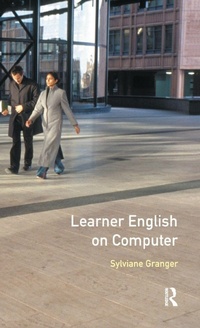
Learner English on Computer
1st Edition
Published on 27. January 2017
Book
Hardback
250 pages
978-1-138-16275-4 (ISBN)
Description
The first book of its kind, Learner English on Computer is intended to provide linguists, students of linguistics and modern languages, and ELT professionals with a highly accessible and comprehensive introduction to the new and rapidly-expanding field of corpus-based research into learner language. Edited by the founder and co-ordinator of the International Corpus of Learner English (ICLE), the book contains articles on all aspects of corpus compilation, design and analysis.
The book is divided into three main sections; in Part I, the first chapter provides the reader with an overview of the field, explaining links with corpus and applied linguistics, second language acquisition and ELT. The second chapter reviews the software tools which are currently available for analysing learner language and contains useful examples of how they can be used. Part 2 contains eight case studies in which computer learner corpora are analysed for various lexical, discourse and grammatical features. The articles contain a wide range of methodologies with broad general application. The chapters in Part 3 look at how Computer Learner Corpus (CLC) based studies can help improve pedagogical tools: EFL grammars, dictionaries, writing textbooks and electronic tools. Implications for classroom methodology are also discussed.
The comprehensive scope of this volume should be invaluable to applied linguists and corpus linguists as well as to would-be learner corpus builders and analysts who wish to discover more about a new, exciting and fast-growing field of research.
The book is divided into three main sections; in Part I, the first chapter provides the reader with an overview of the field, explaining links with corpus and applied linguistics, second language acquisition and ELT. The second chapter reviews the software tools which are currently available for analysing learner language and contains useful examples of how they can be used. Part 2 contains eight case studies in which computer learner corpora are analysed for various lexical, discourse and grammatical features. The articles contain a wide range of methodologies with broad general application. The chapters in Part 3 look at how Computer Learner Corpus (CLC) based studies can help improve pedagogical tools: EFL grammars, dictionaries, writing textbooks and electronic tools. Implications for classroom methodology are also discussed.
The comprehensive scope of this volume should be invaluable to applied linguists and corpus linguists as well as to would-be learner corpus builders and analysts who wish to discover more about a new, exciting and fast-growing field of research.
More details
Series
Language
English
Place of publication
London
United Kingdom
Publishing group
Taylor & Francis Ltd
Target group
College/higher education
Dimensions
Height: 222 mm
Width: 145 mm
Thickness: 17 mm
Weight
453 gr
ISBN-13
978-1-138-16275-4 (9781138162754)
Copyright in bibliographic data and cover images is held by Nielsen Book Services Limited or by the publishers or by their respective licensors: all rights reserved.
Schweitzer Classification
Other editions
Additional editions
Sylviane Granger
Learner English on Computer
E-Book
02/2014
1st Edition
Routledge
€107.99
Available for download
Sylviane Granger
Learner English on Computer
E-Book
02/2014
1st Edition
Routledge
€107.99
Available for download

Sylviane Granger
Learner English on Computer
Book
02/1998
1st Edition
Routledge
€111.50
Shipment within 10-20 days
Person
Sylviane Granger
Content
List of Contributors
Acknowledgements
Preface, Geoffrey Leech
Introduction, Sylviane Granger
Part 1: Learner Corpus Design and Analysis
1. The computerized learner corpus: a versatile new source of data for SLA research, Sylviane Granger
2. Computer tools for the analysis of learner corpora, Fanny Meunier
Part II: Studies of Learner Grammar, Lexis and Discourse
3. Vocabulary frequencies in advanced learner English: a cross-linguistic approach, Hakan Ringbom
4. Overstatement in advanced learners' writing: stylistic aspects of adjective intensification, Gunter Lorenz
5. An automated approach to the phrasicon of EFL learners, Sylvie De Cock, Sylviane Granger, Geoffrey Leech and Tony McEnery
6. The use of adverbial connectors in advanced Swedish learners' written English, Bengt Altenberg and Marie Tapper
7. Direct questions in argumentative student writing, Tuija Virtanen
8. Writer/reader visibility in EFL written discourse, Stephanie Petch-Tyson
9. Automatic profiling of learner texts, Sylviane Granger and Paul Rayson
10. Tag sequences in earner corpora: a key to interlanguage grammar and discourse, Jan Aarts and Sylviane Granger
Part III: Pedagogical Applications of Learner Corpora
11. Comparing native and learner perspectives on English grammar: a study of complement clauses, Doug Biber and Randi Reppen
12. Using a learners' corpus in compiling ELT dictionaries, Patrick Gillard and Adam Gadsby
13. Enhancing a writing textbook: a national perspective, Przemyslaw Kaszubski
14. Exploiting L1 and interlanguage corpora in the design of an electronic language learning and production environment, John Milton
15. Learner corpus data in the foreign language classroom: form-focused instruction and data-driven learning, Sylviane Granger and Chris Tribble
Software mentioned in the book
Bibliography
Subject Index
Acknowledgements
Preface, Geoffrey Leech
Introduction, Sylviane Granger
Part 1: Learner Corpus Design and Analysis
1. The computerized learner corpus: a versatile new source of data for SLA research, Sylviane Granger
2. Computer tools for the analysis of learner corpora, Fanny Meunier
Part II: Studies of Learner Grammar, Lexis and Discourse
3. Vocabulary frequencies in advanced learner English: a cross-linguistic approach, Hakan Ringbom
4. Overstatement in advanced learners' writing: stylistic aspects of adjective intensification, Gunter Lorenz
5. An automated approach to the phrasicon of EFL learners, Sylvie De Cock, Sylviane Granger, Geoffrey Leech and Tony McEnery
6. The use of adverbial connectors in advanced Swedish learners' written English, Bengt Altenberg and Marie Tapper
7. Direct questions in argumentative student writing, Tuija Virtanen
8. Writer/reader visibility in EFL written discourse, Stephanie Petch-Tyson
9. Automatic profiling of learner texts, Sylviane Granger and Paul Rayson
10. Tag sequences in earner corpora: a key to interlanguage grammar and discourse, Jan Aarts and Sylviane Granger
Part III: Pedagogical Applications of Learner Corpora
11. Comparing native and learner perspectives on English grammar: a study of complement clauses, Doug Biber and Randi Reppen
12. Using a learners' corpus in compiling ELT dictionaries, Patrick Gillard and Adam Gadsby
13. Enhancing a writing textbook: a national perspective, Przemyslaw Kaszubski
14. Exploiting L1 and interlanguage corpora in the design of an electronic language learning and production environment, John Milton
15. Learner corpus data in the foreign language classroom: form-focused instruction and data-driven learning, Sylviane Granger and Chris Tribble
Software mentioned in the book
Bibliography
Subject Index