

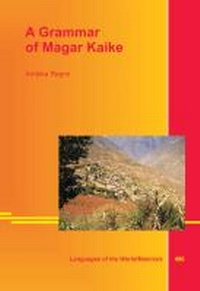
A Grammar of Magar Kaike
LINCOM GmbH (Publisher)
Published on 24. October 2013
Book
209 pages
978-3-86288-493-3 (ISBN)
Description
Ambika Regmi
Tribuvan University
This is a comprehensive description of Magar Kaike, a previously undescribed and endangered Tibeto-Burman language spoken by around 1000 Magar Kaike mainly in four villages, namely, Sahartara, Tupatara, Tarakot and Belawa/Lingdu within Sahartara Village Development Committee of Dolpa District, Midwestern Development Region of Nepal.
This grammar, organized into thirteen chapters, analyzes phonological and morphosyntactic features of the language and compares them with the characteristic structural features of the Tibeto-Burman languages from the typological perspective.
Magar Kaike, a tonal and consistently ergative language, is characterized by a complex verb agreement pattern referred to as conjunct-disjunct. It exhibits case-syncretism and inclusiveexclusive distinction. In Magar Kaike, reflexive is marked morphologically. It massively uses nominalization for a number of syntactic functions. In Magar Kaike, except first person patient, the human patient is also marked by the dative case, referred to as antidative. The relative clauses are formed mainly by nominalization by employing the gap strategy. It employs reduplication for the sequential constructions. Magar Kaike uses different morphosyntactic devices for the coherence of the clauses at the multi-propositional levels. The author, PhD in linguistics, is researcher in Linguistic Survey of Nepal (LinSuN), Central Department of Linguistics, Tribuvan University, Nepal. She has specialized in Tibeto-Burman linguistics, language documentation and sociolinguistic survey.
ISBN 9783862884933. Languages of the World/Materials 496. 209pp. 2013.
Tribuvan University
This is a comprehensive description of Magar Kaike, a previously undescribed and endangered Tibeto-Burman language spoken by around 1000 Magar Kaike mainly in four villages, namely, Sahartara, Tupatara, Tarakot and Belawa/Lingdu within Sahartara Village Development Committee of Dolpa District, Midwestern Development Region of Nepal.
This grammar, organized into thirteen chapters, analyzes phonological and morphosyntactic features of the language and compares them with the characteristic structural features of the Tibeto-Burman languages from the typological perspective.
Magar Kaike, a tonal and consistently ergative language, is characterized by a complex verb agreement pattern referred to as conjunct-disjunct. It exhibits case-syncretism and inclusiveexclusive distinction. In Magar Kaike, reflexive is marked morphologically. It massively uses nominalization for a number of syntactic functions. In Magar Kaike, except first person patient, the human patient is also marked by the dative case, referred to as antidative. The relative clauses are formed mainly by nominalization by employing the gap strategy. It employs reduplication for the sequential constructions. Magar Kaike uses different morphosyntactic devices for the coherence of the clauses at the multi-propositional levels. The author, PhD in linguistics, is researcher in Linguistic Survey of Nepal (LinSuN), Central Department of Linguistics, Tribuvan University, Nepal. She has specialized in Tibeto-Burman linguistics, language documentation and sociolinguistic survey.
ISBN 9783862884933. Languages of the World/Materials 496. 209pp. 2013.