

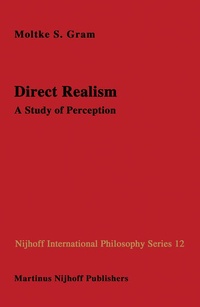
Direct Realism
A Study of Perception
Published on 30. September 1983
Book
Hardback
XV, 203 pages
978-90-247-2870-1 (ISBN)
Description
or their surfaces can be translated without remainder into descriptions of ob jects that are neither material objects or surfaces of any material object. All of these claims have historically conspired to discredit Direct Realism. But Direct Realism can accommodate all of the premises of the three argu ments without admitting any of their conclusions. Inferential perceptual knowl edge assumes a kind of knowledge that is not inferential. Without this assump tion, we are given a vicious infinite regress. But this is compatible with the fact that any case of non-inferential knowledge has a material objeCt as its object. The fact ofinfallible perceptual awareness fails to discredit DireCt Realism for similar reasons. Infallibility is a characteristic, not of the objects which we perceive, but rather of the acts by which we perceive them. And this permits an object of such awareness to be either material or something other than material. It does not fol low from the fact of infallibility that the objects of awareness must be other than material objects. And, finally, the fact of translatability shows at most that we either can or must simultaneously perceive material objects and entities which are not material objects. It does not show that the perception of the one is the same as the perception of the other. The entire argument rests, as we shall learn, on an illicit assimilation of the notions of sameness and equivalence.
Reviews / Votes
` ...a vigorous and challenging defence of direct realism in which one gets not only a clear overview of what precisely the problems are, but also a forceful and often insightful attempt to solve them. ...the book makes a highly readable and stimulating contribution to recent literature in the philosophy of perception. 'Critical Philosophy, 2:1 (1985)
More details
Series
Edition
1983
Language
English
Place of publication
Dordrecht
Netherlands
Publishing group
Springer
Target group
Professional and scholarly
Research
Illustrations
XV, 203 p.
Dimensions
Height: 241 mm
Width: 160 mm
Thickness: 17 mm
Weight
500 gr
ISBN-13
978-90-247-2870-1 (9789024728701)
DOI
10.1007/978-94-009-6908-7
Schweitzer Classification
Other editions
Additional editions
Content
I. Caveats.- 1. Physicalism and Direct Realism.- 2. Adverbialism.- 3. Acts and Objects.- 4. Whither Direct Realism?.- II. The Sensory Scene.- 1. The Argument for Immediacy.- 2. The Argument from Infallibility.- 3. The Argument from Conceptual Frameworks.- 4. The Very Idea of Direct Realism.- III. Qualitative Appearing.- 1. The Sensum Theory.- 2. The Compound Thing Theory.- 3. The Multiple Inherence Theory.- 4. The Multiple Relation Theory.- 5. The Impasse: A Look Backward.- 6. The Multiple Relation Theory Revisited: Major Objections.- 7. Direct Realism and the Multiple Relation Theory Reconciled.- IV. Illusion.- 1. The Received Answers: Direct Realists Manqué.- 2. No Intrinsic Difference: Another Interpretation.- 3. Descriptive Neutrality and Direct Realism.- 4. Indeterminate Perceptual Objects: The Speckled Hen Example.- 5. The Phantom Limb Objection.- V. Time Lag.- 1. The Received Answers.- 2. A New Beginning.- 3. Obstacles and Objections.- 4. Common Sense and Causation.- 5. Microparticles: Causation's Last Resort.- 6. Color Perception: A Counterexample.- VI. Phenomenalism.- 1. Classical Phenomenalism: Mill.- 2. Varieties of Phenomenalism: Hume.- 3. Phenomenalism and Logical Constructions: Russell.- 4. Phenomenalism: A Budget of Difficulties.- 5. The Anomaly of Phenomenalism.