

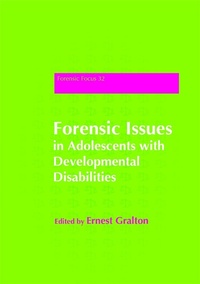
Forensic Issues in Adolescents with Developmental Disabilities
Published on 15. August 2011
Book
Paperback/Softback
288 pages
978-1-84905-144-6 (ISBN)
Description
Adolescents with developmental disabilities are a complex population who require specialised treatment and care. This interdisciplinary text examines the processes involved in working with this client group in forensic settings, and explores the ways in which their needs differ from those of other young people who engage in high risk behaviour or offending.
The book covers assessment, intervention and treatment options for adolescents with a wide range of developmental disabilities, including autism spectrum disorders, acquired brain injury, developmental traumatology, and complex comorbidities. It describes the obstacles, challenges and opportunities to consider when working with this population, and the role played by various professionals, including forensic psychiatry and psychology, occupational therapy, physiotherapy, education, art psychotherapy and social work. The book also outlines the issues to consider when working in secure and community settings as well as the legal aspects of working with this client group, and the complex issues surrounding risk assessment.
The first comprehensive account of forensic issues in adolescents with developmental disabilities, this book will be an indispensible primary resource for a wide range of professionals, including child and adolescent psychiatrists, community psychiatric nurses, developmental paediatricians, social workers and youth workers, lawyers and advocates.
The book covers assessment, intervention and treatment options for adolescents with a wide range of developmental disabilities, including autism spectrum disorders, acquired brain injury, developmental traumatology, and complex comorbidities. It describes the obstacles, challenges and opportunities to consider when working with this population, and the role played by various professionals, including forensic psychiatry and psychology, occupational therapy, physiotherapy, education, art psychotherapy and social work. The book also outlines the issues to consider when working in secure and community settings as well as the legal aspects of working with this client group, and the complex issues surrounding risk assessment.
The first comprehensive account of forensic issues in adolescents with developmental disabilities, this book will be an indispensible primary resource for a wide range of professionals, including child and adolescent psychiatrists, community psychiatric nurses, developmental paediatricians, social workers and youth workers, lawyers and advocates.
Reviews / Votes
McFarlane, weaves the definition of dramatherapy with the emphasis on play, spontaneity and flexibility so effortlessly that I wondered why I ever agonized (and still do) over explaining it when asked "How does it Work?"... I cannot praise this publication any more highly than Dr Sue Jennings does in her foreword to this passionate book. It is the authors' wealth of experience and working relationship that gives this book a realistic, hands-on, practical feel. -- Dramatherapy Journal of the British Association of Dramatherapists (vol 35) The book would be an important addition to the bookshelf of any professional who works with adolescents in forensic settings. -- Medicine, Science and the Law From time to time a book is published that is important to practitioners working in specialist disabilities services - this is one of them. -- The Frontline of Learning Disability In bringing together the contributors to this book, the Editor has, for the first time, been able to draw together how, across the professionals health, social care, education and justice, practitioners can better meet the needs of a very vulnerable patient group; those adolescents with developmental disabilities and forensic needs...For the first time practitioners have a bench book that will enable them to ensure that they have a framework from which to undertake a comprehensive needs assessment that covers all the domains of a young person's life. It will greatly assist in risk assessment and best risk management. As importantly, any team that could deliver the interventions that are described across this book would be helping the adolescent to fulfil their full positive potential, whilst ensuring when they return to the community, and hopefully their families, that their risk to others would have been minimised. -- Professor Sue Bailey, President, Royal College of PsychiatristsMore details
Series
Language
English
Place of publication
London
United Kingdom
Target group
Professional and scholarly
Product notice
Paperback (UK-trade)
Dimensions
Height: 241 mm
Width: 173 mm
Thickness: 20 mm
Weight
522 gr
ISBN-13
978-1-84905-144-6 (9781849051446)
Copyright in bibliographic data and cover images is held by Nielsen Book Services Limited or by the publishers or by their respective licensors: all rights reserved.
Schweitzer Classification
Other editions
Additional editions
E-Book
08/2011
Jessica Kingsley Publishers
€49.99
Available for download
Persons
Ernest Gralton is Consultant Forensic Psychiatrist in Adolescent Developmental Disabilities and Associate Medical Director for Developmental Psychiatry at St Andrew's Healthcare, Northampton.
Content
1. Complex co-morbidities in adolescents with developmental disabilities and forensic needs. Ernest Gralton, Consultant Forensic Psychiatrist in Developmental Disabilities, St Andrew's Healthcare, Northampton. 2. Communication; obstacles and opportunities. Carol Reffin, Specialist Speech and Language Therapist, Malcolm Arnold House, St Andrew's Healthcare, Northampton. 3. The application of sensory integration within an adolescent forensic learning disability service. Claire Underwood, Lead Occupational Therapist, Adolescent Division, St Andrew's Healthcare, Northampton and Jackie O'Connell, Senior Occupational Therapist, Malcolm Arnold House, St Andrew's Healthcare, Northampton. 4. Mental Illness in adolescents with developmental disabilities who require secure care. Ernest Gralton, Consultant Forensic Psychiatrist in Developmental Disabilities, St Andrew's Healthcare, Northampton. 5. Working with the families of developmentally disabled young people detained in secure settings. Phil Webb, Senior Social Worker, Malcolm Arnold House, St Andrew's Healthcare, Northampton and Margaret Mills, Senior Social Worker, St Andrew's Healthcare, Northampton. 6. Education in adolescents with developmental disabilities in secure settings. Cheryl Smith, Specialist Autism Teacher, Malcolm Arnold House, St Andrew's Healthcare, Northampton and Melanie Dixon, Head Teacher, Malcolm Arnold House, St Andrew's Healthcare, Northampton. 7. Autistic spectrum disorders in adolescents who require secure care. Ernest Gralton, Consultant Forensic Psychiatrist in Developmental Disabilities, St Andrew's Healthcare, Northampton. 8. Occupational therapy input for adolescents with developmental disabilities in secure settings. Belafonte Hosier, Senior Occupational Therapist, Malcolm Arnold House, St Andrew's Healthcare, Northampton, Jackie O'Connell, Senior Occupational Therapist, Malcolm Arnold House, St Andrew's Healthcare, Northampton and Lesley Tebbutt, Senior Occupational Therapist, Malcolm Arnold House, St Andrew's Healthcare, Northampton. 9. Physiotherapy in adolescents with developmental disabilities who require secure care. Hilary Haynes, Senior Physiotherapist, Malcolm Arnold House, St Andrew's Healthcare, Northampton. 10. Risk assessment in adolescents with developmental disabilities. Lucy Adamson, Forensic Psychologist, Malcolm Arnold House, St Andrew's Healthcare, Northampton and Anne McLean, Senior Clinical and Forensic Psychologist, St Andrew's Healthcare, Northampton. 11. Developmental traumatology: its relevance to secure settings for adolescents with developmental disabilities. Ernest Gralton, Consultant Forensic Psychiatrist in Developmental Disabilities, St Andrew's Healthcare, Northampton. 12. Genetic influences in forensic adolescent psychiatry. Anu Iyer, Consultant Child and Adolescent and Learning Disability Psychiatrist, Malcolm Arnold House, St Andrew's Healthcare, Northampton. 13. Acquired brain injury in adolescents with forensic needs. Ekkehart Staufenberg, Consultant Forensic Neuropsychiatrist and Senior Lecturer, University of East Anglia, Norwich and Ernest Gralton, Consultant Forensic Psychiatrist in Developmental Disabilities, St Andrew's Healthcare, Northampton. 14. The legal context for adolescents with developmental disabilities, an international perspective. Teresa Flower, Senior Lecturer in Child and Adolescent Forensic Psychiatry, Department of Psychological Medicine, Monash University, Melbourne, Australia. 15. Art psychotherapy for adolescents with developmental disabilities, an inner world examined through images. Mary Barnes, Art Psychotherapist, Malcolm Arnold House, St Andrew's Healthcare, Northampton. 16. Forensic issues for adolescents with developmental disabilities in community settings. Sarah Bernard, Consultant Psychiatrist in Learning Disabilities. National and Specialist CAMHS Learning Disability Team, Michael Rutter Centre, Maudsley Hospital, London. 17. Models of secure inpatient care for adolescents with developmental disabilities. Ernest Gralton, Consultant Forensic Psychiatrist in Developmental Disabilities, St Andrew's Healthcare, Northampton, Charlotte Staniforth, Chartered Clinical Psychologist, Malcolm Arnold House, St Andrew's Healthcare, Northampton and Yve Griffin, Clinical Psychologist, Malcolm Arnold House, St Andrew's Healthcare, Northampton. Contributors. Index.