

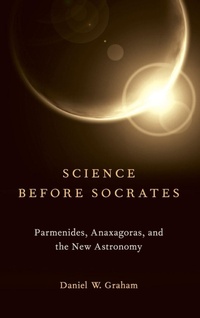
Science before Socrates
Parmenides, Anaxagoras, and the New Astronomy
Published on 1. August 2013
Book
Hardback
304 pages
978-0-19-995978-5 (ISBN)
Description
In Science before Socrates, Daniel Graham argues against the prevalent belief that the Presocratic philosophers did not produce any empirical science and that the first major Greek science, astronomy, did not develop until at least the time of Plato. Instead, Graham proposes that the advances made by Presocratic philosophers in the study of astronomy deserve to be considered as scientific contributions.
Whereas philosophers of the sixth century BC treated astronomical phenomena as ephemeral events continuous with weather processes, those of the fifth century treated heavenly bodies as independent stony masses whirled in a cosmic vortex. Two historic events help to date and account for the change: a solar eclipse in 478 BC and a meteoroid that fell to earth around 466. Both events influenced Anaxagoras, who transformed insights from Parmenides into explanations of lunar and solar eclipses, meteors, and rainbows.
Virtually all philosophers came to accept Anaxagoras' theory of lunar light and eclipses. Aristotle endorsed Anaxagoras' theory of eclipses as a paradigm of scientific explanation. Anaxagoras' theories launched a geometrical approach to astronomy and were accepted as foundational principles by all mathematical astronomers from Aristarchus to Ptolemy to Copernicus and Galileo-and to the present day.
Whereas philosophers of the sixth century BC treated astronomical phenomena as ephemeral events continuous with weather processes, those of the fifth century treated heavenly bodies as independent stony masses whirled in a cosmic vortex. Two historic events help to date and account for the change: a solar eclipse in 478 BC and a meteoroid that fell to earth around 466. Both events influenced Anaxagoras, who transformed insights from Parmenides into explanations of lunar and solar eclipses, meteors, and rainbows.
Virtually all philosophers came to accept Anaxagoras' theory of lunar light and eclipses. Aristotle endorsed Anaxagoras' theory of eclipses as a paradigm of scientific explanation. Anaxagoras' theories launched a geometrical approach to astronomy and were accepted as foundational principles by all mathematical astronomers from Aristarchus to Ptolemy to Copernicus and Galileo-and to the present day.
Reviews / Votes
Graham has written an intriguing book on a much neglected aspect of Presocratic thinking. * Journal of the History of Philosophy * Graham has produced a fascinating and enjoyable challenge to the standard narrative of scientific progress. The passion of his commitment to rehabilitating Parmenides and Anaxagoras as successful scientists is clear throughout. * Jenny Bryan, Notre Dame Philosophical Reviews *More details
Language
English
Place of publication
New York
United States
Target group
College/higher education
Illustrations
15 illus.
Dimensions
Height: 235 mm
Width: 157 mm
Thickness: 21 mm
Weight
591 gr
ISBN-13
978-0-19-995978-5 (9780199959785)
Copyright in bibliographic data and cover images is held by Nielsen Book Services Limited or by the publishers or by their respective licensors: all rights reserved.
Schweitzer Classification
Other editions
Additional editions
E-Book
06/2013
1st Edition
OUP eBook
€38.49
Available for download
Person
Daniel W. Graham is Professor of Philosophy at Brigham Young University. He has written, translated, or edited seven volumes on ancient philosophy and has published numerous scholarly articles on Aristotle, Plato, Socrates, and the Presocratic philosophers. He does research in history of philosophy and history of science. He is president of the International Association for Presoratic Studies and a member of the editorial board of Apeiron.
Content
CONTENTS ; Introduction: Cosmic Conjunctions ; 1 Looking for Science ; 1.1 Unfounded speculation ; 1.2 Footnotes to Thales ; 1.3 Footnotes to Pythagoras ; 1.4 Science without knowledge ; 1.5 History of science without history ; 1.6 History of science without science ; 1.7 Old-time history of science ; Notes ; 2 Azure Pastures: An Early Ionian Model ; 2.1 Hesiod's mythical cosmography ; 2.2 Ionian theories ; 2.3 The Meteorological Model ; Notes ; 3 Borrowed Light: The Insights of Parmenides ; 3.1 Fifth-century advances ; 3.2 Three insights: Heliophotism, planetary unification, sphericity ; 3.3 The power of a model ; 3.4 Conjectures ; 3.5 Conceptual advances ; Notes ; 4 Empire of the Sun: Implications of Heliophotism, and a New Model ; 4.1 Antiphraxis and other theoretical implications ; 4.2 A new physics ; 4.3 Anaxagoras' new cosmology and astronomy ; 4.4 The Lithic Model ; Notes ; 5 Darkened Suns and Falling Stars: Heaven-sent Proofs ; 5.1 Lives of the eminent philosophers ; 5.2 Eclipses ; 5.3 The meteor ; 5.4 The comet ; 5.5 The Nile floods ; Notes ; 6 Lunar Revolutions: The Triumph of the New Astronomy ; 6.1 A community effort ; 6.2 Anaxagoras' theory ; 6.3 Other theories of the fifth century ; 6.4 Characteristics of the Lithic Model ; 6.5 The doxography ; 6.6 Plato's heavenly sphere ; 6.7 Aristotle's paradigm ; 6.8 A scientific consensus ; Notes ; 7 The Geometry of the Heavens ; 7.1 The story of early Greek astronomy ; 7.2 Scientific Progress ; 7.3 Historical and Philosophical Significance ; Notes ; Appendix 1: Anaxagoras in the Historiography of Science ; Notes ; Appendix 2: Science and History ; Notes ; Bibliography