

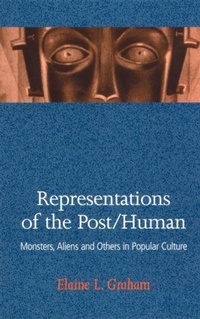
Representations of the Post/Human
Monsters, Aliens, and Others in Popular Culture
Published on 1. March 2002
Book
Paperback/Softback
272 pages
978-0-8135-3059-8 (ISBN)
Description
Microchips. Genetic modification of plants. Cloning. Advances in technology promise to shape our lives more profoundly than ever before. Exciting new discoveries in reproductive, genetic, and information technologies all serve to call into question the immutability of the boundaries between humans, animals, and machines. The category of the "posthuman" reflects the implications of such new technologies on contemporary culture, especially in their capacity to reconfigure the human body and to challenge our most fundamental understandings of human nature.
Elaine L. Graham explores these issues as they are expressed within popular culture and the creative arts. From the myth of Prometheus and the Gothic horror of Frankenstein's monster to contemporary postmodern science fiction, a gallery of fantastic creatures haunts Western myth, religion, and literature. They serve to connect contemporary debates with enduring concerns about the potential-and the limits-of human creativity.
This book breaks new ground in drawing together a wide range of literature on new technologies and their ethical implications. In her explorations of the monstrous and the cyborg, Graham covers the Jewish legend of the golem, the Human Genome Project, Star Trek: Next Generation, Star Trek: Voyager, Fritz Lang's Metropolis, Donna Haraway's cyborg writing, andmany other related topics. This book will interest students in cultural studies, literature, ethics, religion, information technology, and the life sciences.
Elaine L. Graham explores these issues as they are expressed within popular culture and the creative arts. From the myth of Prometheus and the Gothic horror of Frankenstein's monster to contemporary postmodern science fiction, a gallery of fantastic creatures haunts Western myth, religion, and literature. They serve to connect contemporary debates with enduring concerns about the potential-and the limits-of human creativity.
This book breaks new ground in drawing together a wide range of literature on new technologies and their ethical implications. In her explorations of the monstrous and the cyborg, Graham covers the Jewish legend of the golem, the Human Genome Project, Star Trek: Next Generation, Star Trek: Voyager, Fritz Lang's Metropolis, Donna Haraway's cyborg writing, andmany other related topics. This book will interest students in cultural studies, literature, ethics, religion, information technology, and the life sciences.
Reviews / Votes
What does it mean to be human in light of the digital, cybernetic, and biomedical innovations being developed and used today? In Representations of the Post/Human, Elaine Graham addresses this question with clarity and power, giving us a thorough, compelling analysis of these technologies, as well as political debates that surround them. - Sharon Welch (author of Sweet Dreams in America: Making Ethics and Spirituality Work)More details
Language
English
Place of publication
New Brunswick NJ
United States
Target group
College/higher education
Product notice
Paperback (trade)
Unsewn / adhesive bound
Illustrations
illustrations
Dimensions
Height: 237 mm
Width: 156 mm
Thickness: 22 mm
Weight
395 gr
ISBN-13
978-0-8135-3059-8 (9780813530598)
Copyright in bibliographic data and cover images is held by Nielsen Book Services Limited or by the publishers or by their respective licensors: all rights reserved.
Schweitzer Classification
Person
Elaine L. Graham is Samuel Ferguson Professor of Social and Pastoral Theology at the University of Manchester (U.K.). She is the author of several books, including Transforming Practice: Pastoral Theology in an Age of Uncertainty.
Content
Preface: On cathedrals, canals and computers
Introduction: Mapping the post/human
pt. I. Science/Fiction.
1. Representing the post/human.
2. The gates of difference
pt. II. Monstrosity, Genealogy and Representation.
3. What made Victor's creature monstrous?
4. Body of clay, body of glass.
5. In whose image? The politics of representation
pt. III. Post/Humanities.
6. Much ado about Data.
7. 'Nietzsche gets a modem': transhumanism and the technological sublime.
8. The end of the 'human'?
9. Cyborg writing.
10. Gods and monsters
Introduction: Mapping the post/human
pt. I. Science/Fiction.
1. Representing the post/human.
2. The gates of difference
pt. II. Monstrosity, Genealogy and Representation.
3. What made Victor's creature monstrous?
4. Body of clay, body of glass.
5. In whose image? The politics of representation
pt. III. Post/Humanities.
6. Much ado about Data.
7. 'Nietzsche gets a modem': transhumanism and the technological sublime.
8. The end of the 'human'?
9. Cyborg writing.
10. Gods and monsters