

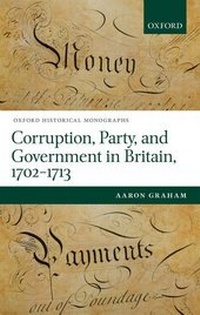
Corruption, Party, and Government in Britain, 1702-1713
Published on 28. May 2015
Book
Hardback
338 pages
978-0-19-873878-7 (ISBN)
Description
Corruption, Party, and Government in Britain, 1702-1713 offers an innovative and original reinterpretation of state formation in eighteenth-century Britain, reconceptualising it as a political and fundamentally partisan process. Focussing on the supply of funds to the army during the War of the Spanish Succession (1702-13), it demonstrates that public officials faced multiple incompatible demands, but that political partisanship helped to prioritise them, and to hammer out settlements that embodied a version of the national interest. These decisions were then transmitted to agents in overseas through a mixture of personal incentives and partisan loyalties which built trust and turned these informal networks into instruments of public policy.
However, the process of building trust and supplying funds laid officials and agents open to accusations of embezzlement, fraud and financial misappropriation. In particular, although successive financial officials ran entrepreneurial private financial ventures that enabled the army overseas to avoid dangerous financial shortfalls, they found it necessary to cover the costs and risks by receiving illegal 'gratifications' from the regiments. Reconstructing these transactions in detail, this book demonstrates that these corrupt payments advanced the public service, and thus that 'corruption' was as much a dispute over ends as means.
Ultimately, this volume demonstrates that state formation in eighteenth-century Britain was a contested process of interest aggregation, in which common partisan aims helped to negotiate compromises between various irreconcilable public priorities and private interests, within the frameworks provided by formal institutions, and then collaboratively imposed through overlapping and intersecting networks of formal and informal agents.
However, the process of building trust and supplying funds laid officials and agents open to accusations of embezzlement, fraud and financial misappropriation. In particular, although successive financial officials ran entrepreneurial private financial ventures that enabled the army overseas to avoid dangerous financial shortfalls, they found it necessary to cover the costs and risks by receiving illegal 'gratifications' from the regiments. Reconstructing these transactions in detail, this book demonstrates that these corrupt payments advanced the public service, and thus that 'corruption' was as much a dispute over ends as means.
Ultimately, this volume demonstrates that state formation in eighteenth-century Britain was a contested process of interest aggregation, in which common partisan aims helped to negotiate compromises between various irreconcilable public priorities and private interests, within the frameworks provided by formal institutions, and then collaboratively imposed through overlapping and intersecting networks of formal and informal agents.
Reviews / Votes
[Corruption, Party, and Government in Britain, 1702-1713] Sets out to challenge a set of assumptions and takes them apart with diligent recourse to sources that have either been long neglected, or misinterpreted, and for this Graham is thoroughly deserving of congratulation. It is a work that will be pored over by scholars interested in a variety of disciplines, but most of all those with an interest in the military and administrative history, and it will be required reading for anyone seeking to make further examinations into the mechanics of state0formation and the nature of corruption. * Robin Eagles, Parliamentary History * This book's rehabilitation of Brydges and its neo-Namierite analysis of the arrangements for financing eighteenth-century warfare is valuable insofar as it counters the continuing tendency among historians to apply anachronistic models of bureaucracy and corruption. * David Lemmings, American Historical Review *More details
Other editions
Additional editions
E-Book
05/2015
1st Edition
OUP eBook
€70.99
Available for download
Person
Aaron Graham received his doctorate from Oxford in 2012, and is currently a British Academy Postdoctoral Fellow and Junior Research Fellow in History at Jesus College, Oxford. He has also been Earhart Foundation Fellow in American History at the William L. Clements Library in Ann Arbor, Michigan, and an Andrew M. Mellon Fellow at the Henry E. Huntington Library in San Marino, California, and has published articles in English Historical Review and Historical Journal. His research examines the intersections of politics, finance, and government in Britain and its empire between 1660 and 1840.
Content
Preface ; Conventions ; Abbreviations ; 1. The British Fiscal-Military States, 1660-1830 ; 2. Public Finance and the Pay Office ; 3. The Pay Office under Charles Fox, 1702-1705 ; 4. The Pay Office in Northern Europe, 1705-1710 ; 5. The Pay Office in Southern Europe, 1705-1710 ; 6. James Brydges and the Pay Office, 1710-1714 ; 7. Conclusion: A Partisan-Political State, 1660-1830 ; Appendices ; Bibliography