

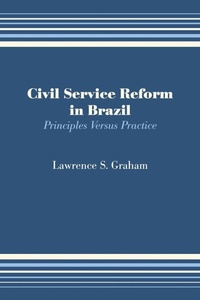
Civil Service Reform in Brazil
Principles Versus Practice
Published on 1. January 1968
Book
Paperback/Softback
248 pages
978-0-292-76896-3 (ISBN)
Description
In the 1930s, during the authoritarian government of GetUlio Vargas, the Brazilian civil service reform movement began. Thirty-five years later, the actual administrative practices of the country did not adequately reflect the philosophy underlying this movement, a philosophy drawn from the reform experience and public administration theories of the United States and Western Europe. This book examines why these ideas, when transplanted to another cultural setting, did not take root and, further, why they unexpectedly proved to be most applicable in Brazil during periods of autocratic rule.
These questions are highly relevant not only to Brazil, but equally to other developing countries struggling to create more effective national administrative systems. For this reason, and in order to evaluate the Brazilian reform experience within its total context (social, economic, and political), Lawrence S. Graham develops a broad conceptual framework. His focus is on the years between 1945 and 1964, a period which allowed a relatively free play of political forces but, ironically, produced a diminution in the success of the reform efforts when compared with the authoritarian governments which preceded and followed it. After a comparative consideration of the public administration theories behind the reform movement, Graham examines this period in terms of the political environment, the functions of political patronage, and the influences of a nascent national party. Finally, he juxtaposes the conditions and course of the Brazilian reform experience with those of the United States and Great Britain.
Graham's study of the Brazilian example, which does not pass judgment on the prevailing public personnel system, reveals the importance of understanding the total cultural context within which administrative principles are put into practice. Such an approach, wider than generally held in the field of public administration, may prove to be the most vital factor in the future of the civil service in Brazil and several other countries facing the same problems.
These questions are highly relevant not only to Brazil, but equally to other developing countries struggling to create more effective national administrative systems. For this reason, and in order to evaluate the Brazilian reform experience within its total context (social, economic, and political), Lawrence S. Graham develops a broad conceptual framework. His focus is on the years between 1945 and 1964, a period which allowed a relatively free play of political forces but, ironically, produced a diminution in the success of the reform efforts when compared with the authoritarian governments which preceded and followed it. After a comparative consideration of the public administration theories behind the reform movement, Graham examines this period in terms of the political environment, the functions of political patronage, and the influences of a nascent national party. Finally, he juxtaposes the conditions and course of the Brazilian reform experience with those of the United States and Great Britain.
Graham's study of the Brazilian example, which does not pass judgment on the prevailing public personnel system, reveals the importance of understanding the total cultural context within which administrative principles are put into practice. Such an approach, wider than generally held in the field of public administration, may prove to be the most vital factor in the future of the civil service in Brazil and several other countries facing the same problems.
More details
Series
Language
English
Place of publication
Austin, TX
United States
Target group
Professional and scholarly
Dimensions
Height: 229 mm
Width: 152 mm
Thickness: 15 mm
Weight
412 gr
ISBN-13
978-0-292-76896-3 (9780292768963)
Copyright in bibliographic data and cover images is held by Nielsen Book Services Limited or by the publishers or by their respective licensors: all rights reserved.
Schweitzer Classification
Person
Lawrence S. Graham is Professor Emeritus of Government at the University of Texas at Austin.
Content
Acknowledgments
List of Tables
Introduction
I. The Conceptual Framework
II. The Setting
III. The Theoretical Foundations of the Reform Movement
IV. Personnel Theory
V. Conflicting Perceptions of the Civil Service
VI. A Model for the Study of the Political System
VII. The Political Understructure (1945-1964)
VIII. The Civil Service and Political Patronage
IX. The Collapse of an Elite Civil Service
X. The Gap between Normas and Realities in Public Administration
XI. Politics and Administration
Appendix
Bibligraphy
Index
List of Tables
Introduction
I. The Conceptual Framework
II. The Setting
III. The Theoretical Foundations of the Reform Movement
IV. Personnel Theory
V. Conflicting Perceptions of the Civil Service
VI. A Model for the Study of the Political System
VII. The Political Understructure (1945-1964)
VIII. The Civil Service and Political Patronage
IX. The Collapse of an Elite Civil Service
X. The Gap between Normas and Realities in Public Administration
XI. Politics and Administration
Appendix
Bibligraphy
Index