

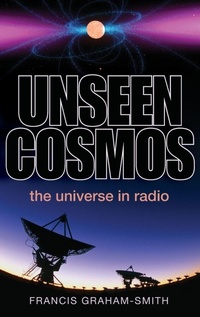
Unseen Cosmos
The Universe in Radio
Published on 7. November 2013
Book
Hardback
248 pages
978-0-19-966058-2 (ISBN)
Description
Radio telescopes have transformed our understanding of the Universe. Pulsars, quasars, Big Bang cosmology: all are discoveries of the new science of radio astronomy. Here, Francis Graham-Smith describes the birth, development, and maturity of radio astronomy, from the first discovery of cosmic radio waves to its present role as a major part of modern astronomy.
Radio is part of the electromagnetic spectrum, covering infra-red, visible light, ultraviolet, X-rays, and gamma-rays, and Graham-Smith explains why it is that radio waves give us a unique view of the Universe. Tracing the development of radio telescopes he shows how each new idea in observing techniques has led to new discoveries, and looks at the ways in which radio waves are generated in the various cosmic sources, relating this to the radio world of mobile phones, radio and television channels, wireless computer connections, and remote car locks.
Today a new generation of radio telescopes promises to extend our understanding of the Universe into further, as yet unknown, fields. Huge new radio telescopes are being built, such as the Atacama Large Millimetre Array (ALMA), Low Frequency Array for Radioastronomy (LOFAR), and the Square Kilometre Array (SKA). Radio telescopes on spacecraft such as the Cosmic Microwave Explorer (COBE) and Planck are tracing in minute detail the faint but universal radio signal from the expanding early Universe.
Graham-Smith shares the excitement of discovering the wonders of the radio universe, and the possibilities promised by the new age of giant radio telescopes.
Radio is part of the electromagnetic spectrum, covering infra-red, visible light, ultraviolet, X-rays, and gamma-rays, and Graham-Smith explains why it is that radio waves give us a unique view of the Universe. Tracing the development of radio telescopes he shows how each new idea in observing techniques has led to new discoveries, and looks at the ways in which radio waves are generated in the various cosmic sources, relating this to the radio world of mobile phones, radio and television channels, wireless computer connections, and remote car locks.
Today a new generation of radio telescopes promises to extend our understanding of the Universe into further, as yet unknown, fields. Huge new radio telescopes are being built, such as the Atacama Large Millimetre Array (ALMA), Low Frequency Array for Radioastronomy (LOFAR), and the Square Kilometre Array (SKA). Radio telescopes on spacecraft such as the Cosmic Microwave Explorer (COBE) and Planck are tracing in minute detail the faint but universal radio signal from the expanding early Universe.
Graham-Smith shares the excitement of discovering the wonders of the radio universe, and the possibilities promised by the new age of giant radio telescopes.
Reviews / Votes
This is a first rate book ... Highly recommended! * Astronomy Now * Interesting and informative. * Nature *More details
Language
English
Place of publication
Oxford
United Kingdom
Target group
College/higher education
Professional and scholarly
Popular science readers fascinated by astronomy and astrophysics
Illustrations
Several black and white images, and a short colour plate section
Dimensions
Height: 240 mm
Width: 161 mm
Thickness: 18 mm
Weight
552 gr
ISBN-13
978-0-19-966058-2 (9780199660582)
Copyright in bibliographic data and cover images is held by Nielsen Book Services Limited or by the publishers or by their respective licensors: all rights reserved.
Schweitzer Classification
Other editions
Additional editions
E-Book
11/2013
1st Edition
OUP eBook
€19.49
Available for download
E-Book
11/2013
1st Edition
OUP eBook
€19.49
Available for download
Person
Sir Francis Graham-Smith is the author of several books on radio astronomy. From 1988-90 he was the Pro-Vice Chancellor of the University of Manchester and Physical Secretary and Vice-President of the Royal Society from 1988-94.
Content
Preface ; 1. Radio noise from space ; 2. Hot sun and cold planets ; 3. Our galaxy the Milky Way ; 4. Cosmic Rays, the Synchrotron, and Molecules ; 5. Radio galaxies and quasars ; 6. Supernovae and Pulsars ; 7. Pulsar clocks and relativity ; 8. Radio expands into cosmology ; 9. Seeing the cosmic fireball ; 10. Radio telescopes and interfermometers ; 11. LOFAR, ALMA and SKA ; Endnotes