

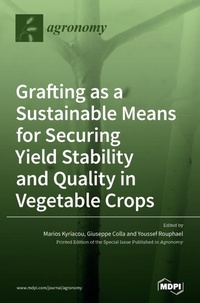
Grafting as a Sustainable Means for Securing Yield Stability and Quality in Vegetable Crops
MDPI AG (Publisher)
Published on 29. March 2021
Book
Hardback
246 pages
978-3-0365-0392-9 (ISBN)
Description
Vegetable growers around the world only collect, on average, half of the yield they would obtain under optimal conditions, known as yield potential. It is estimated that 60-70% of the yield gap is attributable to abiotic factors such as salinity, drought, suboptimal temperatures, nutritional deficiencies, flooding, waterlogging, heavy metals contamination, adverse soil pH and organic pollutants, while the remaining 30-40% is due to biotic factors, especially soilborne pathogens, foliar pathogens, arthropods and weeds. Under climate change forecasts, the pressure of biotic/abiotic stressors on yield is expected to rise and challenge further global food security. To meet global demand, several solutions have been proposed, focusing on the breeding of varieties with greater yield potential, but this one-size-fits-all solution leads to limited benefits. In order to overcome the current situation, grafting of elite scion varieties onto vigorous rootstock varieties has been suggested as one of the most promising drives towards further yield stability. Specifically, the implementation of suitable rootstock × scion × environment combinations in Solanaceous (tomato, eggplant, pepper) and Cucurbitaceous (melon, watermelon, melon) high-value crops represents an untapped opportunity to secure yield stability and reliability under biotic/abiotic stresses. This Special Issue invites Original Research, Technology Reports, Methods, Opinions, Perspectives, Invited Reviews and Mini Reviews dissecting grafting as a sustainable agro technology for enhancing tolerance to abiotic stresses and reducing disease damage. In addition, the following are of interest: potential contributions dealing with genetic resources for rootstock breeding, practices and technologies of rootstock breeding, and rootstock-scion signaling, as well as the physiological and molecular mechanisms underlying graft compatibility. In addition, the effect of grafting on vegetable quality, practical applications and nursery management of grafted seedlings and specialty crops (e.g. artichoke and bean) will be considered within the general scope of the Special Issue. We highly believe that this compilation of high standard scientific papers on the principles and practices of vegetable grafting will foster discussions within this important field.
More details
Language
English
Product notice
sewn/stitched
Cloth over boards
Dimensions
Height: 250 mm
Width: 175 mm
Thickness: 20 mm
Weight
815 gr
ISBN-13
978-3-0365-0392-9 (9783036503929)
Copyright in bibliographic data and cover images is held by Nielsen Book Services Limited or by the publishers or by their respective licensors: all rights reserved.
Schweitzer Classification