

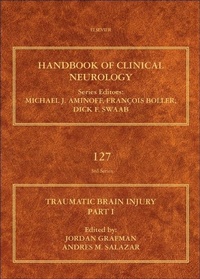
Traumatic Brain Injury, Part I: Volume 127
Volume 127
3rd Edition
Published on 12. February 2015
Book
Hardback
490 pages
978-0-444-52892-6 (ISBN)
Description
The Handbook of Clinical Neurology volume on traumatic brain injury (TBI) provides the reader with an updated review of emerging approaches to traumatic brain injury (TBI) research, clinical management and rehabilitation of the traumatic brain injury patient. Chapters in this volume range from epidemiology and pathological mechanisms of injury, and neuroprotection to long-term outcomes with a strong emphasis on current neurobiological approaches to describing the consequences and mechanisms of recovery from TBI. The book presents contemporary investigations on blast injury and chronic traumatic encephalopathy, making this state-of-the-art volume a must have for clinicians and researchers concerned with the clinical management, or investigation, of TBI.
More details
Series
Edition
3rd edition
Language
English
Place of publication
Oxford
United Kingdom
Publishing group
Elsevier Science & Technology
Target group
Professional and scholarly
Neurologists and neuroscientists
Product notice
sewn/stitched
Cloth over boards
Dimensions
Height: 271 mm
Width: 197 mm
Thickness: 27 mm
Weight
1365 gr
ISBN-13
978-0-444-52892-6 (9780444528926)
Copyright in bibliographic data and cover images is held by Nielsen Book Services Limited or by the publishers or by their respective licensors: all rights reserved.
Schweitzer Classification
Other editions
Additional editions
Jordan H. Grafman | Andres M. Salazar
Traumatic Brain Injury
Handbook of Clinical Neurology (Series Editors: Aminoff, Boller and Swaab)
E-Book
02/2015
Elsevier
€180.00
Available for download
Persons
Dr. Grafman has been the director of Brain Injury Research at the Shirley Ryan AbilityLab ((SRALab)formally known as the Rehabilitation Institute of Chicago) since 2012 and is on faculty at Northwestern University's Feinberg School of Medicine in the Departments of Physical Medicine and Rehabilitation, Neurology, Psychiatry and Behavioral Sciences, and the Cognitive Neurology and Alzheimer's Disease Center as well as the Department of Psychology in the Weinberg College of Arts and Sciences. Before joining the SRALab, Dr. Grafman was briefly director of Traumatic Brain Injury Research at the Kessler Foundation in West Orange New Jersey. Prior to that appointment in 2011, Dr. Grafman was Chief of the Cognitive Neuroscience Section at the National Institute of Neurological Disorders and Stroke in Bethesda, Maryland for many years. His investigation of brain function and behavior contributes to advances in medicine, rehabilitation, and psychology, and informs ethics, law, philosophy, and health policy. His study of the human prefrontal cortex and cognitive neuroplasticity incorporates neuroimaging and genetics, an approach that is expanding our knowledge of the functions of the human frontal lobes, as well as the effects of neurological disorders that impair frontal lobe brain function. Andres M. Salazar, MD, is CEO, Scientific Director and cofounder of Oncovir, Inc., a pharmaceutical company developing the immunomodulator, Hiltonol (R) (Poly-ICLC). He is a retired US Army Colonel and formerly Professor of Neurology at USUHS. He was Director of the Vietnam Head Injury Study and Founder, Principal Investigator, and first Director of the Defense and Veterans Head Injury Program, an ongoing U.S. National Head Injury clinical management and research effort. His research background includes neurotraumatology, neurodegenerative diseases, multiple sclerosis (MS), AIDS, and Oncology. He has over 200 publications, several patents, and has conducted multiple clinical studies, including in head injury, AIDS, pilot and pivotal clinical trials of beta-interferon (Avonex) in multiple sclerosis, and clinical trials of Hiltonol (R) in various cancers, MS, and AIDS. Dr. Salazar is a graduate of Dartmouth College and Jefferson Medical College. He completed Neurology training at Walter Reed Army Medical Center, and a Neurovirology Fellowship at the CNSSL, National Institutes of Health, Bethesda, MD.
Editor
Director, Brain Injury Research, Head, Cognitive Neuroscience Laboratory, Shirley Ryan Ability Lab; Professor, Department of Physical Medicine & Rehabilitation, Feinberg School of Medicine, Northwestern University, Clarkston, IL, USA
Chairman, CEO, & Scientific Director, Oncovir, Inc., Washington, DC, USA
Content
Section 1 Risk and Predisposition
1. Epidemiology
2. Classification of traumatic brain injury: past, present and future
3. Genetic predictors of outcome following TBI
Section 2 Pathology and Mechanisms of Traumatic Brain Injury
4. The neuropathology of traumatic brain injury
5. Cellular and Molecular Mechanisms of Injury and Spontaneous Recovery
6. Injury biomechanics, neuropathology, and simplified physics of explosive blast and impact mild traumatic brain injury
7. Cellular biomechanics of central nervous system injury
8. Animal models of traumatic brain injury
Section 3 Special Considerations
9. Mild traumatic brain injury
10. Acute sports-related traumatic brain injury and repetitive concussion
11. Brain injury from explosive blast: description and clinical management
12. Surgical management of civilian gunshot wounds to the head
13. Acute Loss of Consciousness
14. Systemic manifestations of traumatic brain injury
15. Special Considerations in Infants and Children
Section 4 Current and Emerging Diagnostic Tools
16. Biomarkers
17. Current and future diagnostic tools for traumatic brain injury: CT, conventional MRI, and diffusion tensor imaging
18. Using fMRI and EEG to detect consciousness after severe brain injury
19. Resting Functional Imaging Tools: (MRS, SPECT, PET and PCT)
20. Advances in imaging explosive blast mild traumatic brain injury
21. Electrophysiological recordings in traumatic brain injury
Section 5 Management and Treatment
22. Neuroprotection for traumatic brain injury
23. The prehospital management of traumatic brain injury
24. Acute Management of Military-Related Injury (PHI & Blast)
25. Clinical Management of the Minimally Conscious State
26. Rehabilitation after traumatic brain injury
27. Long-Term Social Integration and Community Support
28. Recent developments in clinical trials for the treatment of traumatic brain injury
1. Epidemiology
2. Classification of traumatic brain injury: past, present and future
3. Genetic predictors of outcome following TBI
Section 2 Pathology and Mechanisms of Traumatic Brain Injury
4. The neuropathology of traumatic brain injury
5. Cellular and Molecular Mechanisms of Injury and Spontaneous Recovery
6. Injury biomechanics, neuropathology, and simplified physics of explosive blast and impact mild traumatic brain injury
7. Cellular biomechanics of central nervous system injury
8. Animal models of traumatic brain injury
Section 3 Special Considerations
9. Mild traumatic brain injury
10. Acute sports-related traumatic brain injury and repetitive concussion
11. Brain injury from explosive blast: description and clinical management
12. Surgical management of civilian gunshot wounds to the head
13. Acute Loss of Consciousness
14. Systemic manifestations of traumatic brain injury
15. Special Considerations in Infants and Children
Section 4 Current and Emerging Diagnostic Tools
16. Biomarkers
17. Current and future diagnostic tools for traumatic brain injury: CT, conventional MRI, and diffusion tensor imaging
18. Using fMRI and EEG to detect consciousness after severe brain injury
19. Resting Functional Imaging Tools: (MRS, SPECT, PET and PCT)
20. Advances in imaging explosive blast mild traumatic brain injury
21. Electrophysiological recordings in traumatic brain injury
Section 5 Management and Treatment
22. Neuroprotection for traumatic brain injury
23. The prehospital management of traumatic brain injury
24. Acute Management of Military-Related Injury (PHI & Blast)
25. Clinical Management of the Minimally Conscious State
26. Rehabilitation after traumatic brain injury
27. Long-Term Social Integration and Community Support
28. Recent developments in clinical trials for the treatment of traumatic brain injury