

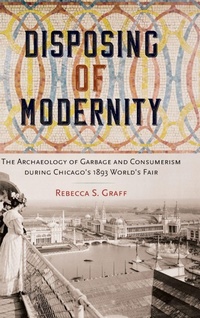
Disposing of Modernity
The Archaeology of Garbage and Consumerism During Chicago's 1893 World's Fair
Published on 31. August 2020
Book
Hardback
224 pages
978-0-8130-6649-3 (ISBN)
Description
Through archaeological and archival research from sites associated with the 1893 World's Columbian Exposition in Chicago, Disposing of Modernity explores the changing world of urban America at the turn of the twentieth century. Featuring excavations of trash deposited during the fair, Rebecca Graff's first-of-its-kind study reveals changing consumer patterns, notions of domesticity and progress, and anxieties about the modernization of society.
Graff examines artifacts, architecture, and written records from the 1893 fair's Ohio Building, which was used as a clubhouse for fairgoers in Jackson Park, and the Charnley-Persky House, an aesthetically modern city residence designed by Louis Sullivan and Frank Lloyd Wright. Many of the items she uncovers were products that first debuted at world's fairs, and materials such as mineral water bottles, cheese containers, dentures, and dinnerware illustrate how fairs created markets for new goods and influenced consumer practices.
Graff discusses how the fair's ephemeral nature gave it transformative power in Chicago society, and she connects its accompanying "conspicuous disposal" habits to today's waste disposal regimes. Reflecting on the planning of the Obama Presidential Center at the site of the Chicago World's Fair, she draws attention to the ways the historical trends documented here continue in the present. Published in cooperation with the Society for Historical Archaeology
Graff examines artifacts, architecture, and written records from the 1893 fair's Ohio Building, which was used as a clubhouse for fairgoers in Jackson Park, and the Charnley-Persky House, an aesthetically modern city residence designed by Louis Sullivan and Frank Lloyd Wright. Many of the items she uncovers were products that first debuted at world's fairs, and materials such as mineral water bottles, cheese containers, dentures, and dinnerware illustrate how fairs created markets for new goods and influenced consumer practices.
Graff discusses how the fair's ephemeral nature gave it transformative power in Chicago society, and she connects its accompanying "conspicuous disposal" habits to today's waste disposal regimes. Reflecting on the planning of the Obama Presidential Center at the site of the Chicago World's Fair, she draws attention to the ways the historical trends documented here continue in the present. Published in cooperation with the Society for Historical Archaeology
More details
Language
English
Place of publication
Florida
United States
Target group
Professional and scholarly
Product notice
Paper over boards
Illustrations
34 black & white illustrations, 7 tables
Dimensions
Height: 235 mm
Width: 157 mm
Thickness: 17 mm
Weight
479 gr
ISBN-13
978-0-8130-6649-3 (9780813066493)
Copyright in bibliographic data and cover images is held by Nielsen Book Services Limited or by the publishers or by their respective licensors: all rights reserved.
Schweitzer Classification
Other editions
Additional editions
Rebecca S. Graff
Disposing of Modernity
The Archaeology of Garbage and Consumerism during Chicago's 1893 World's Fair
E-Book
03/2026
1st Edition
University Press of Florida
€28.99
Available for download
Rebecca S. Graff
Disposing of Modernity
The Archaeology of Garbage and Consumerism during Chicago's 1893 World's Fair
E-Book
07/2020
1st Edition
University Press of Florida
€83.49
Available for download
Person
Rebecca S. Graff is associate professor of anthropology at Lake Forest College.