

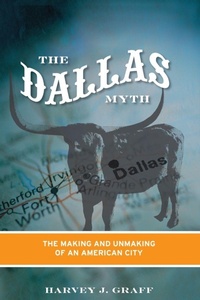
The Dallas Myth
The Making and Unmaking of an American City
Published on 9. September 2010
Book
Paperback/Softback
424 pages
978-0-8166-5270-9 (ISBN)
Description
The ninth largest city in the United States, Dallas is exceptional among American cities for the claims of its elites and boosters that it is a "city with no limits" and a "city with no history." Home to the Dallas Cowboys, self-styled as "America's Team," setting for the television series that glamorized its values of self-invention and success, and site of the assassination of John F. Kennedy, Dallas looms disproportionately large in the American imagination. Yet it lacks an identity of its own.
In The Dallas Myth, Harvey J. Graff presents a novel interpretation of a city that has proudly declared its freedom from the past. He scrutinizes the city's origin myth and its governance ideology, known as the "Dallas Way," looking at how these elements have shaped Dallas and served to limit democratic participation and exacerbate inequality. Advancing beyond a traditional historical perspective, Graff proposes an original, integrative understanding of the city's urban fabric and offers an explicit critique of the reactionary political foundations of modern Dallas: its tolerance for right-wing political violence, the endemic racism and xenophobia, and a planning model that privileges growth and monumental architecture at the expense of the environment and social justice.
Revealing the power of myths that have defined the city for so long, Graff presents a new interpretation of Dallas that both deepens our understanding of America's urban landscape and enables its residents to envision a more equitable, humane, and democratic future for all.
In The Dallas Myth, Harvey J. Graff presents a novel interpretation of a city that has proudly declared its freedom from the past. He scrutinizes the city's origin myth and its governance ideology, known as the "Dallas Way," looking at how these elements have shaped Dallas and served to limit democratic participation and exacerbate inequality. Advancing beyond a traditional historical perspective, Graff proposes an original, integrative understanding of the city's urban fabric and offers an explicit critique of the reactionary political foundations of modern Dallas: its tolerance for right-wing political violence, the endemic racism and xenophobia, and a planning model that privileges growth and monumental architecture at the expense of the environment and social justice.
Revealing the power of myths that have defined the city for so long, Graff presents a new interpretation of Dallas that both deepens our understanding of America's urban landscape and enables its residents to envision a more equitable, humane, and democratic future for all.
Reviews / Votes
"Harvey Graff begins by telling us that living in Dallas challenged all that he knew about cities. This richly-researched and beautifully-written book does the same for the rest of us. Its provocative historical analysis of space, growth, economics, politics, culture, and memory offers an uncommonly lucid account of inequality, segregation, and their denial." -Ira Katznelson, author of When Affirmative Action Was White "The Dallas Myth is an entertaining and meditative reflection on history and the imagination, written with the clear, grounded intelligence of a leading historian at the top of his game." -Michael Frisch, author of Portraits in Steel "The Dallas Myth is a terrific book-bold, persuasive, and important. ... It is interesting how Dallas emerges with a personality, almost like a character in a story." -Michael B. KatzMore details
Language
English
Place of publication
Minnesota
United States
Dimensions
Height: 229 mm
Width: 152 mm
Thickness: 25 mm
Weight
675 gr
ISBN-13
978-0-8166-5270-9 (9780816652709)
Copyright in bibliographic data and cover images is held by Nielsen Book Services Limited or by the publishers or by their respective licensors: all rights reserved.
Schweitzer Classification
Person
Harvey J. Graff is Ohio Eminent Scholar in Literacy Studies and professor of English and history at The Ohio State University. He is the author of numerous books on urban studies, literacy, and the history of children and adolescence, including The Legacies of Literacy: Continuities and Contradictions in Western Culture and Society, The Labyrinths of Literacy: Reflections on Literacy Past and Present, and Conflicting Paths: Growing Up in America.
Content
Contents
Preface: Finding Myself in Dallas
Acknowledgments
Introduction
PART I. SEARCHING FOR DALLAS
1. Locating the City: Three Icons and Images of "Big D"
2. Constructing a City with No Limits
3. Revising Dallas's Histories
PART II. UNDERSTANDING DALLAS
4. The Dallas Way
5. Tales of Two Cities, North and South, in White, Black, and Brown
6. Mimetic and Monumental Development: Memories Lost and Images Found
7. A City at the Crossroads: Dallas at the Tipping Point
Appendix A. Dallas's Historical Development
Appendix B. Chronology of Dallas History
Notes
Index
Preface: Finding Myself in Dallas
Acknowledgments
Introduction
PART I. SEARCHING FOR DALLAS
1. Locating the City: Three Icons and Images of "Big D"
2. Constructing a City with No Limits
3. Revising Dallas's Histories
PART II. UNDERSTANDING DALLAS
4. The Dallas Way
5. Tales of Two Cities, North and South, in White, Black, and Brown
6. Mimetic and Monumental Development: Memories Lost and Images Found
7. A City at the Crossroads: Dallas at the Tipping Point
Appendix A. Dallas's Historical Development
Appendix B. Chronology of Dallas History
Notes
Index