

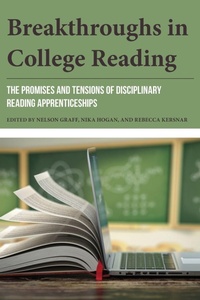
Breakthroughs in College Reading
The Promises and Tensions of Disciplinary Reading Apprenticeships
Published on 15. September 2024
Book
Hardback
244 pages
978-1-5381-9816-2 (ISBN)
Description
How do we help college students become independent learners in their disciplines? In this collection, the editors and contributors argue that we do so by supporting students in learning from texts, which entails recognizing reading as a problem-solving process, supporting students to take responsibility for the intellectual work in their classes, and creating strong classroom communities that help students develop identities as scholars.
Reviews / Votes
This collection makes available a rich and multi-dimensional pedagogy for the "messy" art and "risky business" of reading in the college setting. Faculty teaching online or in person, across first year courses and into the disciplines-particularly in the sciences and mathematics-will find the ideas and attitudes modeled here extremely valuable for addressing students from diverse backgrounds as active and intelligent learners. I urge college teachers to read and learn from the authors' wise stories. -- Eli Goldblatt, author of <i>Alone with Each Other: Literacy and Literature Intertwined</i> Be prepared to be challenged and inspired by these testimonies of teachers of history, chemistry, math, writing, ESL, librarianship, and more who have integrated Reading Apprenticeship into their practice. These candid accounts of change, growth, and hard-won rewards are simply fantastic-- as are the rich and wise principles that underlie this cogent method of teaching and learning. Read this book and spread the word! -- Professor Deborah Brandt, University of Wisconsin-Madison, USA, author of Literacy in American Lives This book offers compelling accounts of how the Reading Apprenticeship framework supports students' work with disciplinary texts. In arguing for three conceptual thresholds that faculty must cross to use reading effectively in their courses, this sweeping collection outlines a transformative teaching practice that has the potential to help students gain the discipline-specific literacy skills they need to succeed in college and beyond. It's a must read for faculty across the disciplines. -- Ellen Carillo, professor and Writing Program Coordinator, University of Connecticut This collection situates the Reading Apprenticeship program within the college classroom. Faculty from many disciplines will find this work engaging, practical, and thought provoking. -- Karen Manarin, professor, Mount Royal UniversityMore details
Language
English
Place of publication
United States
Publishing group
Bloomsbury Publishing Plc
Target group
Professional and scholarly
Illustrations
16 BW Illustrations, 1 BW Photo, 4 Tables
Dimensions
Height: 260 mm
Width: 183 mm
Thickness: 18 mm
Weight
661 gr
ISBN-13
978-1-5381-9816-2 (9781538198162)
Copyright in bibliographic data and cover images is held by Nielsen Book Services Limited or by the publishers or by their respective licensors: all rights reserved.
Schweitzer Classification
Other editions
Additional editions
Nelson Graff | Nika Hogan | Rebecca Kersnar
Breakthroughs in College Reading
The Promises and Tensions of Disciplinary Reading Apprenticeships
E-Book
09/2024
1st Edition
Rowman & Littlefield Publishers
€35.49
Available for download
Persons
Nelson Graff
A former high-school English teacher, Nelson taught English Education from 2000-2015 and is now retired from teaching first-year composition and working with faculty across the disciplines in improving reading and writing instruction. He is a member of the steering committee for the CSU Expository Reading and Writing Curriculum (ERWC) and the CSU English Council. His research focuses on teaching for transfer of learning, reading and writing pedagogy, and assessment. He has a BA in English from San Jose State University, an MA in English and American Literature and a PhD in Composition Studies from the University of Wisconsin-Madison.
Nika Hogan
Nika Hogan is a Professor of English at Pasadena City College (PCC). She helped to develop the First Year Pathways program at PCC, which was awarded the California Community Colleges Chancellor's Office Award for a Student Success Initiative. Since an intensive period of learning and apprenticeship from 2007-2010, she has coordinated the college level work on Reading Apprenticeship for WestEd. From 2011-2023, she supported the California Community Colleges Success network (3CSN) to design and facilitate professional learning for educators across the 116 California community colleges. Her passion is building capacity and helping educators and students alike reach their full potential. She holds an MA and PhD in English with a focus on U.S. multi-ethnic literatures. She lives in Altadena, California with her wife, teenage son, and two incorrigiable terrier mutts.
Rebecca Kersnar
Rebecca Kersnar supports faculty across disciplines as the teaching and learning specialist with the Center for Teaching, Learning, and Assessment (TLA) at CSU, Monterey Bay. Before joining TLA, she served for over 14 years as a science and environmental policy communications lecturer with the College of Science. Before then she taught elementary through graduate students in San Francisco, Korea, Hungary, Thailand, and Mexico. Rebecca has a BS in Biology, concentration Botany from San Francisco State University and an MA in TESOL and certificate in Language Program Administration from the Middlebury Institute of International Studies. She is also a campus Reading Apprenticeship lead, certified Koru Mindfulness teacher, and National Coalition Building Institute facilitator. At CSUMB her work focuses primarily on reading and writing pedagogy, mindfulness and meditation, and equity.
A former high-school English teacher, Nelson taught English Education from 2000-2015 and is now retired from teaching first-year composition and working with faculty across the disciplines in improving reading and writing instruction. He is a member of the steering committee for the CSU Expository Reading and Writing Curriculum (ERWC) and the CSU English Council. His research focuses on teaching for transfer of learning, reading and writing pedagogy, and assessment. He has a BA in English from San Jose State University, an MA in English and American Literature and a PhD in Composition Studies from the University of Wisconsin-Madison.
Nika Hogan
Nika Hogan is a Professor of English at Pasadena City College (PCC). She helped to develop the First Year Pathways program at PCC, which was awarded the California Community Colleges Chancellor's Office Award for a Student Success Initiative. Since an intensive period of learning and apprenticeship from 2007-2010, she has coordinated the college level work on Reading Apprenticeship for WestEd. From 2011-2023, she supported the California Community Colleges Success network (3CSN) to design and facilitate professional learning for educators across the 116 California community colleges. Her passion is building capacity and helping educators and students alike reach their full potential. She holds an MA and PhD in English with a focus on U.S. multi-ethnic literatures. She lives in Altadena, California with her wife, teenage son, and two incorrigiable terrier mutts.
Rebecca Kersnar
Rebecca Kersnar supports faculty across disciplines as the teaching and learning specialist with the Center for Teaching, Learning, and Assessment (TLA) at CSU, Monterey Bay. Before joining TLA, she served for over 14 years as a science and environmental policy communications lecturer with the College of Science. Before then she taught elementary through graduate students in San Francisco, Korea, Hungary, Thailand, and Mexico. Rebecca has a BS in Biology, concentration Botany from San Francisco State University and an MA in TESOL and certificate in Language Program Administration from the Middlebury Institute of International Studies. She is also a campus Reading Apprenticeship lead, certified Koru Mindfulness teacher, and National Coalition Building Institute facilitator. At CSUMB her work focuses primarily on reading and writing pedagogy, mindfulness and meditation, and equity.
Content
Preface
Acknowledgments
Introduction: Making Visible Disciplinary Learning: Faculty Crossing Thresholds to Support College Reading (Nelson Graff, Nika Hogan, and Rebecca Kersnar)
Part I: What is Reading Apprenticeship?
Chapter 1: Making It Real: Reading Apprenticeship in College (Nika Hogan)
Chapter 2: The College STEM Reading Apprenticeship Classroom (Theresa Martin)
Chapter 3: Exponential, Not Linear: Designing for the Four Dimensions in Noncredit ESL (Tiffany Ingle)
Chapter 4: Peer Educators as Reading Apprenticeship Practitioners (Crystal Kiekel)
Part II: Equity Matters: Tensions of Academic Apprenticeship
Chapter 5: Consciously Apprenticing Students (Lauren Servais)
Chapter 6: Culturally Responsive Teaching and Reading Apprenticeship: A Conversation (Yhashika Lee, Salina Lopez, Ibrahim Shelton)
Part III: Reading is a Problem-Solving Process
Chapter 7: Reading Historically Through Metacognitive Logs (Christopher Padgett)
Chapter 8: Not a White Rabbit-Reflection on Metacognitive Conversations and TAPPS (Corin Slown)
Chapter 9: Reading into Information Literacy (Ryne Leuzinger)
Chapter 10: Equitable and Metacognitive Approaches to Library Sessions (Anamika Megwalu)
Part IV: Students Must Be Entrusted with the Work of Making Sense of Texts
Chapter 11: Permission to Take Risk (Shelagh Rose)
Chapter 12: Reading in Calculus: Why, What, and How (Alison Lynch)
Chapter 13: Thinking Matters: Universal Design for Learning and Reading
Apprenticeship in Math (Kristen Purdum and Nika Hogan)
Chapter 14: The Role of the Productive Struggle in Authentic Learning: Why Student Learning Insights Matter as Much as Student Learning Outcomes (Shirley Kahlert)
Chapter 15: Introducing Perusall to Support Reading Apprenticeship in Upper-Division Mathematics Courses in an Online Modality (Peri Shereen and Jeffrey Wand)
Chapter 16: Snapshots of First-Year College Reading (Nanda Warren)
Part V: Reading is Social and Personal
Chapter 17: Feel-the-Text: A Metacognitive Reading Strategy where Readers Make Emotions Visible (Sue Lee)
Chapter 18: Using the Reading Apprenticeship Framework to Change College-Level Math Instruction (Christie Knighton)
Chapter 19: The Early Bird Special (Caren Kongshaug)
Chapter 20: Building Semester-Long Groups to Support the Social Dimension of Learning and Problem Solving in the Large Biology Classroom (Erin Stanfield)
Chapter 21: Restorative Pedagogy in Online Courses: Capitalizing on Relationships through Reading Apprenticeship Routines (Andrea Pantoja Garvey)
Chapter 22: Readers Wanna Read: Developing Self-Regulated Readers in the Online Classroom (Julie Gamberg)
Chapter 23: Social Annotation as a Transdisciplinary Strategy for Engaging Diverse Learners (Jonelle Strickland)
Chapter 24: The We and the Me: The Social and Personal Dimensions (Lora Bagwell)
Chapter 25: It's Time to Eighty-Six the Old Menu (Aimee Beckstrom Escalante)
Afterword
References
About the Authors
Acknowledgments
Introduction: Making Visible Disciplinary Learning: Faculty Crossing Thresholds to Support College Reading (Nelson Graff, Nika Hogan, and Rebecca Kersnar)
Part I: What is Reading Apprenticeship?
Chapter 1: Making It Real: Reading Apprenticeship in College (Nika Hogan)
Chapter 2: The College STEM Reading Apprenticeship Classroom (Theresa Martin)
Chapter 3: Exponential, Not Linear: Designing for the Four Dimensions in Noncredit ESL (Tiffany Ingle)
Chapter 4: Peer Educators as Reading Apprenticeship Practitioners (Crystal Kiekel)
Part II: Equity Matters: Tensions of Academic Apprenticeship
Chapter 5: Consciously Apprenticing Students (Lauren Servais)
Chapter 6: Culturally Responsive Teaching and Reading Apprenticeship: A Conversation (Yhashika Lee, Salina Lopez, Ibrahim Shelton)
Part III: Reading is a Problem-Solving Process
Chapter 7: Reading Historically Through Metacognitive Logs (Christopher Padgett)
Chapter 8: Not a White Rabbit-Reflection on Metacognitive Conversations and TAPPS (Corin Slown)
Chapter 9: Reading into Information Literacy (Ryne Leuzinger)
Chapter 10: Equitable and Metacognitive Approaches to Library Sessions (Anamika Megwalu)
Part IV: Students Must Be Entrusted with the Work of Making Sense of Texts
Chapter 11: Permission to Take Risk (Shelagh Rose)
Chapter 12: Reading in Calculus: Why, What, and How (Alison Lynch)
Chapter 13: Thinking Matters: Universal Design for Learning and Reading
Apprenticeship in Math (Kristen Purdum and Nika Hogan)
Chapter 14: The Role of the Productive Struggle in Authentic Learning: Why Student Learning Insights Matter as Much as Student Learning Outcomes (Shirley Kahlert)
Chapter 15: Introducing Perusall to Support Reading Apprenticeship in Upper-Division Mathematics Courses in an Online Modality (Peri Shereen and Jeffrey Wand)
Chapter 16: Snapshots of First-Year College Reading (Nanda Warren)
Part V: Reading is Social and Personal
Chapter 17: Feel-the-Text: A Metacognitive Reading Strategy where Readers Make Emotions Visible (Sue Lee)
Chapter 18: Using the Reading Apprenticeship Framework to Change College-Level Math Instruction (Christie Knighton)
Chapter 19: The Early Bird Special (Caren Kongshaug)
Chapter 20: Building Semester-Long Groups to Support the Social Dimension of Learning and Problem Solving in the Large Biology Classroom (Erin Stanfield)
Chapter 21: Restorative Pedagogy in Online Courses: Capitalizing on Relationships through Reading Apprenticeship Routines (Andrea Pantoja Garvey)
Chapter 22: Readers Wanna Read: Developing Self-Regulated Readers in the Online Classroom (Julie Gamberg)
Chapter 23: Social Annotation as a Transdisciplinary Strategy for Engaging Diverse Learners (Jonelle Strickland)
Chapter 24: The We and the Me: The Social and Personal Dimensions (Lora Bagwell)
Chapter 25: It's Time to Eighty-Six the Old Menu (Aimee Beckstrom Escalante)
Afterword
References
About the Authors