

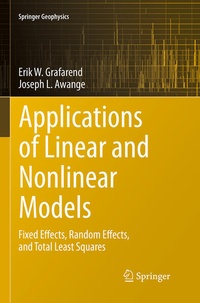
Applications of Linear and Nonlinear Models
Fixed Effects, Random Effects, and Total Least Squares
Published on 23. August 2016
Book
Paperback/Softback
XXI, 1016 pages
978-3-662-50813-8 (ISBN)
Description
Here we present a nearly complete treatment of the Grand Universe of linear and weakly nonlinear regression models within the first 8 chapters. Our point of view is both an algebraic view as well as a stochastic one. For example, there is an equivalent lemma between a best, linear uniformly unbiased estimation (BLUUE) in a Gauss-Markov model and a least squares solution (LESS) in a system of linear equations. While BLUUE is a stochastic regression model, LESS is an algebraic solution. In the first six chapters we concentrate on underdetermined and overdeterimined linear systems as well as systems with a datum defect. We review estimators/algebraic solutions of type MINOLESS, BLIMBE, BLUMBE, BLUUE, BIQUE, BLE, BIQUE and Total Least Squares. The highlight is the simultaneous determination of the first moment and the second central moment of a probability distribution in an inhomogeneous multilinear estimation by the so called E-D correspondence as well as its Bayes design. In addition, we discuss continuous networks versus discrete networks, use of Grassmann-Pluecker coordinates, criterion matrices of type Taylor-Karman as well as FUZZY sets. Chapter seven is a speciality in the treatment of an overdetermined system of nonlinear equations on curved manifolds. The von Mises-Fisher distribution is characteristic for circular or (hyper) spherical data. Our last chapter eight is devoted to probabilistic regression, the special Gauss-Markov model with random effects leading to estimators of type BLIP and VIP including Bayesian estimation.A great part of the work is presented in four Appendices. Appendix A is a treatment, of tensor algebra, namely linear algebra, matrix algebra and multilinear algebra. Appendix B is devoted to sampling distributions and their use in terms of confidence intervals and confidence regions. Appendix C reviews the elementary notions of statistics, namely random events and stochastic processes. Appendix D introduces the basics of Groebner basis algebra, its careful definition, the Buchberger Algorithm, especially the C. F. Gauss combinatorial algorithm.
Reviews / Votes
From the book reviews:
"It is a great book, not only because of its huge volume, but also because of the overwhelming span of topics covered that mainly consider statistical modeling problems from a mathematical point of view. . The book can be especially useful for researchers, scientists, and engineers who apply various kinds of regression modeling to solve theoretical and practical problems." (Stan Lipovetsky, Technometrics, Vol. 55 (2), May, 2013)
More details
Series
Edition
Softcover reprint of the original 1st ed. 2012
Language
English
Place of publication
Berlin
Germany
Publishing group
Springer Berlin
Target group
Professional and scholarly
Illustrations
103 s/w Abbildungen, 8 farbige Abbildungen
XXI, 1016 p. 111 illus., 8 illus. in color.
Dimensions
Height: 235 mm
Width: 155 mm
Thickness: 52 mm
Weight
1728 gr
ISBN-13
978-3-662-50813-8 (9783662508138)
DOI
10.1007/978-3-642-22241-2
Schweitzer Classification
Other editions
Additional editions
Erik Grafarend | Joseph L. Awange
Applications of Linear and Nonlinear Models
Fixed Effects, Random Effects, and Total Least Squares
Book
08/2012
Springer
€299.59
Article exhausted; check for reprint
Content
The first problem of algebraic regression.- The first problem of algebraic regression: the bias problem Special Gauss-Markov model with datum defects, LUMBE.- The second problem of algebraic regression Inconsistent system of linear observational equations.- The second problem of probabilistic regression Special Gauss-Markov model without datum defect.- The third problem of algebraic regression.- The third problem of probabilistic regression Special Gauss-Markov model without datum defect.- Overdetermined system of nonlinear equations on curved manifolds inconsistent system of directional observational equations.- The fourth problem of probabilistic regression Special Gauss-Markov model with random effects.- Appendix A-D.- References.- Index.