

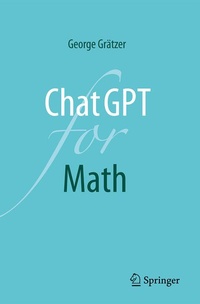
ChatGPT for Math
Description
Large Language Models (LLMs) are reshaping how people write, communicate, and conduct research. ChatGPT, one of the most widely used tools in OpenAI's GPT series, can serve as a practical assistant when used thoughtfully and responsibly. ChatGPT for Math is a concise, hands-on guide to applying ChatGPT in mathematical work. It shows how to clarify arguments, debug proofs, generate diagrams, support LaTeX workflows, and improve both research writing and teaching materials. The book emphasizes a disciplined approach: ChatGPT is treated as an assistant, not an oracle, and its limitations are addressed openly. Each chapter includes carefully designed exercises to help readers build skill, judgment, and confidence in using ChatGPT effectively.
More details
Person
George Grätzer is a distinguished Professor Emeritus at the University of Manitoba. He has authored three other books on LaTex: First Steps in LaTeX and Math into LateX, and Practical LaTeX. Math into LaTeX was chosen by the Mathematics Editor of Amazon.com as one of the ten best books of 2000. Grätzer has also written over 300 articles articles and more than 300 books on the subject of lattices and universal algebra. In addition, Grätzer is the founder of the international mathematical journal, Algebra Universalis .
Content
Preface.- Introduction.- I Foundations.- 1 What can ChatGPT actually do?.- How ChatGPT interacts with Math.- Verification: trust but verify.- II Core Mathematical Workflows.- 4 Mathematical computation and small case experimentation.- 5 Proofs with ChatGPT.- 6 Examples and small structures.- 7 Computations and experiments.- 8 Diagrams beyond lattices.- 9 Teaching with ChatGPT.- 10 Prompt patterns for math.- 11 Bibliographies.- 12 Index.- 13 Notation and terminological consistency.- 14 AI-assisted research.- 15 Explaining math.- 16 LaTeX, diagrams, and writing.- III Limits and outlook.- 17 Limits of ChatGPT for Mathematics.- 18 Reflections and future directions.- A. Prompt Patterns for Mathematics.