

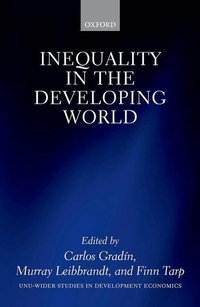
Inequality in the Developing World
Published on 11. March 2021
Book
Hardback
374 pages
978-0-19-886396-0 (ISBN)
Description
This is an open access title available under the terms of a CC BY-NC-SA 3.0 IGO licence. It is free to read at Oxford Scholarship Online and offered as a free PDF download from OUP and selected open access locations. Inequality has emerged as a key development challenge. It holds implications for economic growth and redistribution and translates into power asymmetries that can endanger human rights, create conflict, and embed social exclusion and chronic poverty. For these reasons, it underpins intense public and academic debates and has become a dominant policy concern within many countries and in all multilateral agencies. It is at the core of the 17 goals of the UN 2030 Agenda for Sustainable Development. This book contributes to this important discussion by presenting assessments of the measurement and analysis of global inequality by leading inequality scholars, aligning these to comprehensive reviews of inequality trends in five of the world's largest developing countries--Brazil, China, India, Mexico, and South Africa.
Each is a persistently high or newly high inequality context and, with the changing global inequality situation as context, country chapters investigate the main factors shaping their different inequality dynamics. Particular attention is paid to how broader societal inequalities arising outside of the labour market have intersected with the rapidly changing labour market milieus of the last few decades. Collectively, these chapters provide a nuanced discussion of key distributive phenomena such as the high concentration of income among the most affluent people, gender inequalities, and social mobility. Substantive tax and social benefit policies that each country implemented to mitigate these inequality dynamics are assessed in detail. The book takes lessons from these contexts back into the global analysis of inequality and social mobility and the policies needed to address inequality.
Each is a persistently high or newly high inequality context and, with the changing global inequality situation as context, country chapters investigate the main factors shaping their different inequality dynamics. Particular attention is paid to how broader societal inequalities arising outside of the labour market have intersected with the rapidly changing labour market milieus of the last few decades. Collectively, these chapters provide a nuanced discussion of key distributive phenomena such as the high concentration of income among the most affluent people, gender inequalities, and social mobility. Substantive tax and social benefit policies that each country implemented to mitigate these inequality dynamics are assessed in detail. The book takes lessons from these contexts back into the global analysis of inequality and social mobility and the policies needed to address inequality.
Reviews / Votes
By bringing together this superb group of authors and deploying their considerable talents to key questions about how and why inequality is changing in some of the world's largest countries - as well as globally - the editors of this volume have done us a tremendous service. In my endorsement of the book, I called it a "must-read" volume and I stand by that assessment. I particularly enjoyed the combination of the three "big-picture" chapters at the outset with the five detailed country studies that follow. * Francisco H. G. Ferreira, Journal of Economic Inequality *More details
Series
Edition
1
Language
English
Place of publication
Oxford
United Kingdom
Target group
Professional and scholarly
Product notice
sewn/stitched
Cloth over boards
Illustrations
55 Figures, 42 Tables
Dimensions
Height: 239 mm
Width: 157 mm
Thickness: 28 mm
Weight
771 gr
ISBN-13
978-0-19-886396-0 (9780198863960)
Copyright in bibliographic data and cover images is held by Nielsen Book Services Limited or by the publishers or by their respective licensors: all rights reserved.
Schweitzer Classification
Other editions
Additional editions
Carlos Gradín | Murray Leibbrandt | Finn Tarp
Inequality in the Developing World
E-Book
03/2021
1st Edition
OUP eBook
€117.99
Available for download
Carlos Gradín | Murray Leibbrandt | Finn Tarp
Inequality in the Developing World
E-Book
03/2021
1st Edition
OUP eBook
€0.00
Available for download
Persons
Carlos Gradin is a Research Fellow at the United Nations University World Institute for Development Economics Research (UNU-WIDER) in Helsinki, and Professor of Applied Economics at the University of Vigo. His main research interest is the study of poverty, inequality, and discrimination in both developed and developing countries, especially inequalities between population groups. His research deals with enhancing the empirical evidence as well as methodological tools for the measurement and understanding of those issues. His research has been widely published in several international journals.
Murray Leibbrandt holds the National Research Foundation Chair in Poverty and Inequality Research in the School of Economics at the University of Cape Town. He is the Director of the Southern Africa Labour and Development Research Unit and the African Centre of Excellence for Inequality Research within the African Research Universities Alliance. He is on the Executive Committee of the International Economic Association and is a Senior Research Fellow of UNU-WIDER. From 2007 to 2019 he was a Principal Investigator on the National Income Dynamics Study, South Africa's national longitudinal study. He has published widely in development economics using survey data and especially panel data to analyse South African poverty, inequality, and labour market dynamics.
Finn Tarp is a Professor at the University of Copenhagen (UCPH) and Coordinator of the UCPH Development Economics Research Group (DERG). Director of UNU-WIDER from 2009 to 2018, and now a Non-Resident Senior Fellow of UNU-WIDER, Professor Tarp is a leading international expert on development strategy and foreign aid, with an interest in poverty, income distribution, and growth, micro- and macroeconomic policy and modelling, agricultural sector policy and planning, household/enterprise development, and economic adjustment and reform as well as climate change, sustainability, and natural resources. He has published widely in leading economics and development journals and books by international academic publishers.
Murray Leibbrandt holds the National Research Foundation Chair in Poverty and Inequality Research in the School of Economics at the University of Cape Town. He is the Director of the Southern Africa Labour and Development Research Unit and the African Centre of Excellence for Inequality Research within the African Research Universities Alliance. He is on the Executive Committee of the International Economic Association and is a Senior Research Fellow of UNU-WIDER. From 2007 to 2019 he was a Principal Investigator on the National Income Dynamics Study, South Africa's national longitudinal study. He has published widely in development economics using survey data and especially panel data to analyse South African poverty, inequality, and labour market dynamics.
Finn Tarp is a Professor at the University of Copenhagen (UCPH) and Coordinator of the UCPH Development Economics Research Group (DERG). Director of UNU-WIDER from 2009 to 2018, and now a Non-Resident Senior Fellow of UNU-WIDER, Professor Tarp is a leading international expert on development strategy and foreign aid, with an interest in poverty, income distribution, and growth, micro- and macroeconomic policy and modelling, agricultural sector policy and planning, household/enterprise development, and economic adjustment and reform as well as climate change, sustainability, and natural resources. He has published widely in leading economics and development journals and books by international academic publishers.
Editor
Research Fellow, UNU-WIDER
SARChI Research Chair in Poverty and Inequality Research, SALDRU, University of Cape Town; and Director of the African Centre for Inequality Research; and Non-Resident Senior Research Fellow, UNU-WIDER
Professor of Development Economics, University of Copenhagen; and Non-Resident Senior Research Fellow, UNU-WIDER
Content
PART I: INTRODUCTION
1: Carlos Gradin, Murray Leibbrandt, and Finn Tarp: Setting the scene
PART II: GLOBAL INEQUALITY AND INEQUALITY WITHIN COUNTRIES
2: Martin Ravallion: What might explain today's conflicting narratives on global inequality?
3: James Davies and Anthony Shorrocks: Comparing global inequality of income and wealth
4: Daniele Checchi, Andrej Cupak, and Teresa Munzi: Empirical challenges comparing inequality across countries: the case of middle-income countries from the LIS Database
PART III: INEQUALITY IN FIVE DEVELOPING GIANTS
5: Marcelo Neri: Brazil: what are the main drivers of income distribution changes in the new millennium?
6: Shi Li, Terry Sicular, and Finn Tarp: China: structural change, transition, rent seeking and corruption, and government policy
7: Hai-Anh H. Dang and Peter Lanjouw: India: inequality trends and dynamic: From manufacturing-led export growth to a twenty-first century inclusive growth strategy: explaining the demise of a successful growth model and what to do about it s, the bird's-eye and the granular perspectives
8: Raymundo Campos-Vazquez, Nora Lustig, and John Scott: Mexico: labour markets and fiscal redistribution 1989-2014
9: Murray Leibbrandt, Vimal Ranchhod, and Pippa Green: South Africa: the top-end, labour markets, fiscal redistribution and the persistence of very high inequality
PART IV: INEQUALITY IN A BROADER CONTEXT
10: Andrew Clark and Conchita D'Ambrosio: Economic inequality and subjective wellbeing across the world
11: Roy van der Weide and Ambar Narayan: China versus the United States: different economic models but similarly low levels of socioeconomic mobility
12: Joseph E. Stiglitz: From manufacturing-led export growth to a twenty-first century inclusive growth strategy: explaining the demise of a successful growth model and what to do about it
PART V: SYNTHESIS AND POLICY IMPLICATIONS
13: Carlos Gradin, Murray Leibbrandt, and Finn Tarp: Synthesis and policy implications
1: Carlos Gradin, Murray Leibbrandt, and Finn Tarp: Setting the scene
PART II: GLOBAL INEQUALITY AND INEQUALITY WITHIN COUNTRIES
2: Martin Ravallion: What might explain today's conflicting narratives on global inequality?
3: James Davies and Anthony Shorrocks: Comparing global inequality of income and wealth
4: Daniele Checchi, Andrej Cupak, and Teresa Munzi: Empirical challenges comparing inequality across countries: the case of middle-income countries from the LIS Database
PART III: INEQUALITY IN FIVE DEVELOPING GIANTS
5: Marcelo Neri: Brazil: what are the main drivers of income distribution changes in the new millennium?
6: Shi Li, Terry Sicular, and Finn Tarp: China: structural change, transition, rent seeking and corruption, and government policy
7: Hai-Anh H. Dang and Peter Lanjouw: India: inequality trends and dynamic: From manufacturing-led export growth to a twenty-first century inclusive growth strategy: explaining the demise of a successful growth model and what to do about it s, the bird's-eye and the granular perspectives
8: Raymundo Campos-Vazquez, Nora Lustig, and John Scott: Mexico: labour markets and fiscal redistribution 1989-2014
9: Murray Leibbrandt, Vimal Ranchhod, and Pippa Green: South Africa: the top-end, labour markets, fiscal redistribution and the persistence of very high inequality
PART IV: INEQUALITY IN A BROADER CONTEXT
10: Andrew Clark and Conchita D'Ambrosio: Economic inequality and subjective wellbeing across the world
11: Roy van der Weide and Ambar Narayan: China versus the United States: different economic models but similarly low levels of socioeconomic mobility
12: Joseph E. Stiglitz: From manufacturing-led export growth to a twenty-first century inclusive growth strategy: explaining the demise of a successful growth model and what to do about it
PART V: SYNTHESIS AND POLICY IMPLICATIONS
13: Carlos Gradin, Murray Leibbrandt, and Finn Tarp: Synthesis and policy implications