

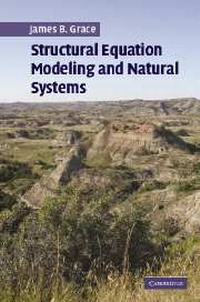
Structural Equation Modeling and Natural Systems
Published on 17. August 2006
Book
Hardback
378 pages
978-0-521-83742-2 (ISBN)
Description
This book, first published in 2006, presents an introduction to the methodology of structural equation modeling, illustrates its use, and goes on to argue that it has revolutionary implications for the study of natural systems. A major theme of this book is that we have, up to this point, attempted to study systems primarily using methods (such as the univariate model) that were designed only for considering individual processes. Understanding systems requires the capacity to examine simultaneous influences and responses. Structural equation modeling (SEM) has such capabilities. It also possesses many other traits that add strength to its utility as a means of making scientific progress. In light of the capabilities of SEM, it can be argued that much of ecological theory is currently locked in an immature state that impairs its relevance. It is further argued that the principles of SEM are capable of leading to the development and evaluation of multivariate theories of the sort vitally needed for the conservation of natural systems.
Reviews / Votes
'... excellent ...' Fish and Fisheries '... well suited to its intended readership.' BiometricsMore details
Language
English
Place of publication
Cambridge
United Kingdom
Target group
College/higher education
Professional and scholarly
Illustrations
40 Tables, unspecified; 1 Halftones, unspecified; 130 Line drawings, unspecified
Dimensions
Height: 235 mm
Width: 157 mm
Thickness: 24 mm
Weight
737 gr
ISBN-13
978-0-521-83742-2 (9780521837422)
Copyright in bibliographic data and cover images is held by Nielsen Book Services Limited or by the publishers or by their respective licensors: all rights reserved.
Schweitzer Classification
Other editions
New editions
James B. Grace
Structural Equation Modeling and Natural Systems
Book
08/2006
Cambridge University Press
€87.50
Shipment within 15-20 days
Additional editions
James B. Grace
Structural Equation Modeling and Natural Systems
E-Book
09/2006
1st Edition
Cambridge University Press
€58.99
Available for download
James B. Grace
Structural Equation Modeling and Natural Systems
Book
08/2006
Cambridge University Press
€87.50
Shipment within 15-20 days
Person
James B. 'Jim' Grace obtained his Bachelor of Science degree from Presbyterian College, his Master's of Science degree from Clemson University, and his Ph.D. from Michigan State University. He served on the faculty at the University of Arkansas and later at Louisiana State University, where he reached the rank of Professor. He has, for the past several years, worked at the US Geological Survey's National Wetlands Research Center in Lafayette, Louisiana, USA where he is a Senior Research Ecologist. He holds an Adjunct Professorship at the University of Louisiana in the Biology Department.
Content
Part I. A Beginning: 1. Introduction; 2. Illustration of structural equation modeling with observed variables: the temporal dynamics of a plant-insect interaction; Part II. Basic Principles of Structural Equation Modeling: 3. The anatomy of structural equation models I: overview and observed variable models; 4. The anatomy of structural equation models II: latent variables; 5. Principles of estimation and model assessment; Part III. Advanced Topics: 6. Composite variables and their use in representing concepts; 7. Additional techniques for complex situations; Part IV. Applications and Illustrations: 8. Model evaluation in practice; 9. Multivariate experiments; 10. The systematic application of a multivariate perspective to understanding plant diversity patterns in ecological communities; 11. Cautions and recommendations for the application of SEM; Part V. The Implications of Structural Equation Modeling for the Study of Natural Systems: 12. How can structural equation modeling contribute to the advancement of the natural sciences?; 13. Tuning in to nature's symphony: frontiers in the study of multivariate relations; Appendix I. Example analyses; References.