

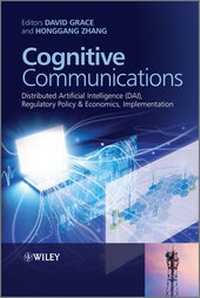
Cognitive Communications
Distributed Artificial Intelligence (DAI), Regulatory Policy and Economics, Implementation
Will be published approx. on 31. August 2012
Book
Hardback
500 pages
978-1-119-95150-6 (ISBN)
Description
This book discusses in-depth the concept of distributed artificial intelligence (DAI) and its application to cognitive communications
In this book, the authors present an overview of cognitive communications, encompassing both cognitive radio and cognitive networks, and also other application areas such as cognitive acoustics. The book also explains the specific rationale for the integration of different forms of distributed artificial intelligence into cognitive communications, something which is often neglected in many forms of technical contributions available today. Furthermore, the chapters are divided into four disciplines: wireless communications, distributed artificial intelligence, regulatory policy and economics and implementation. The book contains contributions from leading experts (academia and industry) in the field.
Key Features:
* Covers the broader field of cognitive communications as a whole, addressing application to communication systems in general (e.g. cognitive acoustics and Distributed Artificial Intelligence (DAI)
* Illustrates how different DAI based techniques can be used to self-organise the radio spectrum
* Explores the regulatory, policy and economic issues of cognitive communications in the context of secondary spectrum access
* Discusses application and implementation of cognitive communications techniques in different application areas (e.g. Cognitive Femtocell Networks (CFN)
* Written by experts in the field from both academia and industry
Cognitive Communications will be an invaluable guide for research community (PhD students, researchers) in the areas of wireless communications, and development engineers involved in the design and development of mobile, portable and fixed wireless systems., wireless network design engineer. Undergraduate and postgraduate students on elective courses in electronic engineering or computer science, and the research and engineering community will also find this book of interest.
More details
Product info
gebunden
Edition
1. Auflage
Language
English
Place of publication
New York
United States
Target group
Professional and scholarly
Product notice
sewn/stitched
Cloth over boards
Dimensions
Height: 249 mm
Width: 175 mm
Thickness: 28 mm
Weight
816 gr
ISBN-13
978-1-119-95150-6 (9781119951506)
Schweitzer Classification
Other editions
Additional editions
David Grace | Honggang Zhang
Cognitive Communications
Distributed Artificial Intelligence (DAI), Regulatory Policy and Economics, Implementation
E-Book
07/2012
Wiley
€131.99
Available for download
David Grace | Honggang Zhang
Cognitive Communications
Distributed Artificial Intelligence (DAI), Regulatory Policy and Economics, Implementation
E-Book
07/2012
Wiley
€131.99
Available for download
Persons
Dr. David Grace, University of York, UK
David Grace is Head of Communications Research Group and Co-Director of York-Zhejiang Lab for Cognitive Radio and Green Communications. He received his MEng and DPhil degrees from York in 1993 and 1999 respectively. David's current research interests include cognitive radio and green communications, specifically spectrum assignment aspects, and cognitive networking.
Dr. Honggang Zhang, Zhejiang University, China
Honggang Zhang is a Full Professor at the Department of Information Science and Electronic Engineering, Zhejiang University, China. He received the Ph.D. degree in Electrical Engineering from Kagoshima University, Japan, in March 1999. Prior to that, he received the Bachelor of Engineering and Master of Engineering degrees, both in Electrical Engineering, from Huazhong University of Science & Technology (HUST), China, in 1989, and Lanzhou University of Technology, China, in 1992, respectively.
David Grace is Head of Communications Research Group and Co-Director of York-Zhejiang Lab for Cognitive Radio and Green Communications. He received his MEng and DPhil degrees from York in 1993 and 1999 respectively. David's current research interests include cognitive radio and green communications, specifically spectrum assignment aspects, and cognitive networking.
Dr. Honggang Zhang, Zhejiang University, China
Honggang Zhang is a Full Professor at the Department of Information Science and Electronic Engineering, Zhejiang University, China. He received the Ph.D. degree in Electrical Engineering from Kagoshima University, Japan, in March 1999. Prior to that, he received the Bachelor of Engineering and Master of Engineering degrees, both in Electrical Engineering, from Huazhong University of Science & Technology (HUST), China, in 1989, and Lanzhou University of Technology, China, in 1992, respectively.
Content
List of Figures xiii
List of Tables xxv
About the Editors xxvii
Preface xxix
PART I INTRODUCTION
1 Introduction to Cognitive Communications 3
David Grace
1.1 Introduction 3
1.2 A NewWay of Thinking 4
1.3 History of Cognitive Communications 6
1.4 Key Components of Cognitive Communications 8
1.5 Overview of the Rest of the Book 9
1.6 Summary and Conclusion 14
References 14
PART II WIRELESS COMMUNICATIONS
2 Cognitive Radio and Networks for Heterogeneous Networking 19
Haesik Kim and Aarne MEURammelEURa
2.1 Introduction 19
2.2 Cognitive Radio for Heterogeneous Networks 26
2.3 Applying Cognitive Networks to Heterogeneous Networks 37
2.4 Performance Evaluation 47
2.5 Conclusion 50
References 50
3 Channel Assignment and Power Allocation Algorithms in Multi-Carrier-Based Cognitive Radio Environments 53
Musbah Shaat and Faouzi Bader
3.1 Introduction 53
3.2 The Orthogonal Frequency-Division Multiplexing (OFDM) Transmission Scheme 54
3.3 Resource Management in Non-Cognitive OFDM Environments 56
3.4 Resource Management in OFDM-Based Cognitive Radio Systems 58
3.5 Conclusions 88
References 89
4 Filter Bank Techniques for Multi-Carrier Cognitive Radio Systems 93
Yun Cui, Zhifeng Zhao, Rongpeng Li, Guangchao Zhang and Honggang Zhang
4.1 Introduction 93
4.2 Basic Features of Filter Banks-Based Multi-Carrier Techniques 94
4.3 Adaptive Threshold Enhanced Filter Bank for Spectrum Detection in IEEE 802.22 98
4.4 Transform Decomposition for Spectrum Interleaving in Multi-Carrier Cognitive Radio Systems 108
4.5 Remaining Problems in Filter Banks-Based Multi-Carrier Systems 115
4.6 Summary and Conclusion 117
References 117
5 Distributed Clustering of Cognitive Radio Networks: A Message-Passing Approach 119
Kareem E. Baddour, Oktay Ureten and Tricia J. Willink
5.1 Introduction 119
5.2 Clustering Techniques for Cognitive Radio Networks 122
5.3 A Message-Passing Clustering Approach Based on Affinity Propagation 124
5.4 Case Studies 126
5.5 Implementation Challenges 138
5.6 Conclusions 140
References 140
PART III APPLICATION OF DISTRIBUTED ARTIFICIAL INTELLIGENCE
6 Machine Learning Applied to Cognitive Communications 145
Aimilia Bantouna, Kostas Tsagkaris, Vera Stavroulaki, Panagiotis Demestichas and Giorgos Poulios
6.1 Introduction 145
6.2 State of the Art 146
6.3 Learning Techniques 148
6.4 Advantages and Disadvantages of Applying Machine Learning to Cognitive Radio Networks 158
6.5 Conclusions 159
Acknowledgement 160
References 160
7 Reinforcement Learning for Distributed Power Control and Channel Access in Cognitive Wireless Mesh Networks 163
Xianfu Chen, Zhifeng Zhao and Honggang Zhang
7.1 Introduction 163
7.2 Applying Reinforcement Learning to Distributed Power Control and Channel Access 165
7.3 Future Challenges 191
7.4 Conclusions 192
References 192
8 Reinforcement Learning-Based Cognitive Radio for Open Spectrum Access 195
Tao Jiang and David Grace
8.1 Open Spectrum Access 195
8.2 Reinforcement Learning-Based Spectrum Sharing in Open Spectrum Bands 196
8.3 Exploration Control and Efficient Exploration for Reinforcement Learning-Based Cognitive Radio 208
8.4 Conclusion 229
References 230
9 Learning Techniques for Context Diagnosis and Prediction in Cognitive Communications 231
Aimilia Bantouna, Kostas Tsagkaris, Vera Stavroulaki, Giorgos Poulios and Panagiotis Demestichas
9.1 Introduction 231
9.2 Prediction 232
9.3 Future Problems 253
9.4 Conclusions 254
References 255
10 Social Behaviour in Cognitive Radio 257
Husheng Li
10.1 Introduction 257
10.2 Social Behaviour in Cognitive Radio 258
10.3 Social Network Analysis 267
10.4 Conclusions 281
References 281
PART IV REGULATORY POLICY AND ECONOMICS
11 Regulatory Policy and Economics of Cognitive Radio for Secondary Spectrum Access 285
Maziar Nekovee and Peter Anker
11.1 Introduction 285
11.2 Spectrum Regulations: Why and How? 286
11.3 Overview of Regulatory Bodies and Their Inter-Relation 287
11.4 Why Secondary Spectrum Access? 291
11.5 Candidate Bands for Secondary Access 293
11.6 Regulatory and Policy Issues 296
11.7 Technology Enablers and Options for Secondary Sharing 304
11.8 Economic Impact and Business Opportunities of SSA 308
11.9 Outlook 313
11.10 Conclusions 314
Acknowledgements 315
References 315
PART V IMPLEMENTATION
12 Cognitive Radio Networks in TV White Spaces 321
Maziar Nekovee and Dave Wisely
12.1 Introduction 321
12.2 Research and Development Challenges 324
12.3 Regulation and Standardization 335
12.4 Quantifying Spectrum Opportunities 343
12.5 Commercial Use Cases 346
12.6 Conclusions 354
Acknowledgement 355
References 355
13 Cognitive Femtocell Networks 359
Faisal Tariq and Laurence S. Dooley
13.1 Introduction 359
13.2 Femtocell Network Architecture 361
13.3 Interference Management Strategies 372
13.4 Self Organized Femtocell Networks (SOFN) 381
13.5 Future Research Directions 388
13.6 Conclusion 391
References 391
14 Cognitive Acoustics: A Way to Extend the Lifetime of Underwater Acoustic Sensor Networks 395
Lu Jin, Defeng (David) Huang, Lin Zou and Angela Ying Jun Zhang
14.1 The Concept of Cognitive Acoustics 395
14.2 Underwater Acoustic Communication Channel 397
14.3 Some Distinct Features of Cognitive Acoustics 401
14.4 Fundamentals of Reinforcement Learning 402
14.5 An Application Scenario: Underwater Acoustic Sensor Networks 404
14.6 Numerical Results 410
14.7 Conclusion 414
Acknowledgements 414
References 414
15 CMOS RF Transceiver Considerations for DSA 417
Mark S. Oude Alink, Eric A.M. Klumperink, Andre B.J. Kokkeler, Gerard J.M. Smit and Bram Nauta
15.1 Introduction 417
15.2 DSATransceiver Requirements 421
15.3 Mathematical Abstraction 423
15.4 Filters 426
15.5 Receiver Considerations and Implementation 428
15.6 Cognitive Radio Receivers 436
15.7 Transmitter Considerations and Implementation 449
15.8 Cognitive Radio Transmitters 451
15.9 Spectrum Sensing 456
15.10 Summary and Conclusions 462
References 462
Index 465