

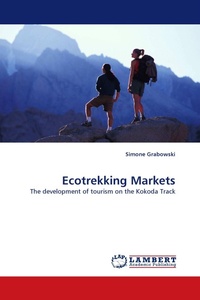
Ecotrekking Markets
The development of tourism on the Kokoda Track
Published on 13. February 2010
Book
Paperback/Softback
112 pages
978-3-8383-4583-3 (ISBN)
Description
In the 20th and 21st centuries many governments of developing countries have been lured by tourism as a quick mechanism for development. This has often involved a trade-off between the pursuit of economic wealth and support for the social, cultural and natural environments. The negative impacts of mass tourism in developing countries are countless and well documented. This book outlines how these impacts can be mitigated by the development of community-based tourism. Taking a market segmentation approach, it conceptualises a sustainable ecotrekking industry through the alignment of community and tourists'' needs. Ecotrekking, as a form of community-based tourism, can play a vital role in development if the right market segment is targeted to meet the needs of the community. Generally this ensures a slower rate of development, giving the community time to adjust to the changes that occur at both a socio-cultural and infrastructural level. The book presents a case study of the Kokoda Track, Papua New Guinea to explore these concepts and the results provide a framework for communities and destination managers in developing countries in developing sustainable tourism.
More details
Language
English
Place of publication
Germany
Product notice
Paperback (trade)
Unsewn / adhesive bound
Dimensions
Height: 220 mm
Width: 150 mm
Thickness: 8 mm
Weight
185 gr
ISBN-13
978-3-8383-4583-3 (9783838345833)
Copyright in bibliographic data and cover images is held by Nielsen Book Services Limited or by the publishers or by their respective licensors: all rights reserved.
Schweitzer Classification
Person
Simone Grabowski is a PhD candidate in the School of Leisure, Sport and Tourism at the University of Technology, Sydney (UTS). She currently teaches and conducts research at UTS in the areas of sustainable tourism, volunteer tourism, tourist behaviour, protected area management and community development.