

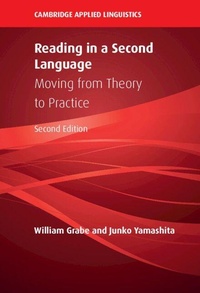
Reading in a Second Language
Moving from Theory to Practice
2nd Edition
Published on 8. September 2022
Book
Hardback
604 pages
978-1-108-84010-1 (ISBN)
Description
Understanding reading abilities and their development is fundamental for language comprehension and human cognition. Now in its second edition, this book draws on research from multiple disciplines to explain reading abilities in both L1 and L2, and shows how this research can be applied in practice in order to support reading development. Research into reading has progressed a great deal since the first edition was published, so this edition has been completely updated and revised, in order to reflect these advances. All chapters present updated research studies, and completely new chapters are included on the neurocognition of reading, reading-writing relationships, and digital reading. If you want to know how reading works, no matter the language(s) involved, as well as how it can be taught effectively, this book provides a persuasive research foundation and many practical insights. It is essential reading for academic researchers and students in Applied Linguistics and TESOL.
More details
Series
Edition
2nd Revised edition
Language
English
Place of publication
Cambridge
United Kingdom
Target group
College/higher education
Edition type
Revised edition
Illustrations
Worked examples or Exercises
Dimensions
Height: 235 mm
Width: 157 mm
Thickness: 37 mm
Weight
1013 gr
ISBN-13
978-1-108-84010-1 (9781108840101)
Copyright in bibliographic data and cover images is held by Nielsen Book Services Limited or by the publishers or by their respective licensors: all rights reserved.
Schweitzer Classification
Other editions
Additional editions
Book
09/2022
2nd Edition
Cambridge University Press
€48.40
Shipment within 15-20 days
E-Book
08/2022
Cambridge University Press
€31.49
Available for download
E-Book
08/2022
2nd Edition
Cambridge University Press
€31.49
Available for download
Persons
William Grabe is Emeritus Regents Professor of Applied Linguistics at Northern Arizona University (NAU). He has been exploring research on reading comprehension, reading development, and reading instruction for over 40 years. He was President of AAAL from 2001-2002, and Vice President for Research at NAU from 2012-2017.
Content
Preface; Part I. Foundations of Reading: 1. The nature of reading: Defining reading; 2. How reading works: Building blocks of fluency and comprehension; 3. How reading works: comprehension processes; 4. Cognitive issues in reading; 5. Neurocognitive processes and reading ability; 6. Explaining reading comprehension: Models of reading; Part II. Patterns of Variation in Reading: 7. Reading in different languages; 8. L1 and L2 reading relationships; 9. Social contexts of reading; 10. Motivation for reading; Part III. Developing Reading Comprehension Abilities: 11. Vocabulary and reading comprehension; 12. Building main idea comprehension: syntax and strategies; 13. Becoming a strategic reader; 14. Building awareness of discourse structure; Part IV. Expanding Reading Comprehension Skills: 15. Reading to learn and reading/writing relationships; 16. Reading in digital contexts; 17. Reading fluency, reading rate, and comprehension; 18. Extensive reading ; Part V. Applications of Reading Research: Instruction and Assessment; 19. Reading curriculum and instruction; 20. Reading assessment; References; Indexes.