

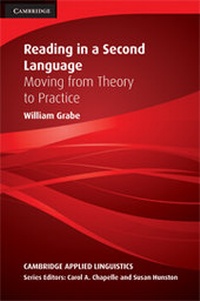
Reading in a Second Language
Moving from Theory to Practice
Published on 15. December 2008
Book
Hardback
484 pages
978-0-521-50986-2 (ISBN)
Description
This volume, through a detailed treatment of the cognitive processes that support reading, explains how reading really works. It offers a thorough overview of important and current research, including first language research, which is not often found in second language acquisition (SLA) publications. This book is a true example of applied linguistics; it makes well-defined linkages between theory and practice, discussing the implications and applications of second language reading theories on instructional practices. It is a valuable resource and reference for action researchers, curriculum designers, teachers, administrators, and those interested in exploring theoretical issues grounded in instructional contexts.
More details
Series
Language
English
Place of publication
Cambridge
United Kingdom
Target group
ELT/ESL
Dimensions
Height: 229 mm
Width: 157 mm
Thickness: 30 mm
Weight
770 gr
ISBN-13
978-0-521-50986-2 (9780521509862)
Copyright in bibliographic data and cover images is held by Nielsen Book Services Limited or by the publishers or by their respective licensors: all rights reserved.
Schweitzer Classification
Other editions
New editions
Book
12/2008
Cambridge University Press
€51.98
No shipping information available
Additional editions
E-Book
06/2010
1st Edition
Cambridge University Press
€23.49
Available for download
Book
12/2008
Cambridge University Press
€51.98
No shipping information available
Person
Content
Research Foundations 1. The Nature of Reading: Defining Reading 2. How Reading Works: The basic building blocks 3. How Reading Works: The Comprehension Process 4. Models, and More Models of Reading: Explaining Reading Research Issues and the L2 Reader 5. Individual Student Variation 6. The Social Contexts of Reading 7. Motivation in Reading 8. Reading in Different Languages and L1 / L2 differences 9. Issues in Reading in a Second Language Component Abilities and Resources for L2 Reading 10. Reading and Vocabulary Development 11. Reading and Grammar 12. Discourse Structure Awareness 13. Reading Strategies 14. Becoming a Strategic Reader 15. Fluency and Reading Rate 16. Extensive Reading Institutional and Instructional Factors Influencing Reading Development 17. Reader-Writer Relations 18. Reading and Content-Based Instruction 19. Assessing Reading 20 From Theory to Practice: Designing a Curriculum GLOSSARY REFERENCES INDEX