

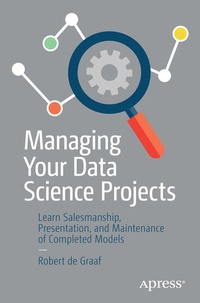
Managing Your Data Science Projects
Learn Salesmanship, Presentation, and Maintenance of Completed Models
Published on 8. June 2019
Book
Paperback/Softback
XII, 144 pages
978-1-4842-4906-2 (ISBN)
Description
At first glance, the skills required to work in the data science field appear to be self-explanatory. Do not be fooled. Impactful data science demands an interdisciplinary knowledge of business philosophy, project management, salesmanship, presentation, and more. In
Managing Your Data Science Projects
, author Robert de Graaf explores important concepts that are frequently overlooked in much of the instructional literature that is available to data scientists new to the field. If your completed models are to be used and maintained most effectively, you must be able to present and sell them within your organization in a compelling way.
The value of data science within an organization cannot be overstated. Thus, it is vital that strategies and communication between teams are dexterously managed. Three main ways that data science strategy is used in a company is to research its customers, assess risk analytics, and log operational measurements. These all require different managerial instincts, backgrounds, and experiences, and de Graaf cogently breaks down the unique reasons behind each. They must align seamlessly to eventually be adopted as dynamic models.
Data science is a relatively new discipline, and as such, internal processes for it are not as well-developed within an operational business as others. With Managing Your Data Science Projects , you will learn how to create products that solve important problems for your customers and ensure that the initial success is sustained throughout the product's intended life. Your users will trust you and your models, and most importantly, you will be a more well-rounded and effectual data scientist throughout your career.
Who This Book Is For
Early-career data scientists, managers of data scientists, and those interested in entering the fieldof data science
The value of data science within an organization cannot be overstated. Thus, it is vital that strategies and communication between teams are dexterously managed. Three main ways that data science strategy is used in a company is to research its customers, assess risk analytics, and log operational measurements. These all require different managerial instincts, backgrounds, and experiences, and de Graaf cogently breaks down the unique reasons behind each. They must align seamlessly to eventually be adopted as dynamic models.
Data science is a relatively new discipline, and as such, internal processes for it are not as well-developed within an operational business as others. With Managing Your Data Science Projects , you will learn how to create products that solve important problems for your customers and ensure that the initial success is sustained throughout the product's intended life. Your users will trust you and your models, and most importantly, you will be a more well-rounded and effectual data scientist throughout your career.
Who This Book Is For
Early-career data scientists, managers of data scientists, and those interested in entering the fieldof data science
More details
Edition
First Edition
Language
English
Place of publication
Berkeley
United States
Target group
Professional and scholarly
Illustrations
5 s/w Abbildungen
XII, 144 p. 5 illus.
Dimensions
Height: 235 mm
Width: 155 mm
Thickness: 9 mm
Weight
248 gr
ISBN-13
978-1-4842-4906-2 (9781484249062)
DOI
10.1007/978-1-4842-4907-9
Schweitzer Classification
Other editions
Additional editions
Robert de Graaf
Managing Your Data Science Projects
Learn Salesmanship, Presentation, and Maintenance of Completed Models
E-Book
06/2019
APress
€46.99
Available for download
Person
Robert de Graaf
is currently a data scientist at RightShip, and was central to the development of the algorithm currently used in the Qi platform to predict maritime accidents, among other models. He initially began his career as an engineer, at different times working in quality assurance, project engineering, and design, but soon became interested in applying statistics to business problems and completed his education with a master's degree in statistics. He is passionate about producing data solutions that solve the right problem for the end user.
Content
Chapter 1: Data Science Team Strategy.- Chapter 2: Data Science Strategy for Projects.- Chapter 3: Data Science Sales Technique.- Chapter 4: Believable Models.- Chapter 5: Reliable Models.- Chapter 6: Promoting Your Data Science Work.- Chapter 7: Team Efficiency.- Chapter 8: Afterword