

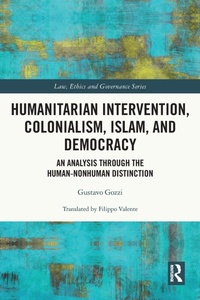
Humanitarian Intervention, Colonialism, Islam and Democracy
An Analysis through the Human-Nonhuman Distinction
1st Edition
Published on 9. January 2023
Book
Paperback/Softback
250 pages
978-0-367-75524-9 (ISBN)
Description
This book offers a critical analysis of the European colonial heritage in the Arab countries and highlights the way this legacy is still with us today, informing the current state of relations between Europe and the formerly colonized states.
The work analyses the fraught relationship between the Western powers and the Arab countries that have been subject to their colonial rule. It does so by looking at this relationship from two vantage points. On the one hand is that of humanitarian intervention-a paradigm under which colonial rule coexisted alongside "humanitarian" policies pursued on the dual assumption that the colonized were "barbarous" peoples who wanted to be civilized and that the West could lay a claim of superiority over an inferior humanity. On the other hand is the Arab view, from which the humanitarian paradigm does not hold up, and which accordingly offers its own insights into the processes through which the Arab countries have sought to wrest themselves from colonial rule. In unpacking this analysis the book traces a history of international and colonial law, to this end also using the tools offered by the history of political thought.
The book will be of interest to students, academics, and researchers working in legal history, international law, international relations, the history of political thought, and colonial studies.
The work analyses the fraught relationship between the Western powers and the Arab countries that have been subject to their colonial rule. It does so by looking at this relationship from two vantage points. On the one hand is that of humanitarian intervention-a paradigm under which colonial rule coexisted alongside "humanitarian" policies pursued on the dual assumption that the colonized were "barbarous" peoples who wanted to be civilized and that the West could lay a claim of superiority over an inferior humanity. On the other hand is the Arab view, from which the humanitarian paradigm does not hold up, and which accordingly offers its own insights into the processes through which the Arab countries have sought to wrest themselves from colonial rule. In unpacking this analysis the book traces a history of international and colonial law, to this end also using the tools offered by the history of political thought.
The book will be of interest to students, academics, and researchers working in legal history, international law, international relations, the history of political thought, and colonial studies.
More details
Series
Language
English
Place of publication
London
United Kingdom
Publishing group
Taylor & Francis Ltd
Target group
College/higher education
Postgraduate
Dimensions
Height: 234 mm
Width: 156 mm
Thickness: 14 mm
Weight
406 gr
ISBN-13
978-0-367-75524-9 (9780367755249)
Copyright in bibliographic data and cover images is held by Nielsen Book Services Limited or by the publishers or by their respective licensors: all rights reserved.
Schweitzer Classification
Other editions
Additional editions
Gustavo Gozzi
Humanitarian Intervention, Colonialism, Islam and Democracy
An Analysis through the Human-Nonhuman Distinction
Book
04/2021
1st Edition
Routledge
€179.51
Shipment within 15-20 days
Gustavo Gozzi
Humanitarian Intervention, Colonialism, Islam and Democracy
An Analysis through the Human-Nonhuman Distinction
E-Book
04/2021
1st Edition
Routledge
€55.49
Available for download
Gustavo Gozzi
Humanitarian Intervention, Colonialism, Islam and Democracy
An Analysis through the Human-Nonhuman Distinction
E-Book
04/2021
1st Edition
Routledge
€55.49
Available for download
Person
Gustavo Gozzi has been full professor of History of Political Doctrines and History of International Law at the University of Bologna, Italy, where he is currently professor of Justice, Multiculturalism, and Human Rights, as well as a member of the advisory board of the King Abdulaziz Chair in Islamic Studies. He is also professor of Colonial Heritage, Euro-Mediterranean Relations, Migrations, and Multiculturalism at the Breyer Center for Overseas Studies in Florence, Stanford University.
Content
A Note on the Criteria for Transliterating the Arab Terms, by Giuseppe Cecere
Introduction
Part One: Intervening for Humanity
1. The Origins of Humanitarian Intervention
2. Civilization and Power: Developing the Colonial Paradigm
3. Deconstructing the Concepts of Humanity and Human Nature
4. The Responsibility to Protect, Humanitarian Intervention, and Neocolonial Policies
Part Two: New Democracies?
5. Anticolonial Nationalism and Arab Nationalism
6. The System of Arab States and the Persistence of Traditional Social Structures
7. Colonial Law and the Formation of the Nation-State
8. Democracy in Islam and Western Democracy: Convergences and Divergences
9. Tunisia and Egypt: Two Constitutional Models
10. The Arab Springs: An Analysis of Its Roots and Causes
11. Democratization and Development in the Arab Countries of the Mediterranean Area
Introduction
Part One: Intervening for Humanity
1. The Origins of Humanitarian Intervention
2. Civilization and Power: Developing the Colonial Paradigm
3. Deconstructing the Concepts of Humanity and Human Nature
4. The Responsibility to Protect, Humanitarian Intervention, and Neocolonial Policies
Part Two: New Democracies?
5. Anticolonial Nationalism and Arab Nationalism
6. The System of Arab States and the Persistence of Traditional Social Structures
7. Colonial Law and the Formation of the Nation-State
8. Democracy in Islam and Western Democracy: Convergences and Divergences
9. Tunisia and Egypt: Two Constitutional Models
10. The Arab Springs: An Analysis of Its Roots and Causes
11. Democratization and Development in the Arab Countries of the Mediterranean Area