

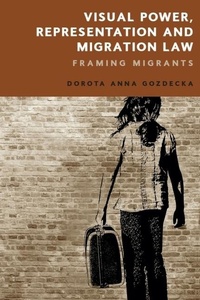
Visual Power, Representation and Migration Law
Framing Migrants
Will be published approx. on 31. December 2025
Book
Paperback/Softback
192 pages
978-1-4744-5999-0 (ISBN)
Description
This book analyses the dominant imagery related to migration and illustrates how framing of migrants as subjects viewed through the lens of the host gaze positions them for exclusion and marginalisation. It focuses on comparative sources derived from public and media visual campaigns focusing on migration issues. It illustrates how the ethical gap that the host-centric way of looking creates results in the growing suspicion of the migrant and how this ethical gap broadens and impacts on the legal exclusion of migrants as legal subjects.
More details
Language
English
Place of publication
Edinburgh
United Kingdom
Target group
Professional and scholarly
Illustrations
11 black and white illustrations
Dimensions
Height: 156 mm
Width: 235 mm
Thickness: 14 mm
Weight
306 gr
ISBN-13
978-1-4744-5999-0 (9781474459990)
Copyright in bibliographic data and cover images is held by Nielsen Book Services Limited or by the publishers or by their respective licensors: all rights reserved.
Schweitzer Classification
Person
Dorota Anna Gozdecka is a Professor at the University of Helsinki. She specialises in topics of othering and exclusion particularly in the area of human rights, and is the author of Rights, Religious Pluralism and the Recognition of Difference: Off the Scales of Justice (2016).
Content
Acknowledgments
Introduction
Part I: LAW AND THE ETHICS OF LOOKING
Chapter 1: The migrant in our gaze
Chapter 2: Looking, feeling, and judging the law
PART II: FIGURES OF THE MIGRANT
Chapter 3: The figures of a 'genuine' refugee and a 'bogus' asylum seeker.
Chapter 4: The spectre of the invisible illegal.
Chapter 5: The figure of the absolute other
Chapter 6: The migrant as an inhuman mass
Chapter 7
PART III: THE COMPLICITY OF THE PICTURE
Chapter 8: The challenge of navigating the ethics of law in the pictorial era
Conclusions
Bibliography
Introduction
Part I: LAW AND THE ETHICS OF LOOKING
Chapter 1: The migrant in our gaze
Chapter 2: Looking, feeling, and judging the law
PART II: FIGURES OF THE MIGRANT
Chapter 3: The figures of a 'genuine' refugee and a 'bogus' asylum seeker.
Chapter 4: The spectre of the invisible illegal.
Chapter 5: The figure of the absolute other
Chapter 6: The migrant as an inhuman mass
Chapter 7
PART III: THE COMPLICITY OF THE PICTURE
Chapter 8: The challenge of navigating the ethics of law in the pictorial era
Conclusions
Bibliography