

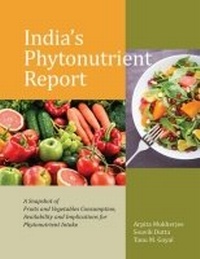
India's Phytonutrient Report
A Snapshot of Fruits and Vegetables Consumption, Availability and Implications for Phytonutrient Intake
Published in December 2016
Book
Hardback
100 pages
978-93-327-0353-7 (ISBN)
Description
IT is scientifically established that fruits and vegetables are essential sources of phytonutrients, which promote a range of health benefits. A pioneering study by the World Health Organization (WHO) on diet, nutrition and prevention of chronic diseases has recommended that a daily intake of at least 400 grams of fruits and vegetables helps to prevent diet-related chronic diseases and micronutrient deficiencies.
India is one of the largest producers of fruits and vegetables in the world. It is also one of the largest consumer markets, with food and grocery having the largest share in the consumption basket. However, a number of studies show that Indian consumers do not consume the WHO recommended quantity of fruits and vegetables. This report, based on secondary information analysis and a survey of 1,001 consumers across different states in India, tries to understand the production and availability of fruits and vegetables, consumption patterns, extent of shortfall in consumption, reasons for shortfall, implications of such shortfall for consumer health and well-being, among others. It also highlights policy issues related to food safety and standards, use of pesticides, organic products, food supply chain, foreign investment in retail, food pricing, and food supplements and nutraceuticals, among others.
The uniqueness of the report is that on the one hand, it will enable the businesses to understand the production and supply chain of fruits and vegetables and the policy environment; on the other, they will have a complete knowledge about Indian consumers.
India is one of the largest producers of fruits and vegetables in the world. It is also one of the largest consumer markets, with food and grocery having the largest share in the consumption basket. However, a number of studies show that Indian consumers do not consume the WHO recommended quantity of fruits and vegetables. This report, based on secondary information analysis and a survey of 1,001 consumers across different states in India, tries to understand the production and availability of fruits and vegetables, consumption patterns, extent of shortfall in consumption, reasons for shortfall, implications of such shortfall for consumer health and well-being, among others. It also highlights policy issues related to food safety and standards, use of pesticides, organic products, food supply chain, foreign investment in retail, food pricing, and food supplements and nutraceuticals, among others.
The uniqueness of the report is that on the one hand, it will enable the businesses to understand the production and supply chain of fruits and vegetables and the policy environment; on the other, they will have a complete knowledge about Indian consumers.
More details
Language
English
Place of publication
Ghaziabad
India
Target group
Professional and scholarly
Dimensions
Height: 279 mm
Width: 216 mm
Weight
439 gr
ISBN-13
978-93-327-0353-7 (9789332703537)
Copyright in bibliographic data and cover images is held by Nielsen Book Services Limited or by the publishers or by their respective licensors: all rights reserved.
Schweitzer Classification
Persons
Tanu M. Goyal is a Consultant at ICRIER. Her research interests include trade in services, food supply chain, international trade agreements and policy and regulatory issues. She has been working at ICRIER since 2008 and has worked on projects for the Government of India, Asian Development Bank (ADB), European Commission (EC), Konrad-Adenauer-Stiftung (KAS), Indian Institute of Management (IIM), Italian Trade Commission, among others. She has contributed to policy reports for the Indian government as well international agencies. She has extensively worked on international agreements and has authored reports providing negotiating strategy for the bilateral agreements being negotiated by the Indian government. She has co-edited a book on trade agreements and has also published several international and national journal articles, book chapters, reports and other popular media articles on policy issues. She holds a Masters degree in Economics with specialisation in world economy, from Centre of Trade and Development (CITD), Jawaharlal Nehru University, New Delhi.