

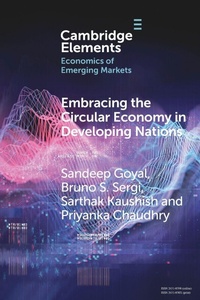
Embracing the Circular Economy in Developing Nations
A Pathway to Sustainable Growth and Resilience
Will be published approx. on 18. June 2026
Book
Paperback/Softback
130 pages
978-1-009-70570-7 (ISBN)
Description
Many developing countries are recognising that the traditional 'take-make-dispose' model of growth is no longer sustainable. This element explores that turning point and examines how the circular economy can offer a better path. A circular economy focuses on using resources for longer, reducing waste, and reusing or recycling materials. It offers a way to grow that can generate income, protect nature, and include more people in development. The element traces how circular economy ideas have evolved over the past decade, moving from a mainly global conversation to one increasingly shaped by local needs and realities. It argues that meaningful progress happens when three forces align: effective public policy, active communities, and strong cross-sector partnerships. Through case studies of businesses in developing countries, the element shows how firms with limited resources use creativity to redesign products and processes, turn waste into value, and collaborate to overcome constraints.
More details
Series
Language
English
Place of publication
Cambridge
United Kingdom
Product notice
Paperback (trade)
Illustrations
Worked examples or Exercises
Weight
200 gr
ISBN-13
978-1-009-70570-7 (9781009705707)
Copyright in bibliographic data and cover images is held by Nielsen Book Services Limited or by the publishers or by their respective licensors: all rights reserved.
Schweitzer Classification
Other editions
Additional editions
Sandeep Goyal | Bruno S. Sergi | Sarthak Kaushish
Embracing the Circular Economy in Developing Nations
A Pathway to Sustainable Growth and Resilience
Book
approx. 06/2026
Cambridge University Press
€68.50
Shipment within 15-20 days
Persons
Content
1. Introduction; 2. Understanding circular economy: conceptual foundation and research literature; 3. Research methodology, sampling and data collection; 4. Business cases: overview; 5. Discussion; 6. Future research directions; 7. Limitations; 8. Implications; References.