

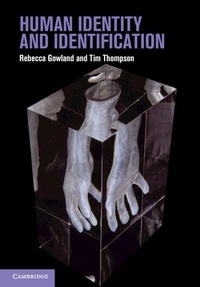
Human Identity and Identification
Published on 17. January 2013
Book
Paperback/Softback
233 pages
978-0-521-71366-5 (ISBN)
Description
Few things are as interesting to us as our own bodies and, by extension, our own identities. In recent years, there has been a growing interest in the relationship between the body, environment and society. Reflecting upon these developments, this book examines the role of the body in human identification, in the forging of identities, and the ways in which it embodies our social worlds. The approach is integrative, taking a uniquely biological perspective and reflecting on current discourse in the social sciences. With particular reference to bioarchaeology and forensic science, the authors focus on the construction and categorisation of the body within scientific and popular discourse, examining its many tissues, from the outermost to the innermost, from the skin to DNA. Synthesising two, traditionally disparate, strands of research, this is a valuable contribution to research on human identification and the embodiment of identity.
More details
Language
English
Place of publication
Cambridge
United Kingdom
Target group
College/higher education
Product notice
Paperback (trade)
Illustrations
4 Tables, black and white; 9 Halftones, unspecified
Dimensions
Height: 244 mm
Width: 170 mm
Thickness: 13 mm
Weight
415 gr
ISBN-13
978-0-521-71366-5 (9780521713665)
Copyright in bibliographic data and cover images is held by Nielsen Book Services Limited or by the publishers or by their respective licensors: all rights reserved.
Schweitzer Classification
Other editions
Additional editions
Rebecca Gowland | Tim Thompson
Human Identity and Identification
Book
01/2013
Cambridge University Press
€88.00
Shipment within 15-20 days
Rebecca Gowland | Tim Thompson
Human Identity and Identification
E-Book
01/2013
1st Edition
Cambridge University Press
€26.49
Available for download
Persons
Rebecca Gowland is a Lecturer in Human Bioarchaeology in the Department of Archaeology at Durham University. Her current research interests lie in health and demography of the past, skeletal ageing and age as an aspect of social identity, social perceptions, care and treatment of the physically impaired in the past, and the interrelationship between the physical body and social identity. Tim Thompson is a Reader in Biological and Forensic Anthropology at Teesside University, where he also acts as a consultant forensic anthropologist. Most of his research examines the effects of burning on the skeleton and how this can help interpret the context of death. He is also interested in the relationship between identity and identification, modification of the body in the modern context, and the role of forensic anthropology in the world at large.
Content
Dedication; Acknowledgements; 1. Introduction; 2. Categories of identity and identification; 3. The skin; 4. Blood and guts; 5. The skeleton; 6. Biomolecular identification and identity; 7. Intentional modification of the phenotype; 8. Conclusions: identity and identification; References; Index.