

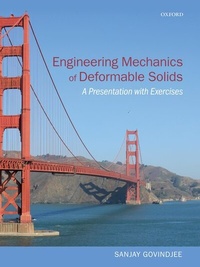
Engineering Mechanics of Deformable Solids
A Presentation with Exercises
Published on 25. October 2012
Book
Hardback
352 pages
978-0-19-965164-1 (ISBN)
Description
This is an open access title. It is available to read and download as a free PDF version on Oxford Academic and is made available under a Creative Commons Attribution-NonCommercial-NoDerivatives 4.0 International licence.
This book covers the essential elements of engineering mechanics of deformable bodies, including mechanical elements in tension-compression, torsion, and bending. It emphasizes a fundamental bottom up approach to the subject in a concise and uncluttered presentation. Of special interest are chapters dealing with potential energy as well as principle of virtual work methods for both exact and approximate solutions. The book places an emphasis on the underlying assumptions of the theories in order to encourage the reader to think more deeply about the subject matter. The book should be of special interest to undergraduate students looking for a streamlined presentation as well as those returning to the subject for a second time.
This book covers the essential elements of engineering mechanics of deformable bodies, including mechanical elements in tension-compression, torsion, and bending. It emphasizes a fundamental bottom up approach to the subject in a concise and uncluttered presentation. Of special interest are chapters dealing with potential energy as well as principle of virtual work methods for both exact and approximate solutions. The book places an emphasis on the underlying assumptions of the theories in order to encourage the reader to think more deeply about the subject matter. The book should be of special interest to undergraduate students looking for a streamlined presentation as well as those returning to the subject for a second time.
Reviews / Votes
Running counter to the trend in undergraduate texts in engineering solid mechanics, Govindjees exposition is compelling for the manner in which it reveals the underlying principles behind the resulting equations. Well written, concise, and insightful, the approach encourages an understanding of fundamental concepts critical to the development of mathematical models in engineering mechanics. The book is highly recommended as a refreshingly intellectual take on a classic topic. * Garrett J. Hall, California Polytechnic State University *More details
Language
English
Place of publication
Oxford
United Kingdom
Target group
College/higher education
Illustrations
429 b/w illustrations
Dimensions
Height: 247 mm
Width: 195 mm
Thickness: 23 mm
Weight
934 gr
ISBN-13
978-0-19-965164-1 (9780199651641)
Copyright in bibliographic data and cover images is held by Nielsen Book Services Limited or by the publishers or by their respective licensors: all rights reserved.
Schweitzer Classification
Other editions
Additional editions
E-Book
10/2012
1st Edition
OUP eBook
€72.49
Available for download
Person
Sanjay Govindjee is a Professor of Civil Engineering at the University of California, Berkeley (1993-2006, 2008-present). His main interests are in theoretical and computational mechanics with an emphasis on micromechanics, shape memory alloys, and elastomers. Prior to joining Berkeley he worked as an engineer at the Lawrence Livermore National Laboratory (1991-1993) in Livermore, California. He was also Professor of Mechanics (2006-2008) at ETH Zurich, Switzerland.
Noteworthy honours include a National Science Foundation Career Award, the inaugural 1998 Zienkiewicz Prize and Medal, an Alexander von Humboldt Foundation Fellowship, a Berkeley Chancellor's Professorship 2006-2011, and a guest Professorship at ETH Zurich 2008-2013.
Noteworthy honours include a National Science Foundation Career Award, the inaugural 1998 Zienkiewicz Prize and Medal, an Alexander von Humboldt Foundation Fellowship, a Berkeley Chancellor's Professorship 2006-2011, and a guest Professorship at ETH Zurich 2008-2013.
Content
1. Introduction ; 2. Tension-Compression Bars: The One Dimensional Case ; 3. Stress ; 4. Strain ; 5. Constitutive Response ; 6. Techniques ; 7. Circular and Thin-Wall Torsion ; 8. Bending of Beams ; 9. Multi-Axial Analysis ; 10. Virtual Work Methods: Virtual Forces ; 11. Potential Energy Methods ; 12. Geometric Instability ; 13. Virtual Work Methods: Virtual Displacements ; Appendix A: Additional Reading ; Appendix B: Units, Constants, and Symbols ; Appendix C: Representative Material Properties ; Appendix D: Parallel Axis Theorem ; Appendix E: Integration Facts ; Appendix F: Bending without Twisting: Shear Center ; Index