

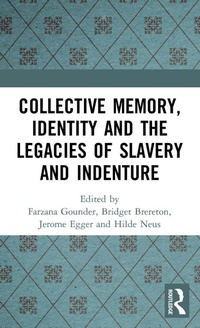
Collective Memory, Identity and the Legacies of Slavery and Indenture
1st Edition
Published on 2. June 2022
Book
Hardback
252 pages
978-1-032-27804-9 (ISBN)
Description
The Caribbean history provides a rich study of the different forms of labour systems that have historically marked the politics of the coloniser and the colonised. It further provides the basis for an essential study for discourses on colonialism and capitalism. This interdisciplinary volume bridges the gap between historiography and the present-day diasporic communities, which emerged from the slave trade and indenture. Through case studies from the Caribbean context, the volume demonstrates how the region's historical labour mobility remains central to performances and negotiations of collective memory and identity.
Please note: Taylor & Francis does not sell or distribute the Hardback in India, Pakistan, Nepal, Bhutan, Bangladesh and Sri Lanka.
Please note: Taylor & Francis does not sell or distribute the Hardback in India, Pakistan, Nepal, Bhutan, Bangladesh and Sri Lanka.
More details
Language
English
Place of publication
London
United Kingdom
Publishing group
Taylor & Francis Ltd
Target group
College/higher education
Postgraduate
Illustrations
8 s/w Photographien bzw. Rasterbilder, 1 s/w Tabelle
1 Tables, black and white; 8 Halftones, black and white
Dimensions
Height: 222 mm
Width: 145 mm
Thickness: 17 mm
Weight
455 gr
ISBN-13
978-1-032-27804-9 (9781032278049)
Copyright in bibliographic data and cover images is held by Nielsen Book Services Limited or by the publishers or by their respective licensors: all rights reserved.
Schweitzer Classification
Other editions
Additional editions
Farzana Gounder | Bridget Brereton | Jerome Egger
Collective Memory, Identity and the Legacies of Slavery and Indenture
E-Book
06/2022
1st Edition
Routledge
€60.49
Available for download
Farzana Gounder | Bridget Brereton | Jerome Egger
Collective Memory, Identity and the Legacies of Slavery and Indenture
E-Book
06/2022
1st Edition
Routledge
€60.49
Available for download
Persons
Farzana Gounder is a linguist and the Deputy Head of School (Research) at IPU Tertiary Institute, New Zealand. Gounder's research interests draw on her indenture heritage. She has extensively examined oral narratives of indenture and their role in collective memory formation.
Bridget Brereton is Emerita Professor of History at UWI, St Augustine, Trinidad and Tobago
Jerome Egger is a Historian, specializing in the twentieth century history of Suriname. Egger is presently the Head of History department of the Faculty of Humanities.
Hilde Neus-van der Putten is a Dutch writer and publicist based in Suriname. She writes regular book reviews for the daily newspaper de Ware Tijd, and articles on history in Museumstof.
Bridget Brereton is Emerita Professor of History at UWI, St Augustine, Trinidad and Tobago
Jerome Egger is a Historian, specializing in the twentieth century history of Suriname. Egger is presently the Head of History department of the Faculty of Humanities.
Hilde Neus-van der Putten is a Dutch writer and publicist based in Suriname. She writes regular book reviews for the daily newspaper de Ware Tijd, and articles on history in Museumstof.
Content
Foreword Introduction PART I: THE LEGACIES OF INDENTURE AND MIGRATION 1. The Legacy of Indian Indentureship in the Caribbean 1838-1920 2. Creative Industries: Our Legacies, Our Future 3. Shadowy Figures: Literary Representation of the Chinese in French-Caribbean Fiction PART II: IDENTITY NEGOTIATIONS THROUGH MUSIC AND CUISINE 4. When the Music Soundin 'Sweet': Musical Instrument Construction, Performance Practice, and the Changing Aesthetics of Indian Trinidadian Tassa Drumming 5. Baithakgana Semantics 6. Creolization and the Evolution of Indo-Trinidadian Cuisine PART III: COLLECTIVE MEMORIES OF SLAVERY AND INDENTURE 7. Sitalpersad, a British Indian Interpreter in Colonial Suriname 8. Five Generations of a Surinamese Family 1873-2010: A Legacy 9. Emancipation and Arrival: How Emancipation Day and Indian Arrival Day have Shaped Ethnic Identities in Twenty-first Century Trinidad and Tobago