

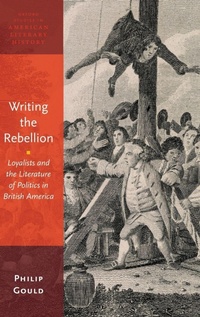
Writing the Rebellion
Loyalists and the Literature of Politics in British America
Published on 27. June 2013
Book
Hardback
230 pages
978-0-19-996789-6 (ISBN)
Description
Writing the Rebellion presents a cultural history of loyalist writing in early America. There has been a spate of related works recently, but Philip Gould's narrative offers a completely different view of the loyalist/patriot contentions than appears in any of these accounts. By focusing on the literary projections of the loyalist cause, Gould dissolves the old legend that loyalists were more British than American, and patriots the embodiment of a new sensibility drawn from their American situation and upbringing. He shows that both sides claimed to be heritors of British civil discourse, Old World learning, and the genius of English culture. The first half of Writing Rebellion deals with the ways "political disputation spilled into arguments about style, form, and aesthetics, as though these subjects could secure (or ruin) the very status of political authorship." Chapters in this section illustrate how loyalists attack patriot rhetoric by invoking British satires of an inflated Whig style by Alexander Pope and Jonathan Swift. Another chapter turns to Loyalist critiques of Congressional language and especially the Continental Association, which was responsible for radical and increasingly violent measures against the Loyalists. The second half of Gould's book looks at satiric adaptations of the ancient ballad tradition to see what happens when patriots and loyalists interpret and adapt the same text (or texts) for distinctive yet related purposes. The last two chapters look at the Loyalist response to Thomas Paine's Common Sense and the ways the concept of the author became defined in early America. Throughout the manuscript, Gould acknowledges the purchase English literary culture continued to have in revolutionary America, even among revolutionaries.
Reviews / Votes
Writing the Rebellion leaves us with a vision of eighteenth-century print culture in British America as more labile and more literary than we'd realized, and with an expanded sense of why that matters. * Early American Literature * Philip Gould's scholarly and beautifully written monograph offers a new way to conceptualize their agency ... [A] deeply scholarly and critically acute study of loyalist writing. * American Historical Review * Philip Gould draws attention to the political dimension of contesting literary styles in the northern colonies during the eve of the War of American Independence. He demonstrates that ongoing transatlantic discourse about literary taste and authorship cannot be extricated from revolutionary politics and, in fact, patriot and Loyalist debates contributed to discussions about the relationship between literary form and political trustworthiness. * Ruma Chopra, Journal of American History *More details
Series
Language
English
Place of publication
New York
United States
Target group
College/higher education
Illustrations
10 illustrations
Dimensions
Height: 240 mm
Width: 161 mm
Thickness: 17 mm
Weight
514 gr
ISBN-13
978-0-19-996789-6 (9780199967896)
Copyright in bibliographic data and cover images is held by Nielsen Book Services Limited or by the publishers or by their respective licensors: all rights reserved.
Schweitzer Classification
Other editions
Additional editions
Book
05/2016
Oxford University Press Inc
€46.70
Shipment within 15-20 days
E-Book
04/2013
1st Edition
OUP eBook
€18.49
Available for download
Person
Philip Gould is author of Covenant and Republic: Historical Romance and the Politics of Puritanism and Barbaric Traffic: Commerce and Antislavery in the 18th Century Atlantic World. He co-edited Genius in Bondage: The Literature of the 18th Century Black Atlantic and The Cambridge Companion to 19th Century American Women's Writing. He served as President of the Society of Early Americanists.
Content
Introduction ; Chapter 1: The Stamp Act Crisis and the Sublime Style of Politics ; Chapter 2: Wit and Ridicule in Revolutionary New York ; Chapter 3: Satirizing the Congress: Ancient Balladry and Literary Taste ; Chapter 4: Loyalists and the Author of Common Sense ; Chapter 5: New English Rebellion ; Epilogue