

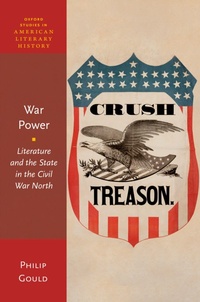
War Power
Literature and the State in the Civil War North
Published on 20. August 2024
Book
Hardback
256 pages
978-0-19-889735-4 (ISBN)
Description
What happens if we reconsider the literature of the Civil War North in light of the transformation of the federal state's power? While literary scholarship about the Civil War has more generally focused on the rise of wartime nationalism, Philip Gould looks particularly at how literary works engage the subjects of censorship, propaganda, and the reconfigured meanings of "loyalty" and "treason" at a time of political crisis.
During the war the Lincoln Administration shut down opposition newspapers and curtailed free expression and civil liberties protected by the US Constitution. Lincoln also suspended the writ of habeas corpus to deal with political dissenters and try to control public opinion. Early in the war, he coined the phrase "war power" to describe the (presumed) powers to address this crisis; his policies became controversial throughout the conflict. War Power: Literature and the State in the Civil War North considers literary production in this "total war" that radically changed the federal government's (and its military's) relation to traditional norms and spaces of private, domestic, and social life.
Each chapter focuses on a major writer in the Civil War North's engagement with questions of identity, affect, and affiliation: Could one love the Union as one loved home and family? What were the implications for literary expression in the midst of a political culture being reshaped by censorship and propaganda? The final two chapters address the role and plight of African Americans in the Civil War and its aftermath, focusing particularly on African American military service as the supposed means by which racially disenfranchised Americans might become citizens.
During the war the Lincoln Administration shut down opposition newspapers and curtailed free expression and civil liberties protected by the US Constitution. Lincoln also suspended the writ of habeas corpus to deal with political dissenters and try to control public opinion. Early in the war, he coined the phrase "war power" to describe the (presumed) powers to address this crisis; his policies became controversial throughout the conflict. War Power: Literature and the State in the Civil War North considers literary production in this "total war" that radically changed the federal government's (and its military's) relation to traditional norms and spaces of private, domestic, and social life.
Each chapter focuses on a major writer in the Civil War North's engagement with questions of identity, affect, and affiliation: Could one love the Union as one loved home and family? What were the implications for literary expression in the midst of a political culture being reshaped by censorship and propaganda? The final two chapters address the role and plight of African Americans in the Civil War and its aftermath, focusing particularly on African American military service as the supposed means by which racially disenfranchised Americans might become citizens.
Reviews / Votes
War Power offers both insight into what may come, and a sense of how even loyal literary writings, and art more generally, can work to name these federal aggressions and counter state power. * Jill Spivey Caddel, The ALH Review *More details
Series
Language
English
Place of publication
Oxford
United Kingdom
Target group
College/higher education
Product notice
sewn/stitched
Cloth over boards
Illustrations
6 black and white illustrations
Dimensions
Height: 242 mm
Width: 163 mm
Thickness: 23 mm
Weight
549 gr
ISBN-13
978-0-19-889735-4 (9780198897354)
Copyright in bibliographic data and cover images is held by Nielsen Book Services Limited or by the publishers or by their respective licensors: all rights reserved.
Schweitzer Classification
Other editions
Person
Philip Gould teaches at Brown University, where he is a member of the English Department. He has published books on eighteenth- and nineteenth-century American and British literatures for nearly thirty years.
Content
List of Illustrations
Acknowledgments
1: Introduction
1: Hawthorne and the State of War
2: Altered Domesticities: Love and Loyalty in Louisa May Alcott's Civil War Fiction
3: Power, Politics, and the Marriage Plot in the Fiction of John W. De Forest
4: Race, Violence, and African-American Citizenship
5: Melville and the Time of War
Epilogue
Notes
Bibliography
Acknowledgments
1: Introduction
1: Hawthorne and the State of War
2: Altered Domesticities: Love and Loyalty in Louisa May Alcott's Civil War Fiction
3: Power, Politics, and the Marriage Plot in the Fiction of John W. De Forest
4: Race, Violence, and African-American Citizenship
5: Melville and the Time of War
Epilogue
Notes
Bibliography