

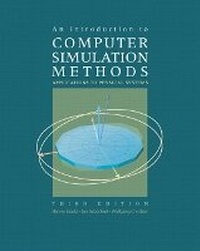
An Introduction to Computer Simulation Methods
Applications to Physical Systems
3rd Edition
Published on 23. March 2006
Book
Paperback/Softback
720 pages
978-0-8053-7758-3 (ISBN)
Description
Now in a third edition, this book teaches physical concepts using computer simulations. The text incorporates object-oriented programming techniques and encourages students to develop good programming habits in the context of doing physics. Designed for college students at all levels, An Introduction to Computer Simulation Methods uses Java, currently the most popular programming language. The text is most appropriately used in a project-oriented course that lets students with a wide variety of backgrounds and abilities work together.
More details
Edition
3rd edition
Language
English
Place of publication
Upper Saddle River
United States
Target group
Professional and scholarly
Dimensions
Height: 236 mm
Width: 171 mm
Thickness: 33 mm
Weight
1340 gr
ISBN-13
978-0-8053-7758-3 (9780805377583)
Copyright in bibliographic data and cover images is held by Nielsen Book Services Limited or by the publishers or by their respective licensors: all rights reserved.
Schweitzer Classification
Other editions
Previous edition
Harvey Gould | Jan Tobochnik
An Introduction to Computer Simulation Methods
Applications to Physical System
Book
09/1995
2nd Edition
Pearson
€61.89
Article exhausted; check for reprint
Persons
Harvey Gould uses molecular dynamics and Monte Carlo methods to study glasses, the dynamics of first-order phase transitions, and other problems in statistical mechanics. His work involves the application of computer simulation algorithms as well as renormalization group and cluster methods. Gould recently co-authored the second edition of an undergraduate level text on computer simulation in physics. He can "foresee the day when physics students take a required computational science curriculum comparable in scope to the present day mathematics curriculum."
Gould is a native of California and received his B.A. and his Ph.D. from the University of California, Berkeley. He did postdoctoral work at the National Bureau of Standards and taught at the University of Michigan before coming to Clark University in 1971. His leisure time is spent with his family and listening to music, especially jazz.
Gould is a native of California and received his B.A. and his Ph.D. from the University of California, Berkeley. He did postdoctoral work at the National Bureau of Standards and taught at the University of Michigan before coming to Clark University in 1971. His leisure time is spent with his family and listening to music, especially jazz.
Content
Preface
Introduction
Tools for Doing Simulations
Simulating Particle Motion
Oscillatory Systems
Few-Body Problems: The Motion of the Planets
The Chaotic Motion of Dynamical Systems
Random Processes
The Dynamics of Many Particle Systems
Normal Modes and Waves
Electrodynamics
Numerical and Monte Carlo Methods
Percolation
Fractals and Kinetic Growth Models
Complex Systems
Monte Carlo Simulations of Thermal Systems
Quantum Systems
Visualization and Rigid Body Dynamics
Seeing in Special and General Relativity
Epilogue: The Unity of Physics