

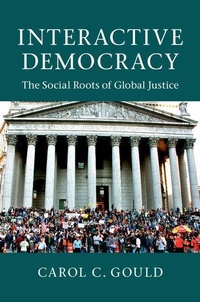
Interactive Democracy
The Social Roots of Global Justice
Published on 21. August 2014
Book
Paperback/Softback
303 pages
978-1-107-60741-5 (ISBN)
Description
How can we confront the problems of diminished democracy, pervasive economic inequality, and persistent global poverty? Is it possible to fulfill the dual aims of deepening democratic participation and achieving economic justice, not only locally but also globally? Carol C. Gould proposes an integrative and interactive approach to the core values of democracy, justice, and human rights, looking beyond traditional politics to the social conditions that would enable us to realize these aims. Her innovative philosophical framework sheds new light on social movements across borders, the prospects for empathy and solidarity with distant others, and the problem of gender inequalities in diverse cultures, and also considers new ways in which democratic deliberation can be enhanced by online networking and extended to the institutions of global governance. Her book will be of great interest to scholars and upper-level students of political philosophy, global justice, social and political science, and gender studies.
Reviews / Votes
'Carol Gould demonstrates again why she is one of the world's best thinkers on interlinked questions of democracy, justice, freedom, and human rights. Her fresh interactive approach yields compelling arguments and new insights on the whole range of key questions in political philosophy, especially as they confront a globalizing world.' John Dryzek, Australian National University 'This engaging book further develops Gould's well-known account of global democracy from her previous writings. It is a significant contribution to the global justice literature.' Kok-Chor Tan, University of Pennsylvania '... Interactive Democracy pushes democratic theory in precisely the right direction. An increasingly global, multilayered, dynamic, networked, digital world requires an equally integrated political theory to guide its development, and Gould's book gives us such a model.' Michael Buckley, The Philosophical Quarterly 'The book is an insightful contribution to the global-justice literature and should be read together with the touchstone texts of global justice.' Brooke A. Ackerly, The Review of Politics '[This book is] serious, thought-provoking, well-informed, and animated by a sort of moral and practical sensibility in too short a supply.' David Reidy, International DialogueMore details
Language
English
Place of publication
Cambridge
United Kingdom
Target group
College/higher education
Professional and scholarly
Product notice
Paperback (trade)
Illustrations
Worked examples or Exercises
Dimensions
Height: 226 mm
Width: 147 mm
Thickness: 15 mm
Weight
522 gr
ISBN-13
978-1-107-60741-5 (9781107607415)
Copyright in bibliographic data and cover images is held by Nielsen Book Services Limited or by the publishers or by their respective licensors: all rights reserved.
Schweitzer Classification
Other editions
Additional editions
Book
08/2014
Cambridge University Press
€98.70
Shipment within 15-20 days
E-Book
08/2014
1st Edition
Cambridge University Press
€26.49
Available for download
Person
Carol C. Gould is Distinguished Professor of Philosophy at Hunter College and in the Doctoral Programs in Philosophy and Political Science at the Graduate Center of the City University of New York. She is the author of Globalizing Democracy and Human Rights (Cambridge, 2004) and Rethinking Democracy: Freedom and Social Cooperation in Politics, Economy, and Society (Cambridge, 1988), and has edited and co-edited several books including Cultural Identity and the Nation-State (2003), The Information Web: Ethical and Social Issues in Computer Networking (1989) and Women and Philosophy (1976).
Content
Introduction; Part I. A Theoretical Framework: 1. A human rights approach to global justice: elements of theory and practice; 2. A social ontology of human rights; 3. Interpreting freedom dynamically: beyond liberty and autonomy to positive freedom; 4. Is there a human right to democracy?; Part II. The Social Roots of Global Justice: 5. Transnational solidarities; 6. Does global justice presuppose global solidarity?; 7. Recognition and care in global justice; 8. Gender equality, culture, and the interpretation of human rights; 9. The sociality of free speech: the case of humor across cultures; 10. Violence, power-with, and the human right to democracy; Part III. Interactive Democracy - Transnational, Regional, Global: 11. Diversity, democracy, and dialogue in a human rights framework; 12. What is emancipatory networking?; 13. Structuring transnational democracy: participation, self-determination, and new forms of representation; 14. Democratic management and international labor rights; 15. Regional vs global democracy: possibilities and limitations; Works cited; Index.