

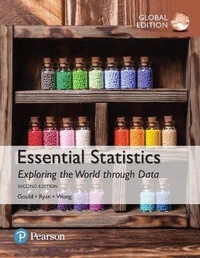
Essential Statistics, Global Edition + MyLab Statistics with Pearson eText
2nd Edition
Published on 13. February 2017
Book
Mixed media product
978-1-292-16132-7 (ISBN)
Description
This book is ideal for a one-semester course in statistics, offering a streamlined presentation of Introductory Statistics: Exploring the World through Data, by Gould/Ryan. This package includes MyStatLab(TM) Exploring the World through Data We live in a data-driven world, and the goal of this text is to teach students how to access and analyze these data critically. Authors Rob Gould, Colleen Ryan, and Rebecca Wong want students to develop a "data habit of mind" because learning statistics is an essential life skill that extends beyond the classroom. Regardless of their math backgrounds, students will learn how to think about data and how to reason using data. With a clear, unintimidating writing style and carefully chosen pedagogy, this text makes data analysis accessible to all students. This package includes MyStatLab. MyStatLab from Pearson is the world's leading online resource for teaching and learning statistics, integrating interactive homework, assessment, and media in a flexible, easy-to-use format. MyStatLab is a course management system that delivers improving results in helping individual students succeed.
MyStatLab should only be purchased when required by an instructor. Please be sure you have the correct ISBN and Course ID. Instructors, contact your Pearson representative for more information.
MyStatLab should only be purchased when required by an instructor. Please be sure you have the correct ISBN and Course ID. Instructors, contact your Pearson representative for more information.
More details
Edition
2nd edition
Language
English
Place of publication
Harlow
United Kingdom
Target group
College/higher education
Dimensions
Height: 275 mm
Width: 215 mm
Thickness: 20 mm
Weight
1139 gr
ISBN-13
978-1-292-16132-7 (9781292161327)
Copyright in bibliographic data and cover images is held by Nielsen Book Services Limited or by the publishers or by their respective licensors: all rights reserved.
Schweitzer Classification
Other editions
New editions

Jonathan Berk | Peter DeMarzo
Corporate Finance: The Core, Global Edition
Book
12/2016
4th Edition
Pearson Education Limited
€106.65
Shipment within 10-20 days
Previous edition
Robert Gould | Colleen Ryan | Rebecca Wong
Essential Statistics, Global Edition -- MyLab Statistics with Pearson eText
Software
04/2016
2nd Edition
Pearson Education Limited
Unfortunately, price unknown
Only available as a set (single article not available)
Content
Preface
Index of Applications
1. Introduction to Data
Case Study-Deadly Cell Phones?
1.1 What Are Data?
1.2 Classifying and Storing Data
1.3 Organizing Categorical Data
1.4 Collecting Data to Understand Causality
Exploring Statistics-Collecting a Table of Different Kinds of Data
2. Picturing Variation with Graphs
Case Study-Student-to-Teacher Ratio at Colleges
2.1 Visualizing Variation in Numerical Data
2.2 Summarizing Important Features of a Numerical Distribution
2.3 Visualizing Variation in Categorical Variables
2.4 Summarizing Categorical Distributions
2.5 Interpreting Graphs
Exploring Statistics-Personal Distance
3. Numerical Summaries of Center and Variation
Case Study-Living in a Risky World
3.1 Summaries for Symmetric Distributions
3.2 What's Unusual? The Empirical Rule and z-Scores
3.3 Summaries for Skewed Distributions
3.4 Comparing Measures of Center
3.5 Using Boxplots for Displaying Summaries
Exploring Statistics-Does Reaction Distance Depend on Gender?
4. Regression Analysis: Exploring Associations between Variables
Case Study-Catching Meter Thieves
4.1 Visualizing Variability with a Scatterplot
4.2 Measuring Strength of Association with Correlation
4.3 Modeling Linear Trends
4.4 Evaluating the Linear Model
Exploring Statistics-Guessing the Age of Famous People
5. Modeling Variation with Probability
Case Study-SIDS or Murder?
5.1 What Is Randomness?
5.2 Finding Theoretical Probabilities
5.3 Associations in Categorical Variables
5.4 Finding Empirical Probabilities
Exploring Statistics-Let's Make a Deal: Stay or Switch?
6. Modeling Random Events: The Normal and Binomial Models
Case Study-You Sometimes Get More Than You Pay For
6.1 Probability Distributions Are Models of Random Experiments
6.2 The Normal Model
6.3 The Binomial Model (optional)
Exploring Statistics-ESP with Coin Flipping
7. Survey Sampling and Inference
Case Study-Spring Break Fever: Just What the Doctors Ordered?
7.1 Learning about the World through Surveys
7.2 Measuring the Quality of a Survey
7.3 The Central Limit Theorem for Sample Proportions
7.4 Estimating the Population Proportion with Confidence Intervals
7.5 Comparing Two Population Proportions with Confidence
Exploring Statistics-Simple Random Sampling Prevents Bias
8. Hypothesis Testing for Population Proportions
Case Study-Dodging the Question
8.1 The Essential Ingredients of Hypothesis Testing
8.2 Hypothesis Testing in Four Steps
8.3 Hypothesis Tests in Detail
8.4 Comparing Proportions from Two Populations
Exploring Statistics-Identifying Flavors of Gum through Smell
9. Inferring Population Means
Case Study-Epilepsy Drugs and Children
9.1 Sample Means of Random Samples
9.2 The Central Limit Theorem for Sample Means
9.3 Answering Questions about the Mean of a Population
9.4 Hypothesis Testing for Means
9.5 Comparing Two Population
Index of Applications
1. Introduction to Data
Case Study-Deadly Cell Phones?
1.1 What Are Data?
1.2 Classifying and Storing Data
1.3 Organizing Categorical Data
1.4 Collecting Data to Understand Causality
Exploring Statistics-Collecting a Table of Different Kinds of Data
2. Picturing Variation with Graphs
Case Study-Student-to-Teacher Ratio at Colleges
2.1 Visualizing Variation in Numerical Data
2.2 Summarizing Important Features of a Numerical Distribution
2.3 Visualizing Variation in Categorical Variables
2.4 Summarizing Categorical Distributions
2.5 Interpreting Graphs
Exploring Statistics-Personal Distance
3. Numerical Summaries of Center and Variation
Case Study-Living in a Risky World
3.1 Summaries for Symmetric Distributions
3.2 What's Unusual? The Empirical Rule and z-Scores
3.3 Summaries for Skewed Distributions
3.4 Comparing Measures of Center
3.5 Using Boxplots for Displaying Summaries
Exploring Statistics-Does Reaction Distance Depend on Gender?
4. Regression Analysis: Exploring Associations between Variables
Case Study-Catching Meter Thieves
4.1 Visualizing Variability with a Scatterplot
4.2 Measuring Strength of Association with Correlation
4.3 Modeling Linear Trends
4.4 Evaluating the Linear Model
Exploring Statistics-Guessing the Age of Famous People
5. Modeling Variation with Probability
Case Study-SIDS or Murder?
5.1 What Is Randomness?
5.2 Finding Theoretical Probabilities
5.3 Associations in Categorical Variables
5.4 Finding Empirical Probabilities
Exploring Statistics-Let's Make a Deal: Stay or Switch?
6. Modeling Random Events: The Normal and Binomial Models
Case Study-You Sometimes Get More Than You Pay For
6.1 Probability Distributions Are Models of Random Experiments
6.2 The Normal Model
6.3 The Binomial Model (optional)
Exploring Statistics-ESP with Coin Flipping
7. Survey Sampling and Inference
Case Study-Spring Break Fever: Just What the Doctors Ordered?
7.1 Learning about the World through Surveys
7.2 Measuring the Quality of a Survey
7.3 The Central Limit Theorem for Sample Proportions
7.4 Estimating the Population Proportion with Confidence Intervals
7.5 Comparing Two Population Proportions with Confidence
Exploring Statistics-Simple Random Sampling Prevents Bias
8. Hypothesis Testing for Population Proportions
Case Study-Dodging the Question
8.1 The Essential Ingredients of Hypothesis Testing
8.2 Hypothesis Testing in Four Steps
8.3 Hypothesis Tests in Detail
8.4 Comparing Proportions from Two Populations
Exploring Statistics-Identifying Flavors of Gum through Smell
9. Inferring Population Means
Case Study-Epilepsy Drugs and Children
9.1 Sample Means of Random Samples
9.2 The Central Limit Theorem for Sample Means
9.3 Answering Questions about the Mean of a Population
9.4 Hypothesis Testing for Means
9.5 Comparing Two Population