

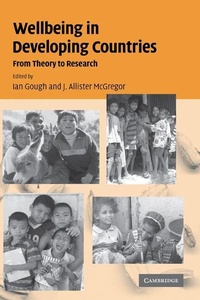
Wellbeing in Developing Countries
From Theory to Research
Published on 31. May 2007
Book
Hardback
424 pages
978-0-521-85751-2 (ISBN)
Description
In a world where many experience unprecedented levels of wellbeing, chronic poverty remains a major concern for many developing countries and the international community. Conventional frameworks for understanding development and poverty have focused on money, commodities and economic growth. This 2007 book challenges these conventional approaches and contributes to a new paradigm for development centred on human wellbeing. Poor people are not defined solely by their poverty and a wellbeing approach provides a better means of understanding how people become and stay poor. It examines three perspectives: ideas of human functioning, capabilities and needs; the analysis of livelihoods and resource use; and research on subjective wellbeing and happiness. A range of international experts from psychology, economics, anthropology, sociology, political science and development evaluate the state-of-the-art in understanding wellbeing from these perspectives. This book establishes a new strategy and methodology for researching wellbeing that can influence policy.
Reviews / Votes
Review of the hardback: 'This is a beautifully constructed and apposite book for those seeking hope amid today's economic crisis and who work in development from any discipline or background. It challenges the conventional wisdom of money, commodities and economic growth as our main ways of understanding development and poverty and could have as much impact on development as Lanyard has done for the relationship between happiness and wealth. It is written by those and for those seeking a more inclusive model for understanding how people in developing countries see themselves and the possibilities of change.' Patricia d'Ardenne, ChartistMore details
Language
English
Place of publication
Cambridge
United Kingdom
Target group
Professional and scholarly
Dimensions
Height: 235 mm
Width: 157 mm
Thickness: 29 mm
Weight
836 gr
ISBN-13
978-0-521-85751-2 (9780521857512)
Copyright in bibliographic data and cover images is held by Nielsen Book Services Limited or by the publishers or by their respective licensors: all rights reserved.
Schweitzer Classification
Other editions
Additional editions
E-Book
06/2007
1st Edition
Cambridge University Press
€44.49
Available for download
Persons
Ian Gough is Professor of Social Policy and Deputy Director of the ESRC Research Group on Wellbeing in Developing Countries at the University of Bath. He is the co-author of Insecurity and Welfare Regimes in Asia, Africa and Latin America (Cambridge, 2004) and A Theory of Human Need (1991) which was the winner of both the Deutscher and the Myrdal prizes. Allister McGregor is an economic anthropologist and lectures in development policy analysis at the University of Bath. He is Director of the ESRC Research Group on Wellbeing in Developing Countries and is the author of numerous articles on development policy and practice. He has worked with a wide range of international development agencies and has extensive primary fieldwork experience in South and Southeast Asia.
Content
Introduction: 1. Theorising wellbeing in international development Ian Gough, J. Allister McGregor and Laura Camfield; Part I. Human Needs and Human Wellbeing: 2. Conceptualising human needs and wellbeing Des Gasper; 3. Basic psychological needs: a self-determination theory perspective on the promotion of wellness across development and cultures Richard Ryan and Aislinn Sapp; 4. Measuring freedoms alongside wellbeing Sabina Alkire; 5. Using security to indicate wellbeing Geoff Wood; 6. Towards a measure of non-economic wellbeing achievement Mark McGillivray; Part II. Resources: From Material to Cultural: 7. Wellbeing, livelihoods and resources in social practice Sarah White and Mark Ellison; 8. Livelihoods and resource accessing in the Andes: desencuentros in theory and practice Tony Bebbington, Leonith Hinojosa-Valencia, Diego Munoz and Rafael Enrique Rojas Lizarazu; 9. Poverty and exclusion, resources and relationships: theorising the links between economic and social development James Copestake; Part III. Quality of Life and Subjective Wellbeing: 10. Cross-cultural quality of life assessment: approaches and experiences from the health care field Monika Bullinger and Silke Schmidt; 11. Researching quality of life in a developing country: lessons from the South African case Valerie Moller; 12. The complexity of wellbeing: a life-satisfaction conception and a domains-of-life approach Mariano Rojas; Conclusion. Researching Wellbeing: 13. Researching wellbeing across the disciplines: some key intellectual problems and ways forward Philippa Bevan; 14. Researching wellbeing: from concepts to methodology J. Allister McGregor.