

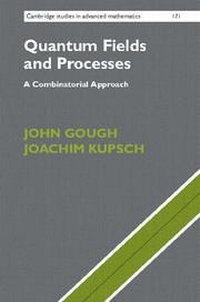
Quantum Fields and Processes
A Combinatorial Approach
Published on 12. April 2018
Book
Hardback
338 pages
978-1-108-41676-4 (ISBN)
Description
Wick ordering of creation and annihilation operators is of fundamental importance for computing averages and correlations in quantum field theory and, by extension, in the Hudson-Parthasarathy theory of quantum stochastic processes, quantum mechanics, stochastic processes, and probability. This book develops the unified combinatorial framework behind these examples, starting with the simplest mathematically, and working up to the Fock space setting for quantum fields. Emphasizing ideas from combinatorics such as the role of lattice of partitions for multiple stochastic integrals by Wallstrom-Rota and combinatorial species by Joyal, it presents insights coming from quantum probability. It also introduces a 'field calculus' which acts as a succinct alternative to standard Feynman diagrams and formulates quantum field theory (cumulant moments, Dyson-Schwinger equation, tree expansions, 1-particle irreducibility) in this language. Featuring many worked examples, the book is aimed at mathematical physicists, quantum field theorists, and probabilists, including graduate and advanced undergraduate students.
Reviews / Votes
'This book offers an excellent account of the probabilistic aspects of quantum theory, focused on the interplay between quantum field theory and quantum stochastic calculus. The text is highly accessible thanks to the careful choice of topics and the systematic use of elegant combinatorial and algebraic methods. This makes the book suitable for graduate level teaching and self-study. I highly recommend it as a timely addition to the classical literature on quantum probability.' Madalin Guta, University of NottinghamMore details
Series
Language
English
Place of publication
Cambridge
United Kingdom
Target group
Professional and scholarly
Product notice
sewn/stitched
Cloth over boards
Illustrations
Worked examples or Exercises
Dimensions
Height: 233 mm
Width: 159 mm
Thickness: 25 mm
Weight
621 gr
ISBN-13
978-1-108-41676-4 (9781108416764)
Copyright in bibliographic data and cover images is held by Nielsen Book Services Limited or by the publishers or by their respective licensors: all rights reserved.
Schweitzer Classification
Other editions
Additional editions
E-Book
04/2018
Cambridge University Press
€58.99
Available for download
E-Book
03/2018
Cambridge University Press
€70.99
Available for download
Persons
John Gough is Professor of mathematical and theoretical physics at Aberystwyth University, Wales. He works in the field of quantum probability and open systems, especially quantum Markovian models that can be described in terms of the Hudson-Parthasarathy quantum stochastic calculus. His more recent work has been on the general theory of networks of quantum Markovian input-output and their applications to quantum feedback control. Joachim Kupsch is Professor Emeritus of theoretical physics at the Technische Universitaet Kaiserslautern, Germany. His research has focused on scattering theory, relativistic S-matrix theory, and infinite-dimensional analysis applied to quantum field theory. His publications have examined canonical transformations, fermionic integration, and superanalysis. His later work looks at open systems and decoherence and he coauthored a book on the subject in 2003.
Content
Preface; Notation; 1. Introduction to combinatorics; 2. Probabilistic Moments and Cumulants; 3. Quantum probability; 4. Quantum fields; 5. Combinatorial species; 6. Combinatorial aspects of quantum fields: Feynman diagrams; 7. Entropy, large deviations and legendre transforms; 8. Introduction to Fock spaces; 9. Operators and fields on the Boson Fock space; 10. L2-representations of the Boson Fock space; 11. Local fields on the Boson Fock space: free fields; 12. Local fields on the Boson Fock space: interacting fields; 13. Quantum stochastic calculus; 14. Quantum stochastic limits; Bibliography; Index.