

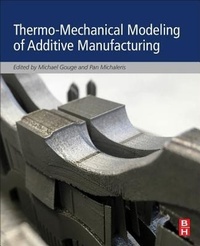
Thermo-Mechanical Modeling of Additive Manufacturing
Published on 7. August 2017
Book
Paperback/Softback
294 pages
978-0-12-811820-7 (ISBN)
Description
Thermo-mechanical Modeling of Additive Manufacturing provides the background, methodology and description of modeling techniques to enable the reader to perform their own accurate and reliable simulations of any additive process. Part I provides an in depth introduction to the fundamentals of additive manufacturing modeling, a description of adaptive mesh strategies, a thorough description of thermal losses and a discussion of residual stress and distortion. Part II applies the engineering fundamentals to direct energy deposition processes including laser cladding, LENS builds, large electron beam parts and an exploration of residual stress and deformation mitigation strategies. Part III concerns the thermo-mechanical modeling of powder bed processes with a description of the heat input model, classical thermo-mechanical modeling, and part scale modeling.
The book serves as an essential reference for engineers and technicians in both industry and academia, performing both research and full-scale production. Additive manufacturing processes are revolutionizing production throughout industry. These technologies enable the cost-effective manufacture of small lot parts, rapid repair of damaged components and construction of previously impossible-to-produce geometries. However, the large thermal gradients inherent in these processes incur large residual stresses and mechanical distortion, which can push the finished component out of engineering tolerance. Costly trial-and-error methods are commonly used for failure mitigation. Finite element modeling provides a compelling alternative, allowing for the prediction of residual stresses and distortion, and thus a tool to investigate methods of failure mitigation prior to building.
The book serves as an essential reference for engineers and technicians in both industry and academia, performing both research and full-scale production. Additive manufacturing processes are revolutionizing production throughout industry. These technologies enable the cost-effective manufacture of small lot parts, rapid repair of damaged components and construction of previously impossible-to-produce geometries. However, the large thermal gradients inherent in these processes incur large residual stresses and mechanical distortion, which can push the finished component out of engineering tolerance. Costly trial-and-error methods are commonly used for failure mitigation. Finite element modeling provides a compelling alternative, allowing for the prediction of residual stresses and distortion, and thus a tool to investigate methods of failure mitigation prior to building.
More details
Language
English
Place of publication
Woburn
United States
Publishing group
Elsevier - Health Sciences Division
Target group
Professional and scholarly
College/higher education
Product notice
Paperback (trade)
Unsewn / adhesive bound
Dimensions
Height: 234 mm
Width: 190 mm
Thickness: 16 mm
Weight
590 gr
ISBN-13
978-0-12-811820-7 (9780128118207)
Copyright in bibliographic data and cover images is held by Nielsen Book Services Limited or by the publishers or by their respective licensors: all rights reserved.
Schweitzer Classification
Other editions
Additional editions
Michael Gouge | Pan Michaleris
Thermo-Mechanical Modeling of Additive Manufacturing
E-Book
08/2017
Butterworth-Heinemann
€119.00
Available for download
Persons
Michael Gouge is a Research Engineer for Autodesk where he focuses on validating and improving the thermo-mechanical modeling of additive manufacturing processes. He completed a Ph.D in mechanical engineering at the Pennsylvania State University under Dr. Pan Michaleris. His graduate research was on the finite element modeling of heat transfer, distortion, microstructure, and material properties of directed energy deposition processes, an area in which has authored several peer reviewed journal articles. He has also received a B.A. in philosophy from Austin Peay, a B.S. in mechanical engineering from the University of Texas San Antonio, and a M.S. in mechanical engineering from Penn State. Pan Michaleris is a Senior Software Architect at Autodesk Inc. He received his Ph.D. in 1994 in theoretical and applied mechanics at the University of Illinois at Urbana-Champaign, and was a senior research engineer at the Edison Welding Institute (EWI) until 1997. Pan served as a professor in the Mechanical and Nuclear Engineering Department at the Pennsylvania State University from 1997-2016. In 2012, Michaleris founded and served as both president and lead developer at Pan Computing LLC. Pan Computing was a software development and commercialization company for physics-based modeling of additive manufacturing processes. Pan Computing was acquired by Autodesk Inc. in 2016. His areas of interest include computational mechanics, finite element methods, manufacturing process modeling, and residual stress and distortion. Michaleris authored Minimization of Welding Distortion and Buckling and in addition to more than 80 peer reviewed journal and proceedings papers. He formerly served on the editorial board of Science and Technology in Welding and Joining, and was an associate editor for Welding Journal.
Content
Part I The fundamentals of additive manufacturing modeling
1. An introduction to additive manufacturing processes and their modeling challenges
Michael Fielding Gouge, Pan Michaleris
2. The Finite Element Method for the Thermo-Mechanical Modeling of Additive Manufacturing Processes
Erik Denlinger, Jeff Irwin, Michael Fielding Gouge
Part II Thermomechanical modeling of Direct Energy Deposition processes
3. Convection Boundary Losses During Laser Cladding
Michael Fielding Gouge
4. Conduction Losses due to Part Fixturing During Laser Cladding
Michael Fielding Gouge
5. Microstructure and Material Properties of AM Builds
Allison Michelle Beese
6. Understanding microstructure evolution during additive manufacturing of metallic alloys using phase-field modeling
Yanzhou Ji, Lei Chen, Long-Qing Chen
7. Modeling Microstructure and Material Properties of AM Processes Using the FE Method
Jeff Irwin
8. Thermo-mechanical Modeling of Thin Wall Builds Using the Direct Process
Jarred Heigel
9. Residual Stress and Distortion Modeling of Electron Beam Direct Manufacturing Ti-6Al-4V
Erik Denlinger
10. Thermo-mechanical Modeling of Large Electron Beam Builds
Erik Denlinger
11. Mitigation of Distortion in Large Additive Manufacturing Parts
Erik Denlinger
Part III Thermomechanical modeling of powder bed processes
12. Development and Numerical Verification of an Adaptive Mesh Coarsening Strategy for Simulating Laser Powder Bed Fusion Processes
Erik Denlinge
13. Experimental Validation for In Situ Distortion Modeling of the Laser Powder Bed Fusion Process
Erik Denlinger
14. Scan Pattern Effects in Laser Powder Bed Fusion Processes: In Situ Measurements and Experimental Validation
Alexander Dunbar
15. Experimental Validation of Multi-scale Thermo-mechanical Modeling of Laser Powder Bed Fusion Processe
Jeff Irwin, Michael Fielding Gouge
1. An introduction to additive manufacturing processes and their modeling challenges
Michael Fielding Gouge, Pan Michaleris
2. The Finite Element Method for the Thermo-Mechanical Modeling of Additive Manufacturing Processes
Erik Denlinger, Jeff Irwin, Michael Fielding Gouge
Part II Thermomechanical modeling of Direct Energy Deposition processes
3. Convection Boundary Losses During Laser Cladding
Michael Fielding Gouge
4. Conduction Losses due to Part Fixturing During Laser Cladding
Michael Fielding Gouge
5. Microstructure and Material Properties of AM Builds
Allison Michelle Beese
6. Understanding microstructure evolution during additive manufacturing of metallic alloys using phase-field modeling
Yanzhou Ji, Lei Chen, Long-Qing Chen
7. Modeling Microstructure and Material Properties of AM Processes Using the FE Method
Jeff Irwin
8. Thermo-mechanical Modeling of Thin Wall Builds Using the Direct Process
Jarred Heigel
9. Residual Stress and Distortion Modeling of Electron Beam Direct Manufacturing Ti-6Al-4V
Erik Denlinger
10. Thermo-mechanical Modeling of Large Electron Beam Builds
Erik Denlinger
11. Mitigation of Distortion in Large Additive Manufacturing Parts
Erik Denlinger
Part III Thermomechanical modeling of powder bed processes
12. Development and Numerical Verification of an Adaptive Mesh Coarsening Strategy for Simulating Laser Powder Bed Fusion Processes
Erik Denlinge
13. Experimental Validation for In Situ Distortion Modeling of the Laser Powder Bed Fusion Process
Erik Denlinger
14. Scan Pattern Effects in Laser Powder Bed Fusion Processes: In Situ Measurements and Experimental Validation
Alexander Dunbar
15. Experimental Validation of Multi-scale Thermo-mechanical Modeling of Laser Powder Bed Fusion Processe
Jeff Irwin, Michael Fielding Gouge