

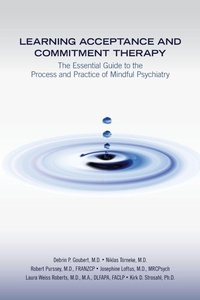
Learning Acceptance and Commitment Therapy
The Essential Guide to the Process and Practice of Mindful Psychiatry
Published on 3. August 2020
Book
Paperback/Softback
358 pages
978-1-61537-173-0 (ISBN)
Description
The traditional practice of psychiatry has been focused on
reducing or eliminating distressing, unwanted symptoms. But what if the key
to health and well-being is not to be symptom free, but rather to function
effectively in life even when symptoms are present? What if symptoms serve
an adaptive and motivational function, rather than being signals of a latent
illness? What if the key to personal health is the ability to accept
symptoms for what they are and to do what matters in life at the same time?
This is the underlying proposition of Acceptance and Commitment Therapy
(ACT), and this book-a collaboration among six clinicians from diverse
practice backgrounds-is the first to systematically describe the principles
and practices of ACT as they apply to psychiatric assessment, case analysis,
and treatment.
The guide begins with an in-depth analysis of the ACT
model, from its scientific origins in the study of the functions of human
language to a fully elaborated model for clinical assessment and
intervention and outlines the clinical benefits of ACT in everyday
practice.
The second section of the book shows the reader how to
conduct a streamlined assessment of the patient's life context, how to
detect and intervene with the patient's unworkable emotional and behavioral
avoidance strategies, and how to blend the use of medication treatment and
behavioral interventions in a way that augments the beneficial effects of
both approaches.
Chapter-length examples in the third section discuss
how to deliver ACT in an ambulatory psychiatric setting, in a hospital
consultation-liaison service, and in an inpatient psychiatric context. The
section also includes a chapter examining the all-important issue of
teaching ACT to psychiatric residents as well as affiliated health
professionals working in medical or psychiatric treatment team
contexts.
Learning Acceptance and Commitment Therapy uses a
diverse array of case examples and clinical dialogues to offer readers a
real-life view of the methodology in practice. Each chapter also includes
additional reading resources to pursue should a particular theoretical or
applied clinical concept create a desire to learn more. Additionally,
readers have unlimited access to an online instructional library that
includes video demonstrations of core ACT clinical strategies "in action" as
well as a host of written practice support tools and worksheets.
This
book is a must for clinicians who want to expand their ability to improve
clinical outcomes for the wide range of patients seen in clinical
practice.
reducing or eliminating distressing, unwanted symptoms. But what if the key
to health and well-being is not to be symptom free, but rather to function
effectively in life even when symptoms are present? What if symptoms serve
an adaptive and motivational function, rather than being signals of a latent
illness? What if the key to personal health is the ability to accept
symptoms for what they are and to do what matters in life at the same time?
This is the underlying proposition of Acceptance and Commitment Therapy
(ACT), and this book-a collaboration among six clinicians from diverse
practice backgrounds-is the first to systematically describe the principles
and practices of ACT as they apply to psychiatric assessment, case analysis,
and treatment.
The guide begins with an in-depth analysis of the ACT
model, from its scientific origins in the study of the functions of human
language to a fully elaborated model for clinical assessment and
intervention and outlines the clinical benefits of ACT in everyday
practice.
The second section of the book shows the reader how to
conduct a streamlined assessment of the patient's life context, how to
detect and intervene with the patient's unworkable emotional and behavioral
avoidance strategies, and how to blend the use of medication treatment and
behavioral interventions in a way that augments the beneficial effects of
both approaches.
Chapter-length examples in the third section discuss
how to deliver ACT in an ambulatory psychiatric setting, in a hospital
consultation-liaison service, and in an inpatient psychiatric context. The
section also includes a chapter examining the all-important issue of
teaching ACT to psychiatric residents as well as affiliated health
professionals working in medical or psychiatric treatment team
contexts.
Learning Acceptance and Commitment Therapy uses a
diverse array of case examples and clinical dialogues to offer readers a
real-life view of the methodology in practice. Each chapter also includes
additional reading resources to pursue should a particular theoretical or
applied clinical concept create a desire to learn more. Additionally,
readers have unlimited access to an online instructional library that
includes video demonstrations of core ACT clinical strategies "in action" as
well as a host of written practice support tools and worksheets.
This
book is a must for clinicians who want to expand their ability to improve
clinical outcomes for the wide range of patients seen in clinical
practice.
More details
Language
English
Place of publication
VA
United States
Target group
Professional and scholarly
US School Grade: College Graduate Student and over
Product notice
Paperback (trade)
Illustrations
4 Figures; 19 Tables, unspecified
Dimensions
Height: 229 mm
Width: 152 mm
Thickness: 25 mm
Weight
600 gr
ISBN-13
978-1-61537-173-0 (9781615371730)
Copyright in bibliographic data and cover images is held by Nielsen Book Services Limited or by the publishers or by their respective licensors: all rights reserved.
Schweitzer Classification
Other editions
Additional editions
Debrin P. Goubert | Niklas Törneke | Robert Purssey
Learning Acceptance and Commitment Therapy
The Essential Guide to the Process and Practice of Mindful Psychiatry
E-Book
06/2020
American Psychiatric Association Publishing
€50.99
Available for download
Persons
Debrin P. Goubert, M.D. is a psychiatrist with
Northwest Permanente/Kaiser Permanente NW in Clackamas,
Oregon.
Niklas Toerneke, M.D. is a psychiatrist in private
practice in Kopingsvik, Sweden.
Robert Purssey, M.D.,
FRANZCP, is the director of the Brisbane ACT Centre as w
ell as
clinical senior lecturer with the University of Queensland in Brisbane,
Australia.
Josephine Loftus, M.D., MRCPsych, is the head of the
Mood Disorder Unit and Expert Bipolar Centre in the Department of Psychiatry
at Centre Hospitalier Princesse Grace in Monaco.
Laura Weiss
Roberts, M.D., M.A., DLFAPA, FACLP, is chairman and Katharine Dexter
McCormick and Stanley McCormick Memorial professor in the Department of
Psychiatry and Behavioral Sciences at Stanford University School of Medicine
in Stanford, California.
Kirk D. Strosahl, Ph.D., is president
of HeartMatters Consulting, LLC, in Wheeler Oregon.
Northwest Permanente/Kaiser Permanente NW in Clackamas,
Oregon.
Niklas Toerneke, M.D. is a psychiatrist in private
practice in Kopingsvik, Sweden.
Robert Purssey, M.D.,
FRANZCP, is the director of the Brisbane ACT Centre as w
ell as
clinical senior lecturer with the University of Queensland in Brisbane,
Australia.
Josephine Loftus, M.D., MRCPsych, is the head of the
Mood Disorder Unit and Expert Bipolar Centre in the Department of Psychiatry
at Centre Hospitalier Princesse Grace in Monaco.
Laura Weiss
Roberts, M.D., M.A., DLFAPA, FACLP, is chairman and Katharine Dexter
McCormick and Stanley McCormick Memorial professor in the Department of
Psychiatry and Behavioral Sciences at Stanford University School of Medicine
in Stanford, California.
Kirk D. Strosahl, Ph.D., is president
of HeartMatters Consulting, LLC, in Wheeler Oregon.
Author
Director, Brisbane ACT Centre; Clinical Senior LecturerUniversity of Queensland, Brisbane, Australia
Head of Mood Disorder Unit and Expert Bipolar CentreCentre Hospitalier Princesse Grace, Monaco
Chairman and Katharine Dexter McCormick and Stanley McCormick Memorial ProfessorStanford University
Content
Part I. What Is ACT?
Chapter 1. Letters From the
Front Lines: The Benefits of ACT in Psychiatric Practice
Chapter
2. An Overview of ACT: From Basic Behavioral Science Foundations
to a Model of Human Resilience
Part II. How to Do ACT
Chapter
3. The Practice of Functional Psychiatry
Chapter 4. The Dance of Change:
How to Treat Your Patient With CARE
Chapter 5. ACT Dancing: Strategies
for Mastering the Clinical Conversation
Chapter 6. The Art and Science
of Functional Psychopharmacology
Part III. ACT in
Practice
Chapter 7. ACT in Outpatient Psychiatric
Practice
Chapter 8. ACT in Consultation-Liaison
Psychiatry
Chapter 9. ACT in the Inpatient Psychiatric
Unit
Chapter 10. Teaching ACT in Residency, Institutional, and
Programmatic Settings
Index
Chapter 1. Letters From the
Front Lines: The Benefits of ACT in Psychiatric Practice
Chapter
2. An Overview of ACT: From Basic Behavioral Science Foundations
to a Model of Human Resilience
Part II. How to Do ACT
Chapter
3. The Practice of Functional Psychiatry
Chapter 4. The Dance of Change:
How to Treat Your Patient With CARE
Chapter 5. ACT Dancing: Strategies
for Mastering the Clinical Conversation
Chapter 6. The Art and Science
of Functional Psychopharmacology
Part III. ACT in
Practice
Chapter 7. ACT in Outpatient Psychiatric
Practice
Chapter 8. ACT in Consultation-Liaison
Psychiatry
Chapter 9. ACT in the Inpatient Psychiatric
Unit
Chapter 10. Teaching ACT in Residency, Institutional, and
Programmatic Settings
Index